Commission-free offer
Kontraktlogistikfläche Ibbenbüren
Object no.: 9406
Contract logistics
Warehousing (warehouse with management)
Germany
49479 Ibbenbüren
5000.00 m²
2000 (PP)
Price on request

Ruhr trimodal logistics hub on course for the future
Object no.: 9406
Warehousing (warehouse with management)
Germany
49479 Ibbenbüren
Price on request
Object no.: 9387
Warehousing (warehouse with management)
Germany
44149 Dortmund
Price on request
» Location analysis: The Herne-Emscher freight village – trimodal powerhouse in the heart of Europe
» Key facts at a glance: The profile of the GVZ Herne-Emscher
» The Trimodal Strength: The Infrastructure Heart of the Ruhr Area
» Detailed analysis of transport modes: Where rubber, steel and water meet
» Strategic location: Why Herne shines as a top logistics region
» Location as an economic factor: costs, taxes and development
» An ecosystem of success: local companies and synergies
» The Human Factor: Workforce and Skilled Worker Potential
» Special features and conclusion: The overall Herne-Emscher package
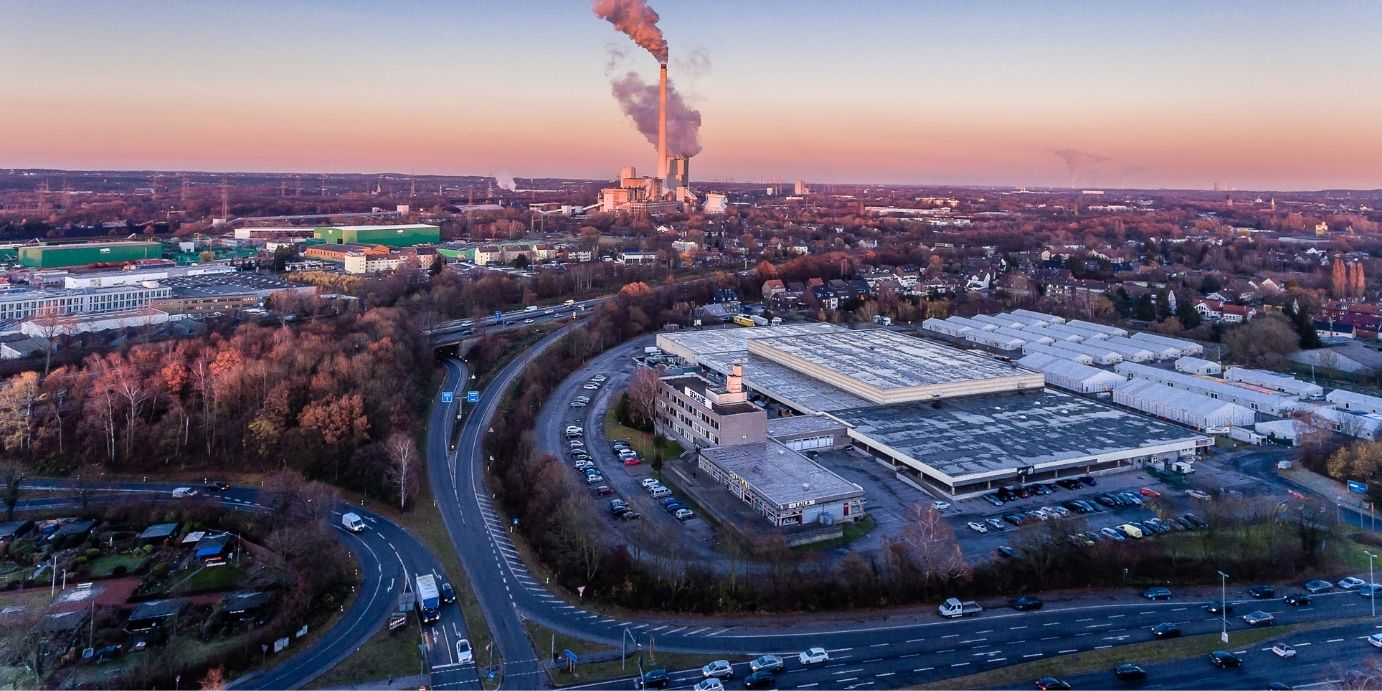
What makes a logistics location not only good, but also strategically superior? In a globalized economy, where supply chains determine efficiency, costs and, increasingly, sustainability, multimodal hubs are coming into focus. The Herne-Emscher freight village is a prime example of such a top-class location. Located in the middle of the Rhine-Ruhr metropolitan region, the most densely populated region in Germany, it acts as one of the country's most efficient logistics hubs.
This text dives deep into the structures of the GVZ Herne-Emscher. We not only analyse the obvious strengths, but also shed light on the economic framework conditions such as tax rates and land prices. For logistics decision-makers, real estate developers and analysts, this text offers a sound basis for evaluating one of the most dynamic logistics clusters in Germany. Is the Herne-Emscher freight transport center the right location for future growth?
Before we go into depth, an overview of the core data provides a quick overview of the dimensions of this location. The Herne-Emscher freight village is not a monolithic block, but an area that has grown over decades, which is primarily made up of the logistics parks "Herne-Baukau" and the "Wanne-West industrial area".
| Feature | Detail |
| Location | Herne, North Rhine-Westphalia, Rhine-Ruhr Metropolitan Region |
| Status | Freight Transport Center (GVZ) |
| Modality | Trimodal: road, rail, water |
| Area (Total) | approx. 215 hectares (distributed among the core areas) |
| Road access | Direct: A42, A43; Indirect: A2, A40, A45 |
| Rail connection | Public CT terminal (operator: WHE) |
| Water connection | Port of Wanne-West on the Rhine-Herne Canal (RHK) |
| Nearest cargo airport | Düsseldorf Airport (DUS), approx. 35 km |
| Top Companies | DHL, Rhenus, UPS, GXO, Pfenning Logistics and many more. |
| Region | Top logistics region Ruhr area (often No. 1 in the DE ranking) |
Sources: City of Herne, Herne Economic Development Corporation (WFG), various logistics market reports.
The overriding location advantage (USP) of the GVZ Herne-Emscher is its fully developed trimodality. But what does "trimodal" mean in daily practice for a company based there? It means ultimate flexibility and the ability to be resilient.
If a mode of transport fails (e.g. low water on the Rhine, line closure on the rails, traffic jams on the motorway), a trimodal freight village can intelligently redirect the flow of goods to the remaining carriers. For companies in the Herne-Emscher freight village, this is not a theoretical construct, but a lived reality. It not only enables the optimization of costs and transit times, but is also the central lever for decarbonizing logistics by shifting from road to rail and ship.
The quality of a freight village is measured by the performance of its individual connections. Herne-Emscher plays in the first league here.
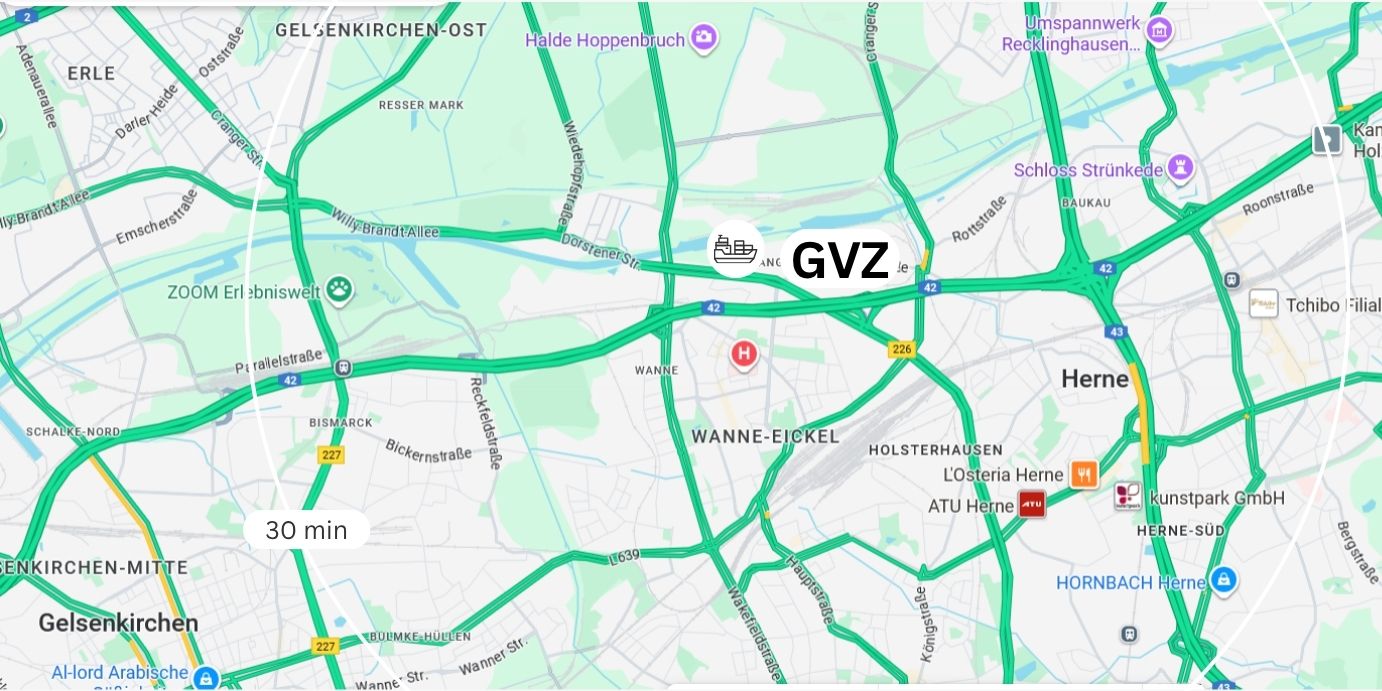
The Ruhr area is the densest motorway network in Europe. The Herne-Emscher freight village is located in the middle of it:
This redundancy on highways minimizes the risk of congestion compared to locations that are only connected to a single axis.
A blessing for combined transport (CT). The public transshipment terminal in the GVZ, operated by Wanne-Herner Eisenbahn und Hafen GmbH (WHE), is the backbone for intermodal transport.
Often underestimated, but strategically crucial, is the connection to the European waterway network. The port of Wanne-West on the Rhine-Herne Canal (RHK) is a fully-fledged inland port.
→ Warehouse Düsseldorf
→ Warehouse Dortmund
→ Warehouse Recklinghausen
The infrastructure is the "how", the location the "where". The combination of both makes up the quality of the Herne-Emscher freight village.
The GVZ is located in the heart of the "Blue Banana", the densest and most affluent economic area in Europe, which stretches from Manchester via the Ruhr area to Milan.
Studies such as the renowned analysis "Logistics Real Estate Regions in Germany" (conducted by Fraunhofer IML and others) have consistently ranked the "Ruhr area" region (also known as the "Ruhr") in 1st place among the 28 top logistics regions in Germany for years.
Why? The experts' reasoning is: "No other region combines such a high concentration of industry, trade and population with such a dense and multimodal infrastructure." [Source: Various logistics real estate market reports, e.g. Bulwiengesa/Fraunhofer IML]. The Herne-Emscher freight village is a centrepiece of this top region.
For time-critical shipments (air cargo), proximity to cargo airports is essential.
A top location has its price. But what are the tough economic conditions in Herne? For companies, the total cost of ownership (TCO) is decisive, and here the high assessment rates must be offset against the operational efficiency gains.
The logistics real estate market in the Ruhr region is characterised by high demand and a shortage of space.
→ Berlin Freight Center
→ Bremen Freight Center
→ Frankfurt Oder Freight Center
It's an open secret: The municipalities in the Ruhr area have some of the highest tax rates in a nationwide comparison. Herne is no exception.
[Source: City of Herne, Budget 2024]
At first glance, these figures seem daunting. However, logistics controllers have to put this burden into perspective: Can the savings in transport costs (through shorter distances, avoidance of tolls by rail/water), faster market penetration and the higher resilience of the supply chain compensate for or even overcompensate for these additional costs? For many globally active companies (see below), the answer seems to be "yes".
The GVZ is a driver of structural change. A modern logistics landscape has emerged on former colliery and industrial brownfields. The city of Herne and the Economic Development Agency (WFG) are considered pro-investment and actively support settlements, as logistics has been identified as one of the central future industries for the region.
The best location analysis is to look at who is already there. The Herne-Emscher freight village is home to a "Who's Who" of the logistics and trade industry.
This concentration of top companies creates valuable synergies. A cluster effect is created: service providers are on site, cooperation is easier and competition drives innovation.
Infrastructure is nothing without the people who operate it. But can you still find staff in the Ruhr area in times of a shortage of skilled workers?
With around 2.2 million employees subject to social security contributions, the Ruhr area represents the largest labour pool in Germany.
Despite the large pool, the "war for talents" is also a reality in Herne. Competition for qualified specialists (especially professional drivers, IT specialists for logistics software and dispatchers) is intense, precisely because so many top companies compete in the same location. Companies that want to be successful here must invest in employer branding, good working conditions and further training.
Special features: The outstanding special feature is the lived trimodality in a confined space. While other freight villages are "trimodal" on paper, the density of infrastructure (port basins, crane systems, intermodal terminal) and the frequency of departures (block trains, liner services inland waterway vessels) are exceptional. In addition, there is the successful revitalisation of brownfield areas, which makes the GVZ a prime example of sustainable land development.
The Herne-Emscher freight village is more than just an industrial park with a motorway connection. It is a highly integrated, trimodal logistics hub that enables companies to strategically position themselves in the center of Europe's largest market.
The disadvantages – primarily the high municipal tax rates – must be openly named. However, they must be assessed in the context of the outstanding infrastructural advantages. The efficiency gains from the free choice of mode of transport, the short distances to a huge B2B and B2C market and the resilience of supply chains can more than justify the higher ancillary costs for many business models.
For companies whose success depends on efficient, flexible and increasingly sustainable logistics, there is hardly any way around the top Ruhr region – and thus the power center GVZ Herne-Emscher – when choosing a location in Germany.
Commercial property, logistics property and contract logistics in Hesse at a glance - LAGERflaeche.de!
Object no.: 10182
Rental
Germany
34399 Oedelsheim
Price on request
Object no.: 10181
Rental
Germany
34385 Bad Karlshafen-Helmarshausen
Price on request
Object no.: 10104
Warehousing (warehouse with management)
Germany
64646 Heppenheim
Price on request
Object no.: 10073
Warehousing (warehouse with management)
Germany
34582 Borken
Price on request