


B2B vs. B2C Fulfillment: The Ultimate Comparison for Logistics Decision-Makers
Table of Contents
- The Foundation: What are the Structural Differences between B2B and B2C?
- What do you have to Pay Special Attention to in B2B Fulfillment? (Compliance & Interfaces)
- The Achilles' Heel of B2C: Returns Management and Speed
- Innovations: Which Technologies Drive the Respective Division?
- Convergence: Where can both Learn from Each Other? (The D2C Trend)
- International Differences: Germany vs. World
- Case Study from Practice: The Transformation of "Werkzeug-Profi GmbH"
- Conclusion and Outlook: Where is the Journey Heading?
Logistics is no longer just moving boxes from A to B. It has become a decisive competitive advantage, the "new marketing" and often the tip of the scales for customer satisfaction. But why do experienced B2B retailers often fail to enter the end customer market? And why do successful online shops find it difficult to supply major customers?
The answer lies in the DNA of fulfillment. While the boundaries are increasingly blurred by trends such as D2C (direct-to-consumer), the operational challenges remain fundamentally different. In this deep dive, we not only shed light on the obvious differences, but also go into depth: from the psychological expectations of the recipients to the cultural logistics peculiarities in Germany compared to the world.
The Foundation: What are the Structural Differences between B2B and B2C?
At first glance, the goal is identical: deliver goods on time. But beneath the surface, two completely different machine rooms are working.
Volume and frequency
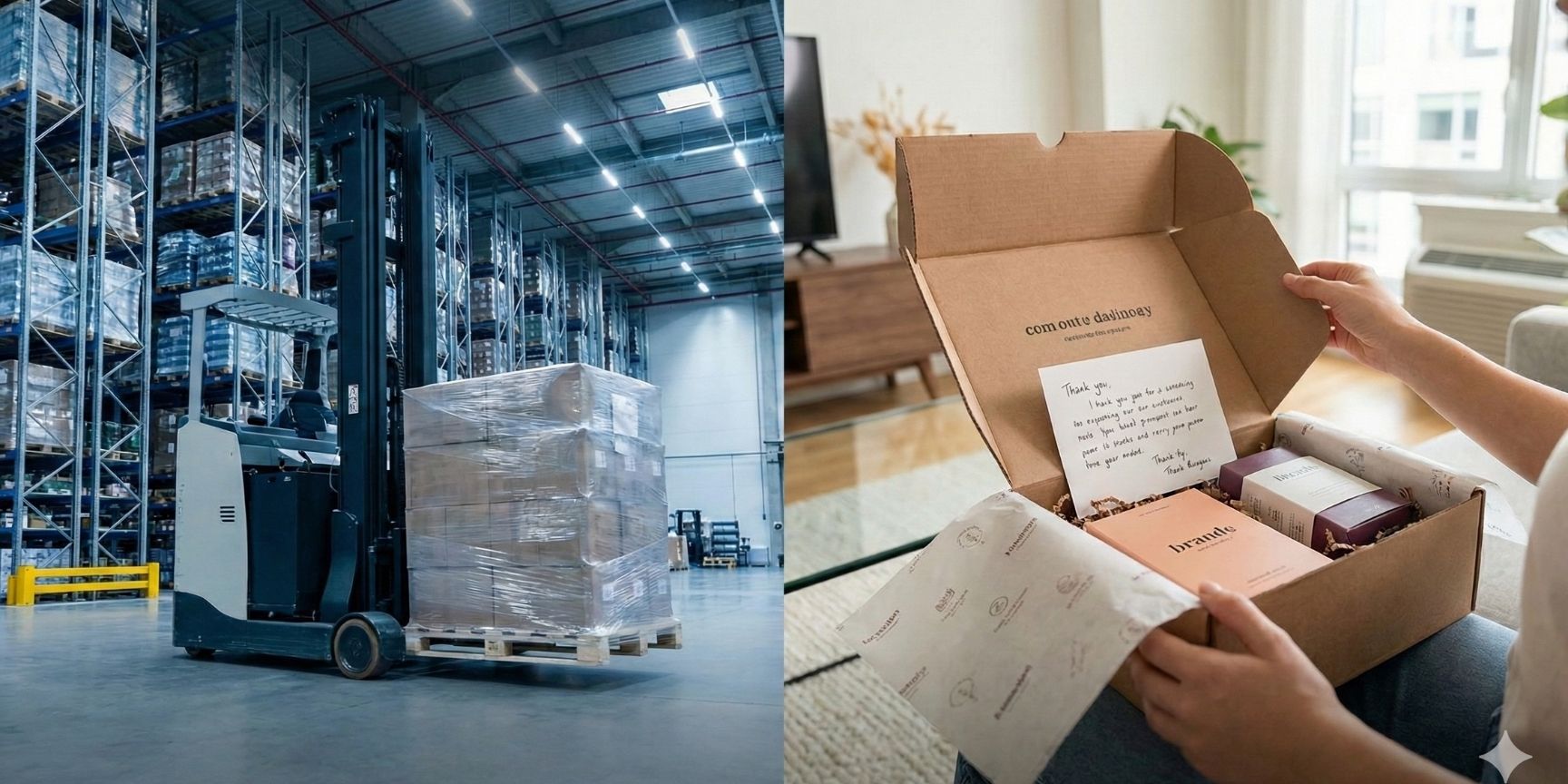
In B2B fulfillment (business-to-business), we speak of "bulk" orders. A retailer doesn't order a single toothbrush, but three pallets of it. The order frequency is often lower, but the volume per order (Average Order Value - AOV) is massively higher. In B2C (business-to-consumer) fulfillment, atomization reigns. Thousands of orders with often only 1 to 3 items have to be picked, packed and shipped individually.
The psychology of the recipient
- The B2B customer: Makes rational decisions. What counts for him is predictability, adherence to compliance requirements and costs. Pretty packaging is irrelevant as long as the goods on the pallet are undamaged and the barcode is scannable.
- The B2C customer: Often makes emotional decisions. Delivery is the only physical touchpoint with the brand. Punctuality is a hygiene factor, but the "unboxing" is the wow moment.
Fact: According to studies, 72% of B2B buyers now expect the same convenience (tracking, speed) as with their private Amazon orders. The pressure on B2B logistics companies is increasing massively.
What do you have to Pay Special Attention to in B2B Fulfillment? (Compliance & Interfaces)
The B2B business does not forgive errors in documentation. The biggest special feature here is the routing guides and vendor compliance manuals.
Large customers (such as Amazon Vendor, Kaufland, Walmart or large supermarket chains) dictate to their suppliers exactly how deliveries must be made.
- How high can the pallet be? (eg. max 1.60m incl. wood).
- What type of pallet? (Euro vs. Chep).
- Where does the SSCC (Serial Shipping Container Code) label have to be applied?
The danger: If these requirements are disregarded, there is a risk of severe penalties (chargebacks) or complete refusal to accept them. A B2B fulfillment service provider must therefore be EDI-capable (Electronic Data Interchange) and be able to store complex rules for each recipient.
The Achilles' Heel of B2C: Returns Management and Speed
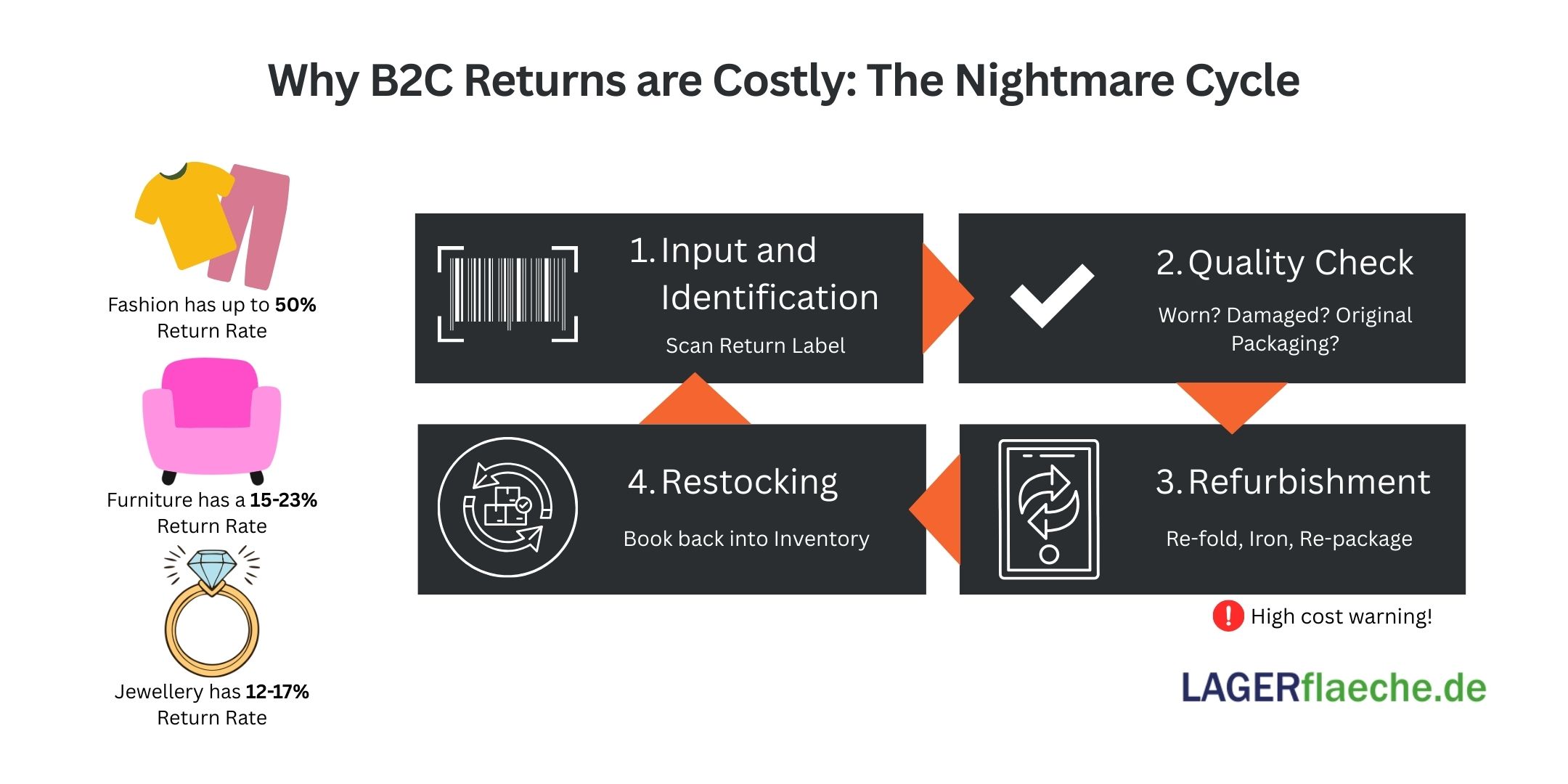
While B2B returns are usually due to quality defects or incorrect deliveries and account for <5%, returns in B2C are a calculated part of the customer journey – especially in Germany.
Special features in B2C:
- Speed: "Next Day" or "Same Day" delivery is often standard in urban areas. The warehouse must be optimized for throughput during peak periods (e.g. Black Friday).
- Returns processing: A returned sweater must be checked, refolded, repackaged and re-booked. This process (refurbishment) is extremely cost-intensive.
- Personalization: inserts, tissue paper, fragrance sprays in a package. B2C logistics is part of the branding.
Innovations: Which Technologies Drive the Respective Division?
Technological development is taking place in parallel, but with different emphases.
B2B innovations: transparency and IoT
- Internet of Things (IoT): Smart pallets that track temperature and vibration. Relevant for pharmaceuticals or food.
- Blockchain: For complete traceability in the supply chain (supply chain visibility).
- Automated high-bay warehouses: Focus on pallet handling by autonomous forklifts (AGVs).
B2C innovations: robotics and the last mile
- Autonomous Mobile Robots (AMR): Systems such as Locus Robotics or Kiva (Amazon) that bring shelves to the picker to save walking distances.
- AI-supported inventory forecasting: To distribute inventory in a decentralized manner so that it is closer to the end customer before the end customer even orders (predictive logistics).
- Green last mile: cargo bikes and e-vans in city centers.
Convergence: Where can both Learn from Each Other? (The D2C Trend)
We are observing a massive merger. Manufacturers who used to only supply B2B now sell directly to end customers (D2C - Direct to Consumer). Conversely, successful B2C brands (such as Anker or Gymshark) are building B2B channels to retail.
What B2B needs to learn from B2C:
- User experience (UX): Tracking links and proactive communication in case of delays are also valuable for B2B buyers.
- Small quantity handling: B2B warehouses must learn to pick even initial quantities efficiently ("pick-pack-ship" instead of just "pallet-in-pallet-out").
What B2C needs to learn from B2B:
- Cost control: B2B logistics is extremely efficient in cost-per-unit management. B2C startups often "burn" money through inefficient packaging and a lack of automation.
- Long-term contracts: B2B is based on fixed framework agreements, while B2C often operates volatilely in the spot market.
International Differences: Germany vs. World
Logistics is local. What works in Berlin fails in Texas or Tokyo. Here is a concrete country comparison:
| Feature | Germany (DE) | USA | China | United Kingdom (UK) |
| Payment practices | Purchase on account dominates (especially in B2B and conservative B2C). | Credit card is king. Cash flow is faster. | Mobile Payment (Alipay/WeChat). Integration in "Super-Apps". | Similar to USA, high credit card usage. |
| Returns | World champion of returns. B2C odds in fashion often at 50%+. Customers order selected consignments. | Returns rate significantly lower (~20-30%). Returns often subject to a fee/more cumbersome. | Low return rate, but extremely high expectations of delivery speed. | Complex since Brexit. Cross-border returns are a nightmare (customs). |
| Data protection | GDPR is sacred. Tracking data is sensitive. | Lax data protection. Data is being used aggressively for marketing. | Data belongs to the ecosystem (Alibaba/JD). Total transparency. | GDPR-like, but more pragmatic. |
| Infrastructure | Dense settlement, high street density. "Next Day" is possible almost anywhere. | Gigantic distances. Zone systems at carriers (FedEx/UPS). Air freight is essential for speed. | Hyper-urban logistics. Delivery often within hours in metropolises. | Island logistics. The challenge of the Northern Ireland Protocol. |
Why these differences? Germany has developed a culture of "view broadcasting" through historically strong mail order companies (source, Otto). Consumer protection is extremely strong (§ 355 BGB right of withdrawal). In the USA, on the other hand, the distances are so great that "free returns" are logistically more expensive and culturally less expected (except for Amazon Prime).
Case Study from Practice: The Transformation of "Werkzeug-Profi GmbH"
To make the theory tangible, let's look at an (anonymized) practical example of a customer who went through the change.
Initial situation:
The "Werkzeug-Profi GmbH" from North Rhine-Westphalia sold high-quality drills only to DIY stores (B2B).
Challenge:
Launch of her own online shop for do-it-yourselfers. Suddenly, orders came in via a drill.
- Problem 1: The forklift drivers were too slow to pick individual parts.
- Problem 2: The forwarding company did not accept 2kg parcels.
- Problem 3: End customers complained about oil-smeared industrial packaging.
Solution (hybrid warehouse):
- Zoning: Creation of a "pick zone" on the ground floor with flow racks for fast-moving goods (B2C). The replenishment comes by forklift from the B2B reserve warehouse above.
- IT upgrade: Introduction of a WMS (Warehouse Management System) that splits orders: Large orders go to the forklift terminal, individual orders to mobile handheld scanners with route optimization.
- Carrier mix: Contract with DHL/DPD for parcels, retention of the freight forwarder (Dachser/Schenker) for pallets.
Result:
Within 12 months, B2C sales accounted for 30%, with the same warehouse space.
Conclusion and Outlook: Where is the Journey Heading?
The strict separation between B2B and B2C is dissolving. We are moving towards "B2X" logistics. Decisive for the future are:
- Flexibility: Warehouses must be able to "breathe" – scalable for the Christmas business (B2C) and robust for seasonal business in retail (B2B).
- Data sovereignty: If you know your holdings in real time, you can sell them across channels.
- Sustainability: B2B customers demand CO2 reports for their balance sheet, B2C customers for their conscience.
The winners of tomorrow are those companies that see their supply chain not as a cost factor, but as a service product.
References
- Bundesverband E-Commerce und Versandhandel Deutschland e.V. (bevh) – Data on return rates.
- Fraunhofer Institute for Material Flow and Logistics IML – Studies on IoT in Logistics.
- McKinsey & Company – "The changing face of B2B marketing and sales" (Consumerization trends).
- Statista – E-commerce sales and logistics data worldwide.
- DHL Trend Research – "Logistics Trend Radar".
Latest Blog Posts
Stay up to date with the newest trends, insights, and tips in warehouse and logistics. Our latest articles help you navigate the industry with confidence.
Data Centres vs. Logistics Facilities: The Race for Power and Land
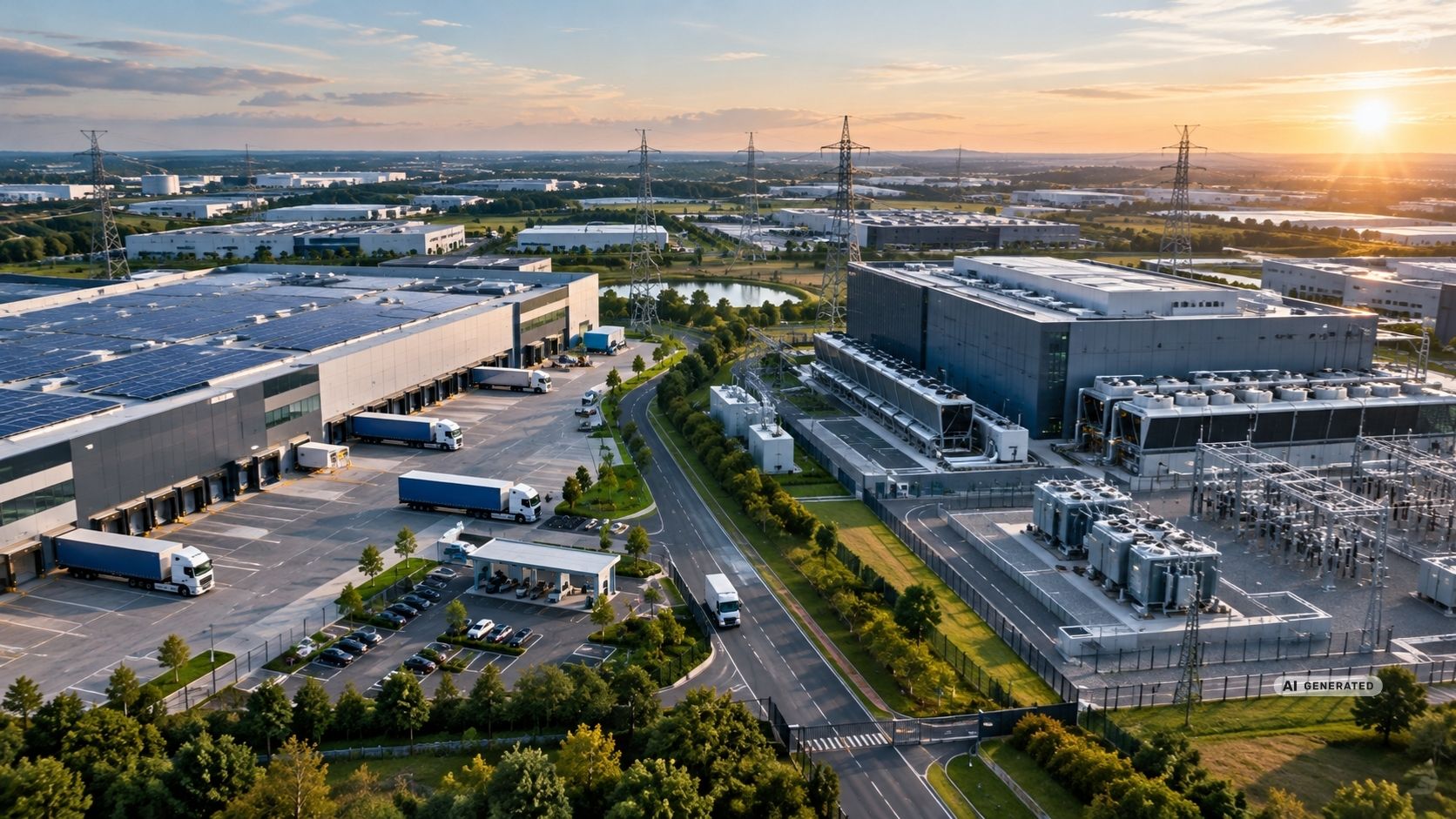
Across Europe, logistics operators are competing for more than land and transport access. They increasingly need something much harder to secure: grid capacity. Data centres are intensifying that competition — and changing how logistics locations are evaluated....
Chinese companies discover Europe's logistics real estate
Chinese companies are becoming an increasingly visible user group in Europe's logistics real estate market. What does this mean for warehouse space, 3PL structures and the requirements for European logistics locations?...
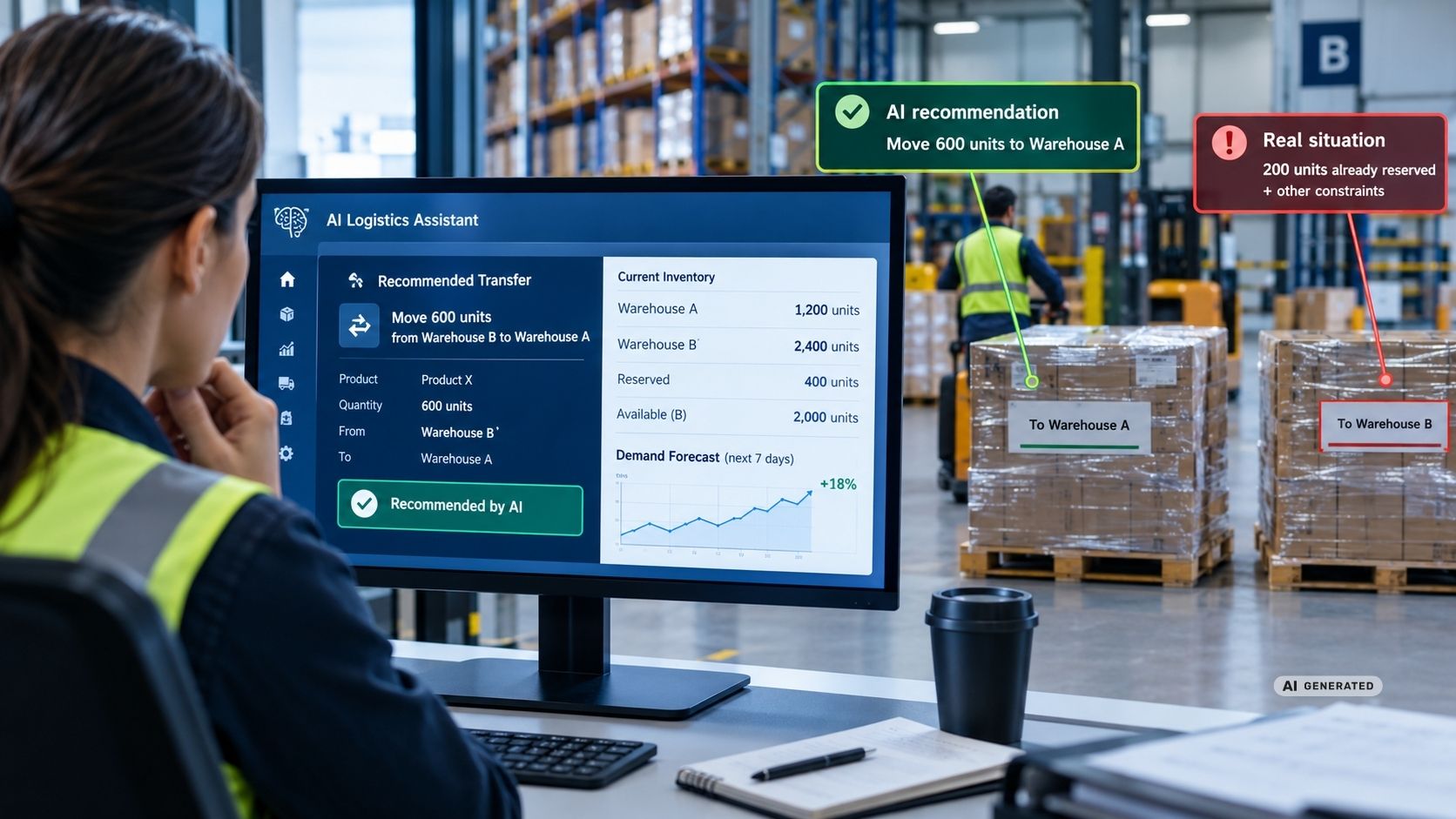
AI Hallucinations in Logistics: When AI Plans the Wrong Delivery
AI can analyze enormous amounts of logistics data — but it can also produce a convincing answer that is simply wrong. The critical question is not whether AI makes mistakes, but what happens when a wrong recommendation becomes an operational decision....
The Green Revolution on the Hall Roof: From Concrete Block to Ecological Power Plant?
Logistics roofs can do more than PV: greening, bees, urban farming and even sports areas turn unused roof space into multifunctional rooms....