




Vertical storage systems in warehouse logistics
Table of Contents
- System Architecture: VLM vs. Paternoster
- The Logistics Property: Requirements for the Envelope
- Contract Logistics: Scalability and ROI
- Integration into the Software Landscape (WMS & ERP)
- Practical Questions: What Decision-makers need to know (Q&A)
- Key Figures and Facts about Planning
- Conclusion for Practice
In modern warehouse logistics, space is the most precious commodity. While the horizontal expansion of logistics real estate often comes up against property boundaries or exploding lease prices, the vertical offers almost untapped potential. Vertical storage systems are much more than just high racks; they are automated, closed systems that perfect the "goods-to-man" principle.
System Architecture: VLM vs. Paternoster
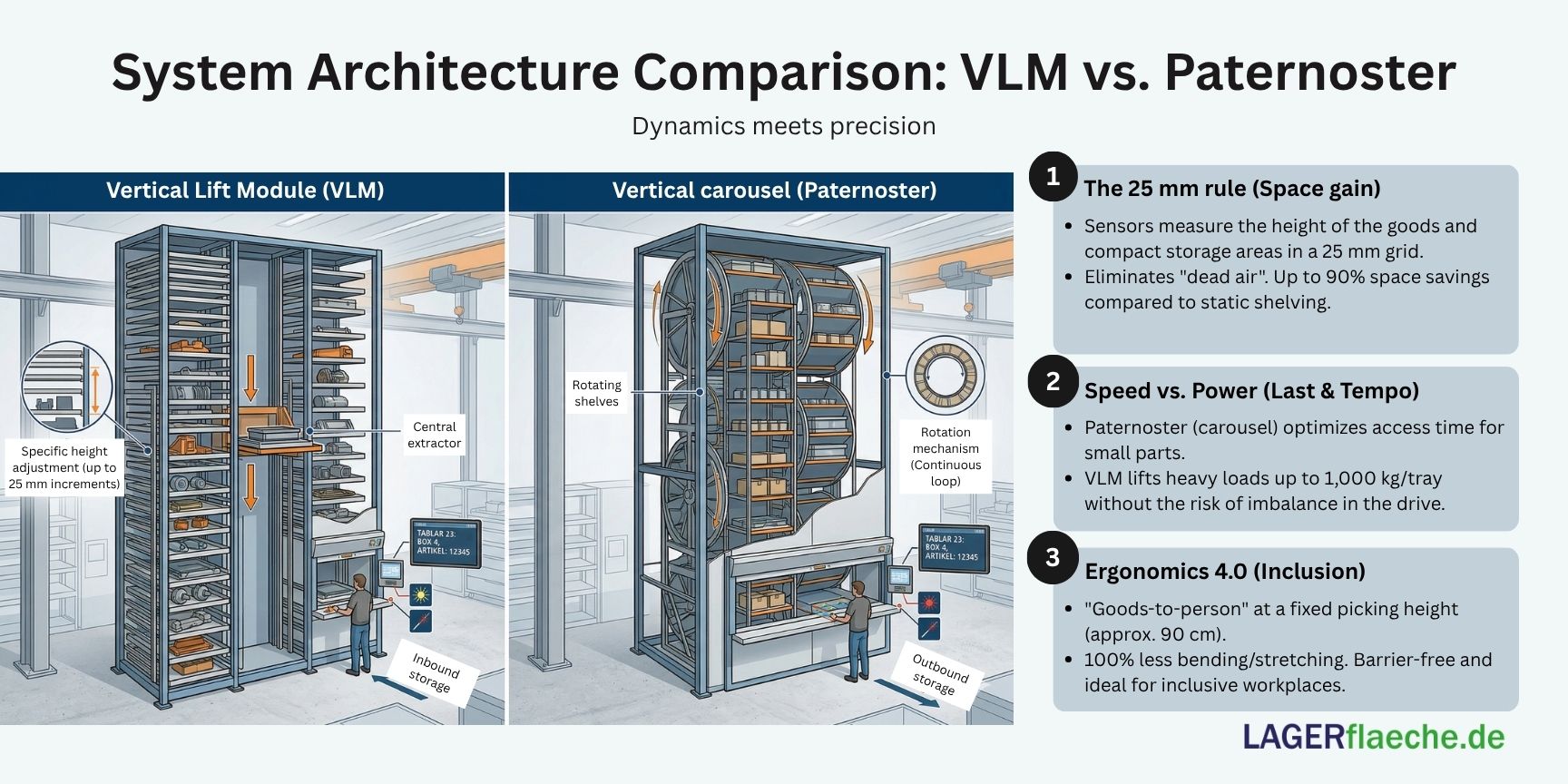
In the professional world, a distinction is primarily made between two types:
- Vertical Lift Module (VLM): A computer-controlled lift moves in the center between two rows of shelves. He removes trays (carriers) and brings them to the dispensing opening. The advantage: Sensors measure the height of the stored goods on the shelf and place them in a grid of often only 25 mm distance – maximum compaction without air holes.
- Vertical carousel (paternoster): Here, all storage compartments rotate like a chain. This is ideal for uniform small parts with high access frequency, but historically reached its limits (imbalance) when weight distribution is uneven.
The Logistics Property: Requirements for the Envelope
The integration of vertical systems places specific demands on the hall. While standard logistics halls often have a clear height of 10 to 12 meters, modern vertical lifts can rise up to 30 meters in height.
- Floor pressure: A fully loaded lift concentrates enormous loads on a few square meters. Point loads of 20 to 50 kN/m² are not uncommon. This often requires reinforced foundation slabs (special foundations).
- Roof breakthroughs: In existing properties, roof turrets are often installed to allow the equipment to protrude beyond the actual roof cladding, which technically upgrades the property, but entails building law inspections (fire protection, statics).
Contract Logistics: Scalability and ROI
For contract logistics companies, flexibility is crucial. Vertical systems offer a decisive advantage here: space savings of up to 90% compared to static shelving units.
- Numerical example: Where there used to be 400 m² of shelving, now approx. 40 m² of floor space is sufficient for a group of lift systems.
- Throughput times: The picking performance increases from approx. 60–80 positions (manual) to 150 to 400 positions per hour and operator.
- Pick accuracy: Technologies such as pick-to-light or laser pointers reduce the error rate to almost zero (<0.1%).
Integration into the Software Landscape (WMS & ERP)
A vertical storage system is only as intelligent as its connection. Modern systems no longer function as a self-sufficient isolated solution. They communicate directly with the Warehouse Management System (WMS) via standardized interfaces (REST API, IDoc). Inventory management is carried out in real time. Especially in spare parts logistics or e-commerce, this enables "chaotic warehousing" within the lift: The system knows at all times on which tray which item is located at what height, and optimizes the extractor's routes in advance (batch picking).
Practical Questions: What Decision-makers Need to Know (Q&A)
Question: From which article structure is a vertical system worthwhile?
Answer: Small to medium-sized goods with high variance (SKUs) are ideal. As soon as you store more than 500 different small parts or the access time in the manual warehouse exceeds 50% of the working time due to long walking distances, the break-even point is near.
Question: What about reliability?
Answer: This is a critical point in contract logistics. Modern systems have redundant drives and manual emergency lowering functions. Maintenance contracts with 24/7 support and remote diagnostics are standard for automated systems to minimize downtime.
Question: Can vertical systems be used in cold or clean room environments?
Answer: Yes. There are specialized designs for the pharmaceutical industry (cleanroom up to class ISO 5) and for deep-freeze logistics (down to -25 °C). This is where they shine in particular, as the volume to be cooled is drastically reduced by the high compression, which massively reduces energy costs.
Key Figures and Facts about Planning
To illustrate the depth of the topic, here are the most important parameters for a tender:
- Tray payload: Typically, between 250 kg and 1,000 kg per tray.
- Total payload: 60 tons and more are often possible per device.
- Access time: Average 15-30 seconds per shelf change.
- Energy consumption: Modern systems use recuperation (recovery of braking energy), which can reduce consumption to the level of a household kettle.
Conclusion for Practice
Vertical storage systems are the backbone of modern intralogistics 4.0. They make logistics properties more efficient, reduce dependence on labor shortages through ergonomic workplaces and offer transparency in the portfolio that is almost impossible to achieve manually. Anyone planning a hall or optimizing an existing property today can no longer avoid the vertical dimension.