




Vacancy costs in warehouses
Table of Contents
- The phenomenon of vacancy costs: When square meters become a negative business
- The logistics property: fixed costs at idle speed
- Contract logistics: The trap of holding capacity
- The mathematical perspective: How do you calculate vacancy?
- Strategic approaches to minimise idle costs
- FAQ: Frequently asked questions about vacancy costs
- Focus on the hall: Structural flexibility reduces the risk
- Conclusion: Proactive management instead of passive management
- Summary for practice:
The phenomenon of vacancy costs: When square meters become a negative business
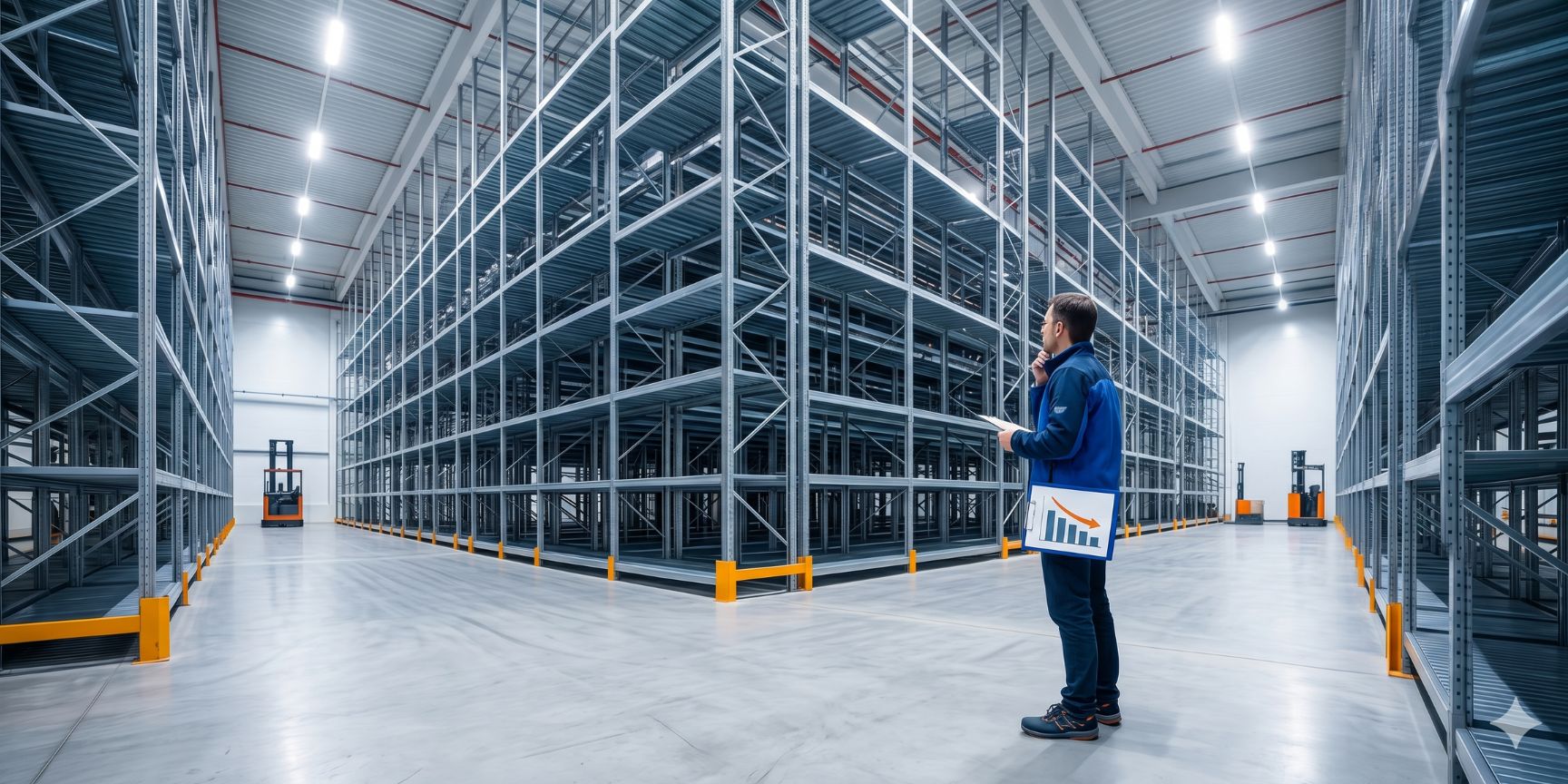
In the world of logistics, space is the most valuable resource. But while a full hall is often seen as a sign of success, unused pallet spaces hide a financial burden that is often underestimated: the cost of vacancy.
Generally defined, vacancy costs refer to the expenses incurred when storage capacities (space, technology, personnel) are kept available but not covered by goods handling or storage fees. In times of fluctuating supply chains and volatile markets, managing these costs is a key competitive advantage.
The logistics property: Fixed costs at idle speed
From the point of view of the real estate industry, vacancy costs are hard facts. A logistics property incurs costs, regardless of whether there is a package in it or not. Primary factors include:
- Financing costs: Interest and repayment for the building.
- Maintenance: Unused halls also have to be maintained, secured and partially heated (frost protection).
- Property taxes and insurance: These continue regardless of occupancy.
Practical figures: For a modern logistics hall in Germany, the management costs (without depreciation) are often between €1.50 and €3.50 per square metre per month. A vacancy of 1,000 m² thus costs the owner or tenant up to €42,000 per year – purely for the preservation of the shell.
Contract logistics: The trap of holding capacity
In contract logistics, vacancy costs are particularly treacherous. Here, dedicated areas are often reserved for certain customers. If their sales fall (underperformance), the logistics service provider (3PL) is left with the costs, unless minimum commitments have been agreed.
This is where the opportunity costs come into play: The space is blocked and cannot be used for more lucrative new customers. The staff trained for this customer is underutilized, which drives up unit labor costs.
The mathematical perspective: How do you calculate vacancy?
In order to analyze vacancy costs in depth, a look at the balance sheet is not enough. The formula of empty capacity costs is used:
- Vacancy costs
- Total fixed costs of the warehouse (rent, depreciation, administration)
- Maximum capacity (e.g. 10,000 parking spaces)
- Actual occupancy
Example: A warehouse has fixed costs of €50,000/month and 5,000 storage spaces. Currently, only 3,500 places are occupied. The cost per parking space is 10 €. The vacancy of 1,500 places thus causes monthly costs of €15,000.
Strategic approaches to minimise idle costs
How do professionals react to unused hall space?
- Multi-user warehouses: Instead of one hall for one customer, space is flexibly rented to several customers. This smooths out seasonal fluctuations.
- Third-party use: Short-term subletting to partners or marketplaces for on-demand warehousing.
- Automation vs. flexibility: In highly automated halls, vacancy costs are more fatal, as the depreciation for expensive conveyor technology is massively significant. Conservative capacity planning is mandatory here.
FAQ: Frequently asked questions about vacancy costs
Question: Is 100% occupancy the goal?
Answer: No. In warehouse logistics, a capacity utilization rate of 85% to 90% is considered ideal. The remaining 10% is "respiratory reserve". At 100% occupancy, efficiency decreases (block storage, relocations), which causes process costs to rise more sharply than the vacancy costs saved.
Question: Can vacancy costs be claimed for tax purposes?
Answer: Yes, they reduce profits as operating expenses. Nevertheless, a euro earned is always more valuable than a tax-deductible euro from losses.
Question: What role does AI play in preventing vacancies?
Answer: Predictive analytics can help calculate inventory needs months in advance. In this way, lease agreements can be made more flexible or space can be offered on the spot market at an early stage.
Focus on the hall: Structural flexibility reduces the risk
A specialised hall (e.g. for hazardous goods or freezers) has a higher risk of vacancy because the group of users is small. Modern logistics properties are therefore built "suitable for third-party use". This means:
- Standardised ceiling heights (12m UKB).
- Sufficient ramp delivery.
- Flexible fire compartments. Such halls can be re-let more quickly if they are vacant, which minimizes the "vacancy period" and thus the costs.
Conclusion: Proactive management instead of passive management
Vacancy costs are unavoidable in warehouse logistics, but they can be controlled. Those who know their data – especially the fixed costs per parking space – can react more quickly to market changes. Whether through clever contract design in logistics, flexible hall use or the use of AI-supported forecasting tools: The goal must be a dynamic surface that breathes without taking your financial breath away.
Summary for practice:
| Area | Main cost drivers | Solution approach |
| Real Estate | Interest, maintenance | Third-party usability |
| Logistics | Personnel provision, technology | Multi-user concepts |
| Finance | Capital commitment | Lean Warehousing & Forecasting |