


Returnable Packaging Management in Warehouse Logistics
Table of contents
- 1. What is emballage? Definition and tasks of returnable packaging management
- 2. Why returnable packaging management is business-critical for warehouse and contract logistics
- 3. Packaging and the logistics property: empties yard, hall layout and fire protection
- 4. Facts and figures: the economic dimension of returnable packaging
- 5. Value added services (VAS) around returnable packaging
- 6. Digital control: auto-ID, IoT and interfaces to ERP and WMS
- 7. Frequently asked questions (FAQ) about returnable packaging management
Consistent returnable packaging management has a decisive influence on space productivity, cycle times and the smooth interface with the logistics property in warehouse and contract logistics. This guide explains the term and its tasks, the requirements for empties areas and fire protection, key economic figures, value added services offered by contract logistics providers and the digital control of container cycles.
1. What is emballage? Definition and tasks of returnable packaging management
The term emballage comes from French (emballer = to pack) and, in logistics and trade, refers to all kinds of packaging, wrapping, loading and transport aids. In industrial usage it mainly covers reusable or one-way packaging such as Euro pallets, mesh box pallets, small load carriers (KLT), trays, drums, containers and special racks.
Returnable packaging management (also called emballage, load carrier, packaging or container management) describes the end-to-end planning, provision, booking, monitoring, maintenance and return of these transport and storage aids along the entire supply chain. It acts as the physical and data link between production, warehouse, transport and customer.
This goes well beyond a pallet account: a pallet account books the exchange of standardised pallets between two partners, whereas returnable packaging management controls the entire cycle of all packaging – from demand at the production line through cleaning and repair to replacement purchasing.
2. Why returnable packaging management is business-critical for warehouse and contract logistics
Without standardised packaging, the flow of goods in the warehouse comes to a halt. If suitable KLT or pallets are missing for order picking, outbound shipping is delayed. At the same time, returning empty packaging (reverse logistics) creates considerable capacity problems for logistics providers.
In contract logistics, providers (3PL) operate integrated container cycles for several clients at once. Here, system-supported returnable packaging management determines whether stock is settled transaction by transaction via digital container accounts or whether unexplained shrinkage eats into the provider's margin. Unexplained container shrinkage is therefore one of the hidden costs of poor contract logistics.
3. Packaging and the logistics property: empties yard, hall layout and fire protection
Packaging takes up a lot of space – often exactly where space is most expensive. The structural and planning requirements for halls and yards are therefore high:
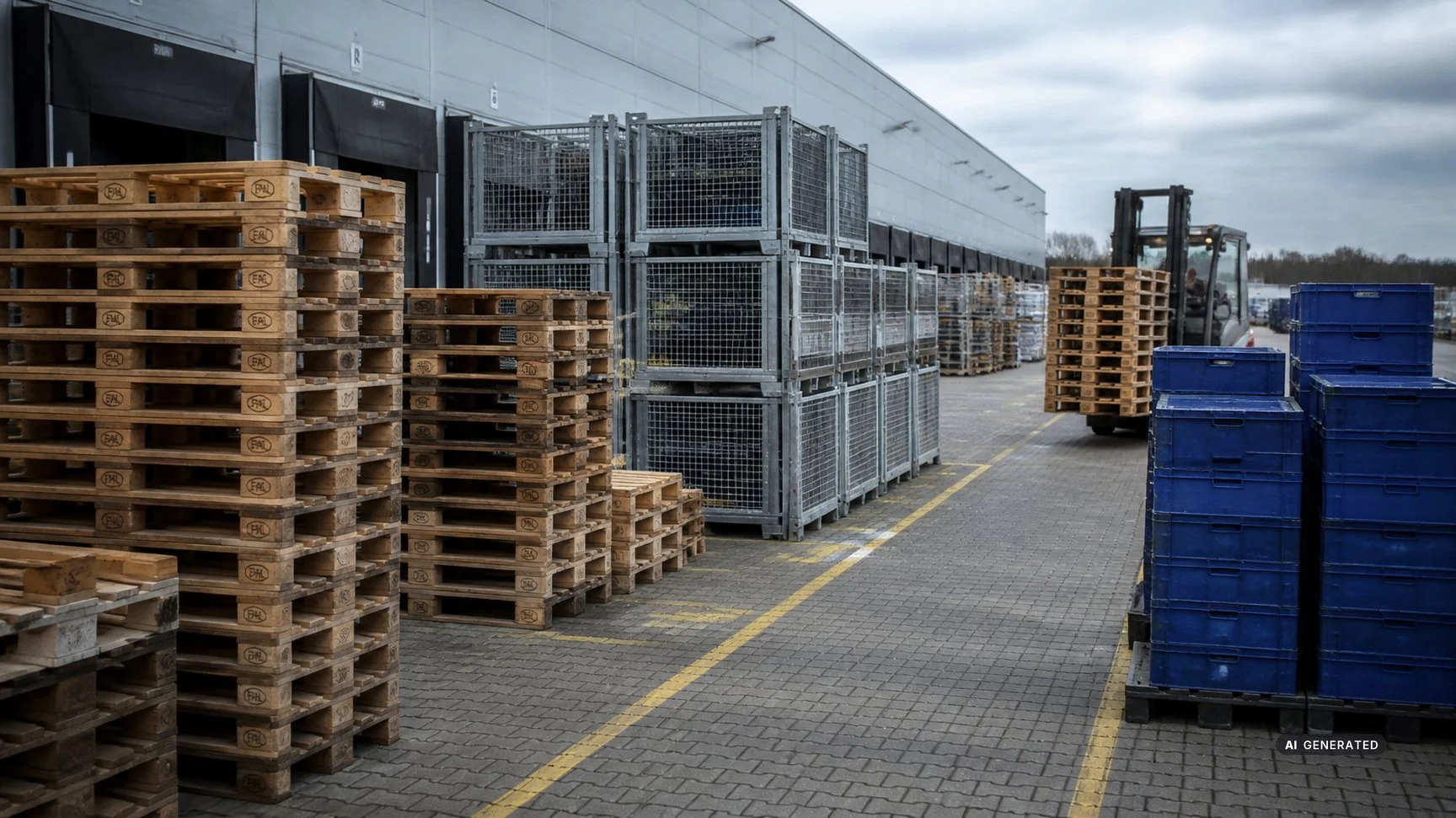
Empties are bulky but low in value: paved buffer areas close to the docks, separate flows for full goods and returned packaging, and dedicated fire compartments keep expensive hall space free for full goods.
- Open areas and empties yards: Because empties are bulky but low in value density, paved, weather-resistant outdoor areas or uninsulated cold halls are used for them.
- Floor loads and stacking heights: Empty load carriers are comparatively light; even high stacks of empty pallets or mesh boxes usually stay well below the typical floor load of modern logistics halls of around 50 kN/m². The limiting factors are rather the permissible stacking height of the load carriers, the stability of the stacks and fire protection requirements. It is important that empties areas can later also be used for full goods in block storage or for racking.
- Fire protection and fire load: Large quantities of wooden pallets or plastic KLT represent a high fire load. Logistics properties often need separate fire compartments for such buffer zones and a suitable sprinkler design, for example with ESFR sprinklers (Early Suppression Fast Response) in line with VdS CEA 4001 or FM Global. The decisive factors are the property insurer's requirements and the approved fire protection concept.
- Loading dock infrastructure: Separate return flows of empties require well-planned dock allocation to prevent conflicts between outbound full goods and the return of packaging.
4. Facts and figures: the economic dimension of returnable packaging
A lack of transparency in container flows ties up a disproportionate amount of capital. Studies and practical examples illustrate the economic leverage:
- Shrinkage and loss rates: In returnable cycles without end-to-end tracking, a noticeable share of stock is lost every year. For returnable containers in the automotive supply chain, the Center for Automotive Research reports typical losses of 3 to 10 % of total container stock per year (Source: Center for Automotive Research, "Cost Benefits Analysis of Container Tracking for the Automotive Supply Chain", 2019). For Euro pallets in the exchange system, around 13 % per cycle have to be replaced or repaired due to loss, breakage or quality defects (Source: Fraunhofer IML, "Ergebnisse der empirischen Kostenanalyse des Tauschverfahrens im Europalettenpool", 2009).
- Space usage: Empties acceptance, buffering, sorting and cleaning take up a considerable share of hall and yard space in distribution and production warehouses. How large this share is depends mainly on cycle times, the exchange procedure and how often accounts are reconciled: regularly balancing container accounts and returning empties quickly keeps buffer areas small.
- Administrative and clarification effort: Recording movements, reconciling accounts and clarifying discrepancies from pallet slips account for a noticeable share of exchange costs. A study of 123 companies from industry, retail and logistics in Switzerland puts administration at 15 % of the total cost of a pallet cycle (Source: University of St. Gallen, Grimm/Hofstetter, "Optimierungspotenzial", Handelszeitung, 2011). One practical example: at plastic container manufacturer Georg Utz, two employees together spent four to five hours a day reconciling account statements, delivery notes and pallet documents; after digitalisation, it takes about one hour a day (Source: LOGISTRA, "Utz digitalisiert Paletten-Management mit LCMS von Logistikbude", 7 July 2026).
- Empty runs: Around one fifth of all vehicle-kilometres in EU road freight transport are empty runs – 21.8 % in 2025 and as much as 26.0 % in national transport (Source: Eurostat, Road freight transport by journey characteristics, 2025 data). Part of this is due to returning empties; pooling networks and bundled round trips help reduce empty kilometres.
5. Value added services (VAS) around returnable packaging
In modern warehousing, handling packaging is no longer a mere side effect but a value added service (VAS) in its own right offered by contract logistics providers. The blog article How value-added services are changing logistics shows how such services are changing the business model of logistics providers.
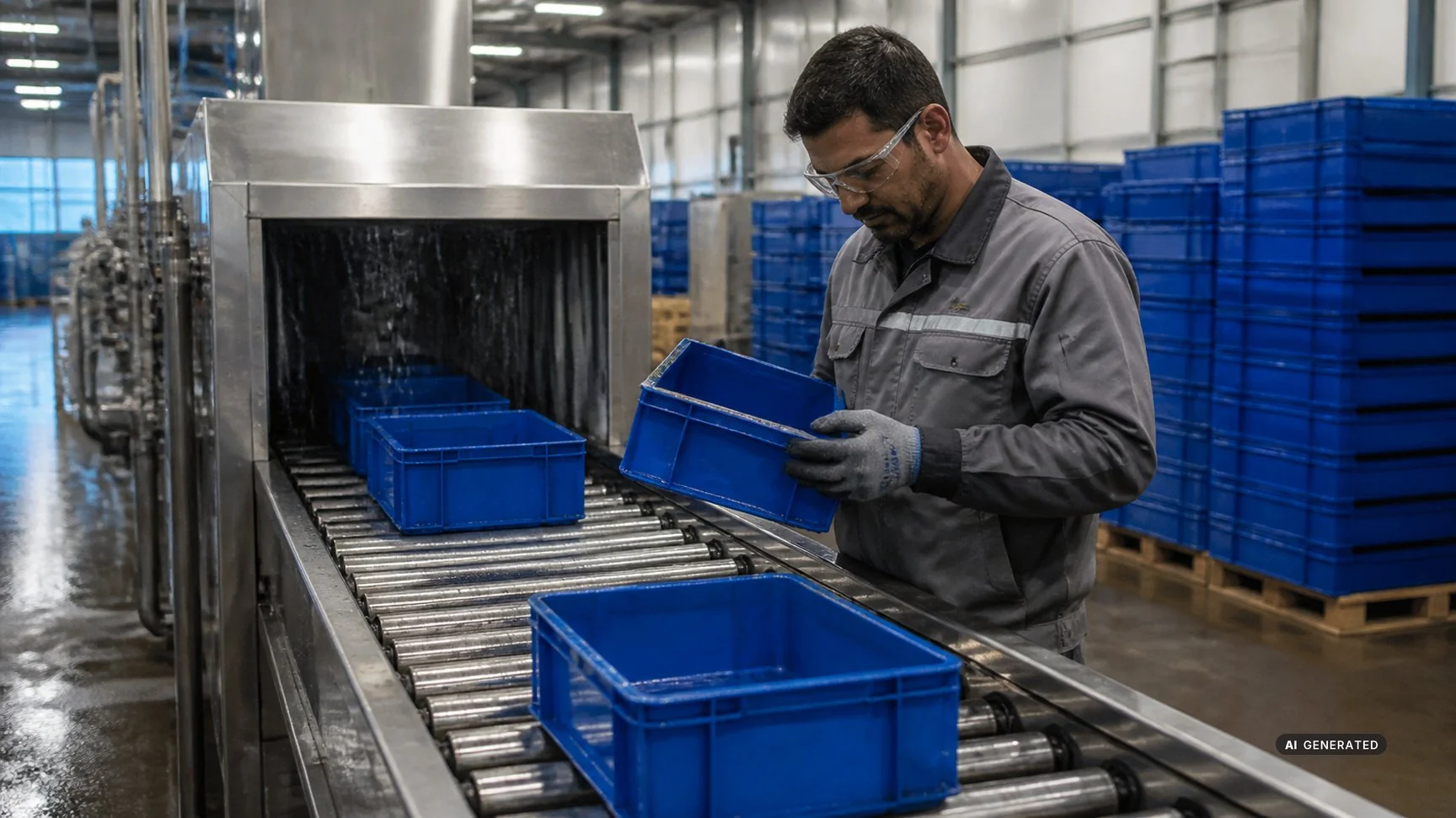
Cleaning, repair and quality inspection turn returnable packaging management into a value added service in its own right: contract logistics providers pool these services for several clients and lower the cost per container cycle.
- Container cleaning and disinfection: industrial washing systems for KLT in line with VDA or HACCP requirements for automotive and food suppliers.
- Repair and maintenance: licensed repair of Euro pallets (EPAL) and mesh box pallets in line with UIC requirements.
- Kitting and pre-assembly: fitting packaging with made-to-measure dividers, inlays or blisters for production lines.
- Quality inspection and sorting: mechanical and visual checks for cracks, warping or contamination before packaging is fed back into production. For pallets, this is increasingly handled by automatic AI-based pallet inspection.
6. Digital control: auto-ID, IoT and interfaces to ERP and WMS
Manual paperwork is replaced by integrated IT structures:
- Auto-ID technologies: Barcodes, 2D DataMatrix codes and RFID or BLE tags (Bluetooth Low Energy) allow bulk reading at truck doors or on conveyor lines.
- IoT tracking: High-value special containers (e.g. for battery transport or pharmaceuticals) are monitored seamlessly via GPS and sensors for location, temperature and shock.
- WMS and ERP integration: Digital load carrier accounts rebook stock in real time during put-away and retrieval, automatically reconcile supplier accounts and trigger follow-up orders when stock falls below a threshold.
7. Frequently asked questions (FAQ) about returnable packaging management
Question: What is the difference between one-way and returnable packaging?
Answer: One-way packaging (such as cartons, shrink film or one-way pallets) remains with the recipient after a single use and is recycled or disposed of. Returnable packaging (such as EPAL Euro pallets, KLT or mesh box pallets) stays in the economic cycle permanently and is reused via exchange or pooling systems.
Question: What role does the pallet account play in returnable packaging management?
Answer: A pallet account is a clearing account between two logistics partners (e.g. shipper and carrier). It records handovers, returns and outstanding pallet debts item by item so that discrepancies caused by non-returns can be settled transparently. In returnable packaging management it is one building block among several: besides pallets, KLT, mesh box pallets and special containers are also managed via their own container accounts.
Question: What role does returnable packaging management play for ESG requirements?
Answer: Switching from one-way to durable returnable systems can reduce the Scope 3 carbon footprint and cut packaging waste – provided the containers circulate often enough and return transports are bundled. Accurate documentation of container life cycles also provides data for the sustainability reporting of companies subject to the CSRD, in particular for the ESRS E5 standard (resource use and circular economy).
Question: What minimum requirements apply to empties storage zones in halls?
Answer: They require level, abrasion-resistant industrial floors, clear floor markings, sufficient aisle widths for industrial trucks and a fire protection concept that copes with the high fire load of dry wooden or plastic packaging.
Question: What does load carrier pooling mean?
Answer: With pooling, a company rents packaging from a specialised provider (e.g. CHEP, LPR). The pool operator takes care of maintenance, cleaning and availability, so users do not have to buy their own container fleets as fixed assets (CAPEX).
Question: How does a contract logistics provider reduce the costs of returnable packaging management?
Answer: Through economies of scale: several customers share sorting and cleaning stations in multi-user centres. In addition, real-time scans and automated booking minimise shrinkage and manual reconciliation errors.
Question: What does VDA 4500 cover in container management?
Answer: The VDA recommendation 4500 (currently version 3.1, December 2025) describes the standardised KLT system of the automotive and supplier industry: dimensions and weights, material and quality requirements, the modular design on Euro and ISO pallet footprints, handling, a damage catalogue and the permanent marking of the containers (Source: VDA 4500 Small Load Carrier (KLT) System). The goods label for the load is inserted into the KLT's card pocket and follows the VDA 4994 label standard (Global Transport Label).
Your Ideal Logistics Warehouse
Browse listings for warehouse space, logistics real estate, industrial land, and contract logistics solutions.
Browse Exposés
Maximize Exposure for Your Warehouse Space
Showcase your logistics properties and attract qualified inquiries.
Discover Products