


Pallet Account in Logistics
Table of contents
- 1. Definition: What is a pallet account and how does it work?
- 2. Exchange procedures at a glance: Cologne vs. Bonn pallet exchange
- 3. Relevance for contract logistics: multi-client control without margin killers
- 4. Impact on the logistics property: empty pallet areas, fire protection and yard logistics
- 5. Facts and figures: what pallet exchange really costs
- 6. Digital pallet account: WMS interfaces, apps and pooling systems
- 7. Frequently asked questions (FAQ) about the pallet account
In warehouse and contract logistics, a transparently managed pallet account works like a shadow currency: it records load carrier flows between shipper, freight forwarder, logistics service provider and consignee piece by piece and helps to limit costly buffer areas for empty pallets in the logistics property.
1. Definition: What is a pallet account and how does it work?
A pallet account is a clearing account between at least two logistics parties – usually between shipper, freight forwarder, logistics service provider (3PL) and consignee. Instead of money, it records receipts, issues and outstanding claims for standardised reusable load carriers, above all the EPAL Euro pallet (dimensions according to DIN EN 13698-1). Mesh box pallets are often managed via the account as well.
If goods are handed over on exchangeable pallets and the pallets are not swapped on the spot at the loading dock, a pallet debt arises. The difference in quantity is credited or debited to the pallet account. The legal basis is the pallet exchange agreement in the freight, forwarding or logistics contract. The pallet note (Palettenschein) and the consignment note serve as proof or receipt for the pallets handed over and exchanged. The CMR consignment note only plays a role in cross-border road haulage; for domestic transport in Germany, the consignment note under the German Commercial Code (HGB) applies.
2. Exchange procedures at a glance: Cologne vs. Bonn pallet exchange
In practice, two standardised clauses determine how pallets are exchanged and booked to the pallet account. They were developed by the leading associations of shippers, freight forwarders and road hauliers (Source: DSLV, pallet clauses):
- Cologne pallet exchange (Kölner Palettentausch): The so-called double exchange. The carrier brings its own exchangeable empty pallets to the loading point and receives pallets of the same number, type and quality back from the consignee at the unloading point. This procedure suits changing locations, for example in part-load and full-load traffic and in long-distance haulage.
- Bonn pallet exchange (Bonner Palettentausch): Pallet exchange with an obligation to return. The carrier does not use its own pallets, receives empty pallets at the unloading point and returns them to the loading point or another agreed location. This procedure suits loading points that are served regularly, for example in groupage, regional and scheduled services.
For exchangeability, the clauses refer to UIC standard 435-4. If exchanges break down – for instance because consignees do not offer an exchange or reject damaged pallets – the pallet accounts of the parties drift apart. Only signed pallet notes and regular balance reconciliation help in that case.
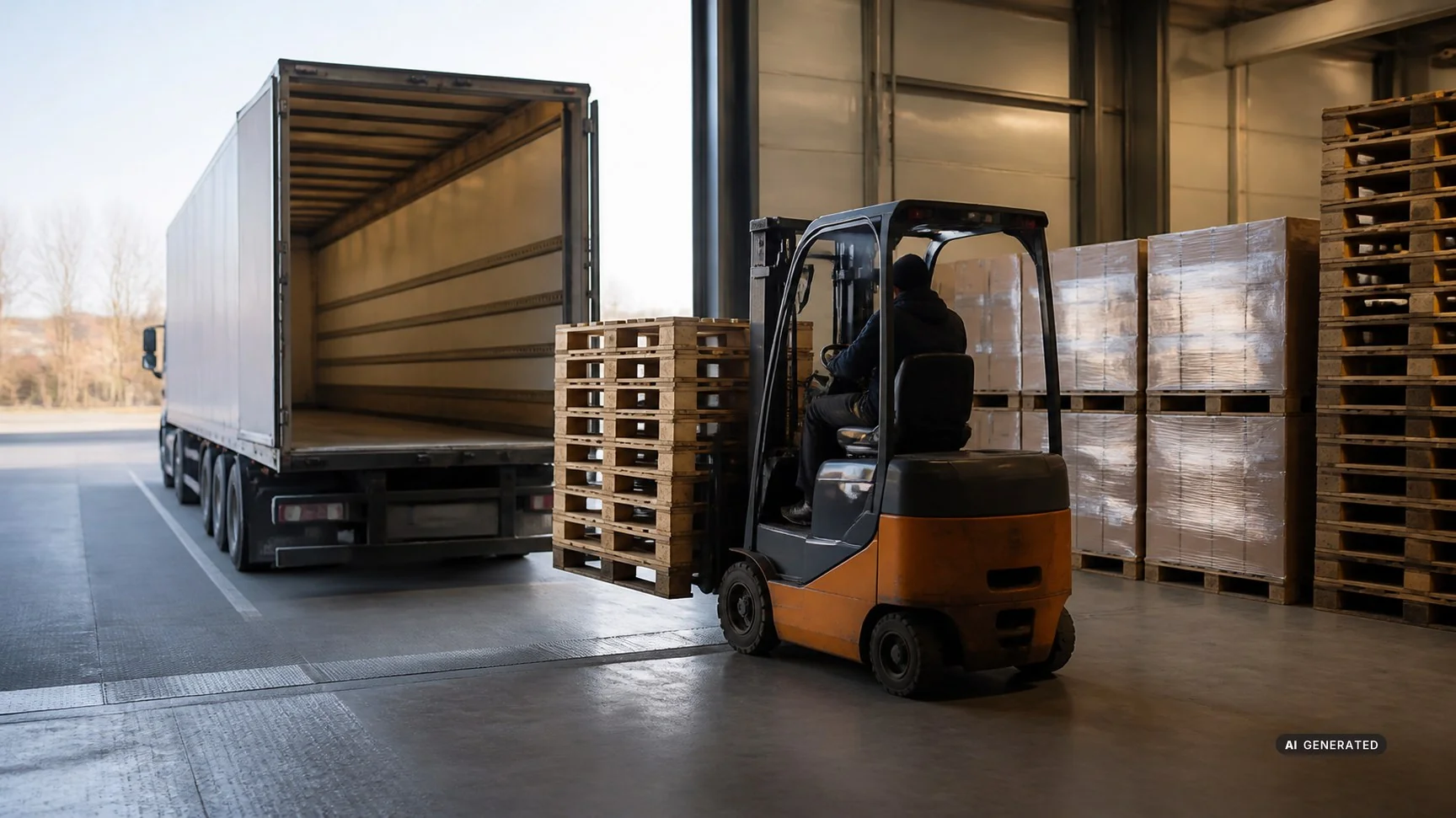
The pallet account records exchanged load carriers; the Cologne and Bonn exchange procedures handle the return flow differently.
3. Relevance for contract logistics: multi-client control without margin killers
In contract logistics, service providers manage the stocks of many clients at the same time in multi-user centres. Here, the pallet account becomes an operational control tool. At market prices of around EUR 12.50 to 13.30 for a new EPAL Euro pallet (Source: PalettenReport, 03/2026), an undocumented loss of 500 pallets already means a loss of around EUR 6,250 to 6,650.
On top of this come the running costs of the exchange: according to a study commissioned by the German freight forwarders' association DSLV, one cycle of an exchangeable Euro flat pallet in groupage traffic costs around EUR 5.69 – if the client requires new pallets, the figure rises to EUR 6.72 (Source: DSLV/FORLOGIC, 2022). Items like these are among the hidden costs of contract logistics that quietly eat into margins.
Service providers therefore link pallet accounts directly to their warehouse management system (WMS) and ERP system. Transaction-based billing then covers not only the storage and retrieval of goods but also account management per client as a value added service (VAS).
4. Impact on the logistics property: empty pallet areas, fire protection and yard logistics
An unbalanced pallet account has physical consequences in the warehouse and on the site:
- Space requirements and buffer zones: When exchanges fall behind, hundreds or even thousands of empty pallets quickly pile up. They occupy hall space that is actually intended for profitable full-pallet goods.
- Floor load capacity: Empty pallets themselves are not critical for the warehouse floor: a Euro pallet weighs approx. 25 kg and is 144 mm high (Source: EPAL). A stack of 15 to 20 empty pallets is therefore around 2.2 to 2.9 m high and weighs about 375 to 500 kg on just under one square metre. What matters is that the area can later also be used for full pallets in block storage or for racking. Here, 5 t/m² (≈ 50 kN/m²) is considered the usual standard for modern logistics halls – read more in our guide floor load capacity in logistics.
- Fire load and sprinklers: Large quantities of dry pallet wood represent a considerable fire load. Empty pallet storage may therefore require separate fire compartments or a special sprinkler design, for example with ESFR sprinklers (Early Suppression Fast Response). VdS CEA 4001 treats empty pallets as a special risk of its own (Source: VdS CEA 4001, Annex K.4). For pallets in manufacturing areas without adequate sprinkler protection, FM Global recommends stacks no higher than 1.5 m with 3 m separation (Source: FM Global Data Sheet 8-24). Ultimately, the requirements of the property insurer and the approved fire protection concept are decisive. Further background is provided in our article on fire protection in the warehouse.
- Yard infrastructure and turning curves: Separate handling of empty pallets requires paved yard areas, sufficient truck turning radii and, depending on the storage concept, weather-protected canopies.
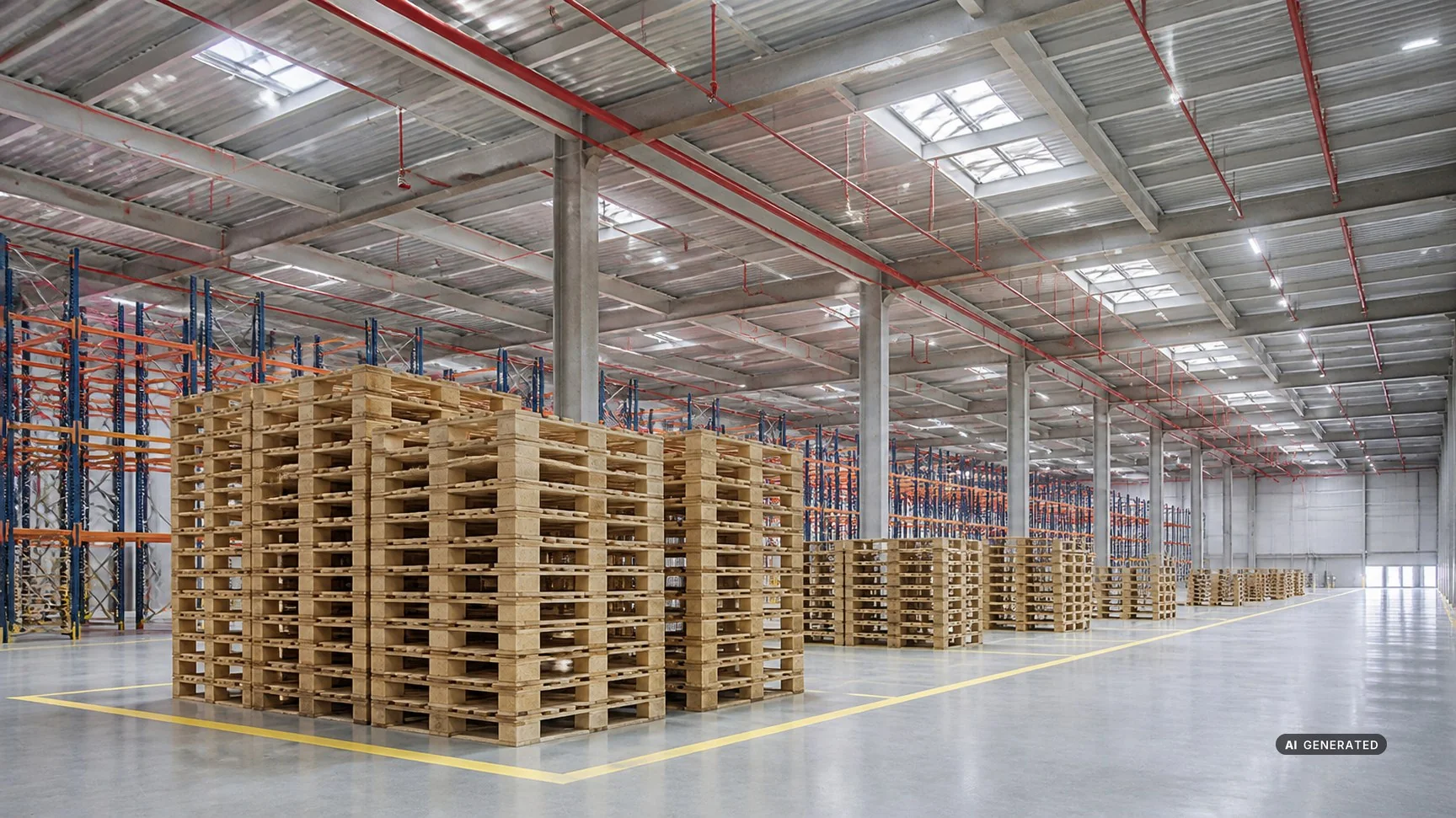
Empty pallets from the pallet account need dedicated storage areas, which affect fire protection and yard logistics of the property.
5. Facts and figures: what pallet exchange really costs
The following figures come from the study “Kosten des Palettentausches” (costs of pallet exchange; FORLOGIC on behalf of the DSLV, 2022) and refer to groupage and system networks (Source: DSLV/FORLOGIC, 2022):
- Total costs: Around EUR 5.69 per Euro flat pallet and cycle, of which EUR 3.62 is incurred at the dispatching depot and EUR 2.07 at the receiving depot. If new pallets are required, costs rise to EUR 6.72.
- Administrative effort: Administration – recording pallet movements, maintaining and reconciling pallet accounts, clarifying differences – costs a combined EUR 1.18 per pallet (EUR 0.59 each at the dispatching and the receiving depot).
- Breakage and loss: 6.7% of the pallets in outgoing groupage shipments had to be replaced due to breakage or loss. For 16% of the pallets, a loss of value occurred during the exchange because pallets of lower quality were returned.
- Market prices: In March 2026, new EPAL Euro pallets cost around EUR 12.50 to 13.30 in the trade, used class A pallets around EUR 10.80 to 11.55 (Source: PalettenReport, 03/2026).
How much hall space empty pallet buffers occupy depends heavily on the customer structure, the exchange procedure and the reconciliation cycle. Those who balance their accounts regularly keep this space small.
6. Digital pallet account: WMS interfaces, apps and pooling systems
Paper-based processes are giving way to software solutions. Mobile apps document the condition of pallets at the dock by photo. Camera systems up to automatic AI-based pallet inspection detect damaged exchange pallets at an early stage. Electronic receipts (e-pallet notes) are transmitted to the WMS in real time.
In addition, closed rental pools (e.g. CHEP, LPR) are gaining importance: instead of bilateral pallet accounts and pallet debts, a central pool operator takes care of provision, repair and collection. For users, this turns capital expenditure (CAPEX) into variable operating expenditure (OPEX).
7. Frequently asked questions (FAQ) about the pallet account
Question: What happens if there are differences in the pallet account?
Answer: If the balances of two parties differ, the signed pallet notes are compared. If the difference cannot be settled by subsequent delivery, a financial compensation is made at the contractually agreed price.
Question: How is a pallet account balance settled?
Answer: Primarily physically, by returning empty, exchangeable pallets. Alternatively, the contracting parties agree on a compensation payment or the transfer of the balance to other sites within a logistics network.
Question: Which quality classes have to be considered in the pallet account?
Answer: The usual distinction is between new pallets and used pallets of classes A, B and C, which differ mainly in wood colour and soiling. Damaged pallets are not exchangeable. Modern accounts book the classes separately to make losses in value visible. Details are explained in the guide Euro pallet in logistics.
Question: What role does the pallet account play in choosing a logistics property?
Answer: If large volumes of empty pallets are moved for key accounts, the property needs suitable open storage or unheated hall areas and appropriate fire protection in addition to sufficient dock capacity. This keeps valuable hall space free for value-adding storage.
Question: What is the difference between an open and a closed pallet pool?
Answer: In an open exchange pool (e.g. EPAL), the pallets pass into the ownership of the parties involved and are settled via pallet accounts. In a closed pool, they remain the property of the pool operator and are rented – read more in the guide CHEP pallet in logistics.
Question: Why do contract logistics providers charge fees for pallet management?
Answer: Inspecting, sorting, storing, reconciling accounts and tracking differences tie up staff, forklift time and space. According to the DSLV study, administration alone costs around EUR 1.18 per pallet and cycle (Source: DSLV/FORLOGIC, 2022).
Question: How can pallet shrinkage at the loading dock be prevented?
Answer: With scan gates or mobile data terminals, standardised handover protocols, prompt countersigning by drivers and fixed reconciliation cycles (weekly or monthly) in the ERP system.
Your Ideal Logistics Warehouse
Browse listings for warehouse space, logistics real estate, industrial land, and contract logistics solutions.
Browse Exposés
Maximize Exposure for Your Warehouse Space
Showcase your logistics properties and attract qualified inquiries.
Discover Products