


Excellence in Steel and Concrete: The Guide to Certificates and Awards for Logistics Real Estate
Table of Contents
- Seals of approval for the arteries of the economy: Why is everyone talking about certificates?
- The Champions League of building certificates: DGNB, BREEAM and LEED in detail
- The path to the seal: How does certification work?
- A matter for the federal states: Why certificates differ in Europe
- More than just a trophy: The most important awards in the logistics industry
- The Reward for the Effort: Why Participation Really Pays Off
- Conclusion: Excellence is not a coincidence, but the result of a process
Seals of approval for the arteries of the economy: Why is everyone talking about certificates?
Have you ever wondered what distinguishes a first-class logistics property from an average one? It's no longer just the location. Today, these are measurable, transparent and comparable quality standards. Certificates for sustainable construction have become the decisive instrument for assessing and communicating the ecological, economic and social quality of a property. In view of the increasing requirements of the EU taxonomy and the Corporate Sustainability Reporting Directive (CSRD), they have gone from being a "nice-to-have" to a "must-have" for many companies to prove ESG (Environmental, Social, Governance) compliance.
The Champions League of building certificates: DGNB, BREEAM and LEED in detail
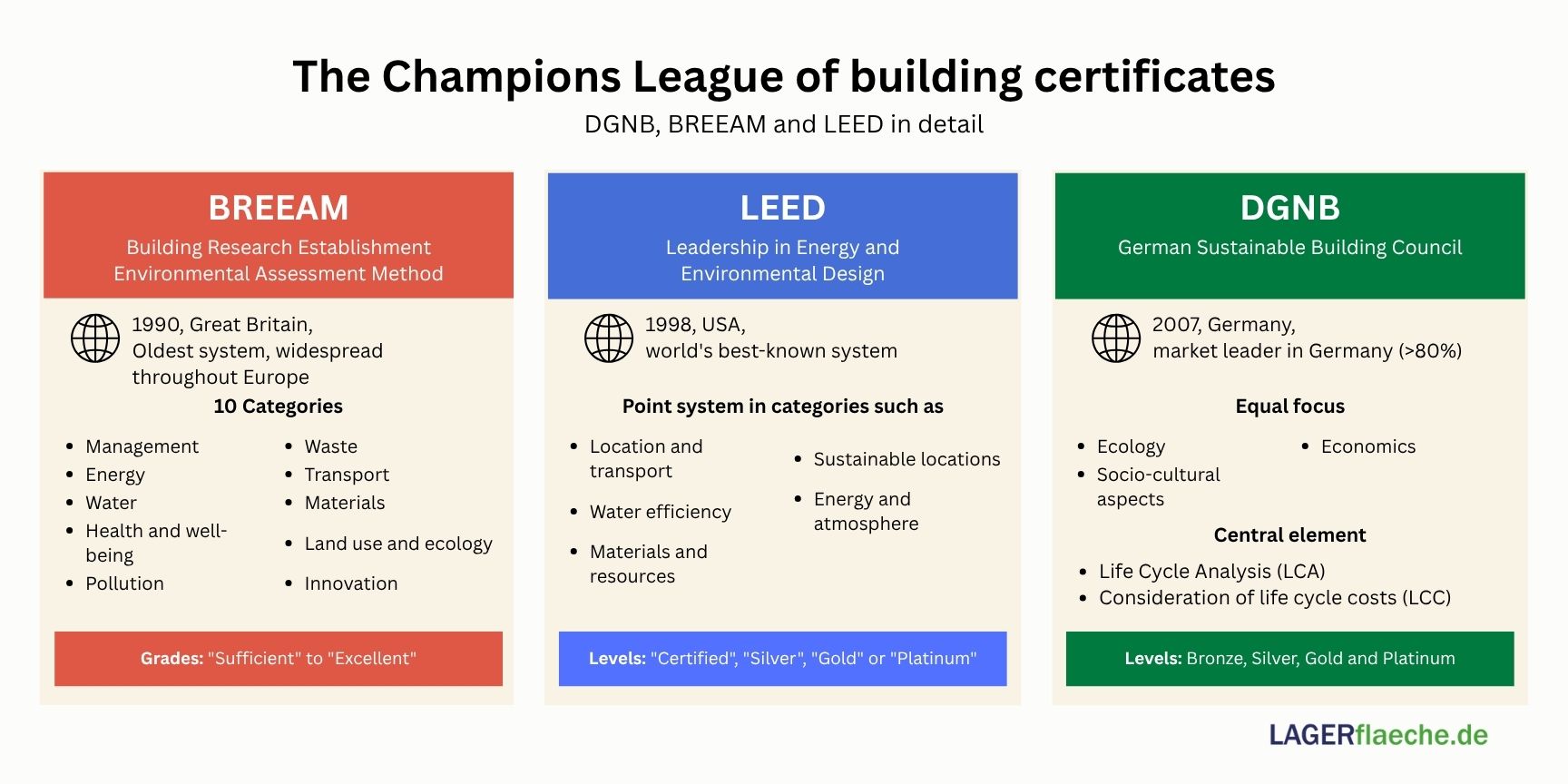
Essentially, the certificates for logistics real estate can be classified in the category of sustainability or green building certificates. They evaluate a building holistically over its entire life cycle. The three most prominent and oldest systems are BREEAM, LEED and DGNB.
- BREEAM (Building Research Establishment Environmental Assessment Method): As the oldest system, developed in the UK in 1990, BREEAM is widely used in Europe. It evaluates buildings in ten categories (Management, Health and Wellbeing, Energy, Transport, Water, Materials, Waste, Land Use and Ecology, Pollution, Innovation) and awards grades from "Sufficient" to "Outstanding".
- LEED (Leadership in Energy and Environmental Design): Launched in the USA in 1998 by the U.S. Green Building Council (USGBC), LEED is the world's best-known system. It is based on a points system in categories such as location and transportation, sustainable locations, water efficiency, energy and atmosphere, materials and resources, and indoor climate. The points achieved lead to the levels "Certified", "Silver", "Gold" or "Platinum".
- DGNB (German Sustainable Building Council): The DGNB system developed in Germany in 2007 is considered the second generation of certificates. It is the only system with an equal focus on ecology, economy and socio-cultural aspects. A central element is the life cycle analysis (LCA) and the consideration of life cycle costs (LCC). With a market share of over 80% in new-build commercial properties, DGNB is the undisputed market leader in Germany. The award levels are Bronze, Silver, Gold and Platinum.
Facts, figures, data
According to a 2023 analysis by BNP Paribas Real Estate, 19% of all green building certifications in Germany were in the logistics asset class. Of the total number of certified buildings in Germany, 1,760 bore the DGNB seal, 920 a BREEAM certificate and 540 were LEED certified. This underlines the dominance of the German system on the domestic market.
The path to the seal: How does certification work?
Certification is a structured process that ideally begins in the earliest planning phase of a construction project. The process is similar for the systems:
- Registration: The construction project is officially registered with the respective organization (DGNB, BRE, USGBC).
- Appointment of an auditor/assessor: A licensed auditor (DGNB) or assessor (BREEAM) is engaged. These independent experts advise the project team and verify compliance with the criteria.
- Definition of objectives and pre-assessment: Together with the auditor, the desired certification level (e.g. DGNB Gold) and the necessary measures are defined.
- Documentation and verification: During the entire planning and construction phase, the project team collects the necessary evidence (e.g. material passports, energy calculations, construction site documentation).
- Submission and compliance check: The auditor checks the documentation for completeness and accuracy and submits it to the certification organization.
- Certificate issuance: After successful examination, the official certificate is issued.
This process requires careful planning and coordination, but in return ensures high construction and process quality.
A matter for the federal states: Why certificates differ in Europe
The landscape of building certification is by no means homogeneous in Europe. The choice of system is strongly influenced by national conditions, legal regulations and market requirements.
- Germany: The DGNB system clearly dominates here. It is optimally aligned with German standards and building regulations, such as the Building Energy Act (GEG). The emphasis on profitability and life cycle costs accommodates the mentality of German investors and developers.
- UK & Netherlands: In these markets, BREEAM is the undisputed standard. Historically, the British system has become firmly established here and is often taken for granted by local investors and banks.
- France: The national label HQE (Haute Qualité Environnementale) sets the tone here. It is closely linked to French building legislation, in particular the new, strict RE2020 environmental regulation, which places a strong focus on CO2 emissions over the entire life cycle.
- Poland & Eastern Europe: In these emerging logistics markets, the picture is more mixed. International investors often bring BREEAM or LEED with them, with BREEAM often coming out on top due to its European roots. A 2020 study showed that out of 141 certified logistics facilities in Poland, 108 carried the BREEAM label.
- Asia: In markets such as China, a separate system, the "Three Star System", has been established, although international standards such as LEED also play a role in globally active companies. In Japan, systems such as CASBEE (Comprehensive Assessment System for Built Environment Efficiency) and BELS (Building-Housing Energy-efficiency Labeling System) are leading the way.
The reason for these differences lies in the different building cultures, the national legal requirements for energy efficiency and sustainability, and the preferences of local investor markets.
More than just a trophy: The most important awards in the logistics industry
In addition to the building-related certificates, there are renowned awards that honour outstanding projects or companies in contract logistics and supply chain. They honour innovation, efficiency and forward-looking concepts.
- German Logistics Award (BVL): Awarded by the German Logistics Association (BVL), this prize is considered the "Oscar of logistics" in Germany. It honors innovative logistics concepts that have been implemented in practice. The application process is demanding: After a written application with key figures and facts, the finalists are nominated by a jury and audited by a team of experts on site. The degree of innovation, the increase in efficiency and the transferability of the concept are evaluated.
- Best Logistics Brand: A readers' and experts' choice by the trade journal LOGISTIK HEUTE and BVL. In numerous categories – from "Logistics Real Estate Developer" to "IT for Warehouse Management" to "Contract Logistics Service Provider" – the strongest brands in the industry are chosen. This award is purely a popularity and brand award, but a strong barometer of the market's mood.
- Logix Award: This award, initiated by the "Initiative Logistikimmobilien", honors outstanding new-build logistics properties in Germany. In addition to economic efficiency and architecture, the jury primarily evaluates the aspects of sustainability and the well-being of employees.
- European Logistics Association (ELA) Award: This is one of the most prestigious awards at the European level. National logistics associations nominate their national award winners, who then compete for the title of "Project of the Year" in a kind of "Champions League". Criteria include innovation, sustainability, customer service and operational excellence.
The Reward for the Effort: Why Participation Really Pays Off
Investing in certificates and participating in competitions involves effort and costs. But the strategic benefit is immense and manifests itself on several levels:
- Objective proof of quality: Certificates provide transparent and internationally recognized confirmation of building and process quality.
- Increase in value and minimise risk: Certified buildings often generate higher rental income and sales prices. They are "more future-proof" against increasing regulatory requirements and are considered less risky investments. A survey by Savills in the Netherlands found that almost 90% of logistics users are willing to pay more rent for a certified building.
- ESG compliance: They are the easiest way to document compliance with ESG criteria to banks, investors, and the public.
- Employer branding: High-quality, certified buildings with a focus on health and well-being are a strong argument in the competition for skilled workers.
- Marketing and reputation: Awards such as the German Logistics Award generate enormous media attention and position a company as an innovation leader in its industry.
Conclusion: Excellence is not a coincidence, but the result of a process
In the modern logistics world, certificates and awards have become indispensable instruments for quality assurance, risk management and marketing. They create transparency, promote sustainable and economical solutions and highlight the pioneers of the industry. For developers looking to maximize the value of their properties, investors looking for safe and profitable investments, and logistics service providers looking to demonstrate operational excellence, exposure to these standards and awards is no longer an optional extra – it is a critical building block for long-term success.
Latest Blog Posts
Stay up to date with the newest trends, insights, and tips in warehouse and logistics. Our latest articles help you navigate the industry with confidence.

Data Centres vs. Logistics Facilities: The Race for Power and Land
Across Europe, logistics operators are competing for more than land and transport access. They increasingly need something much harder to secure: grid capacity. Data centres are intensifying that competition — and changing how logistics locations are evaluated....

Chinese companies discover Europe's logistics real estate
Chinese companies are becoming an increasingly visible user group in Europe's logistics real estate market. What does this mean for warehouse space, 3PL structures and the requirements for European logistics locations?...
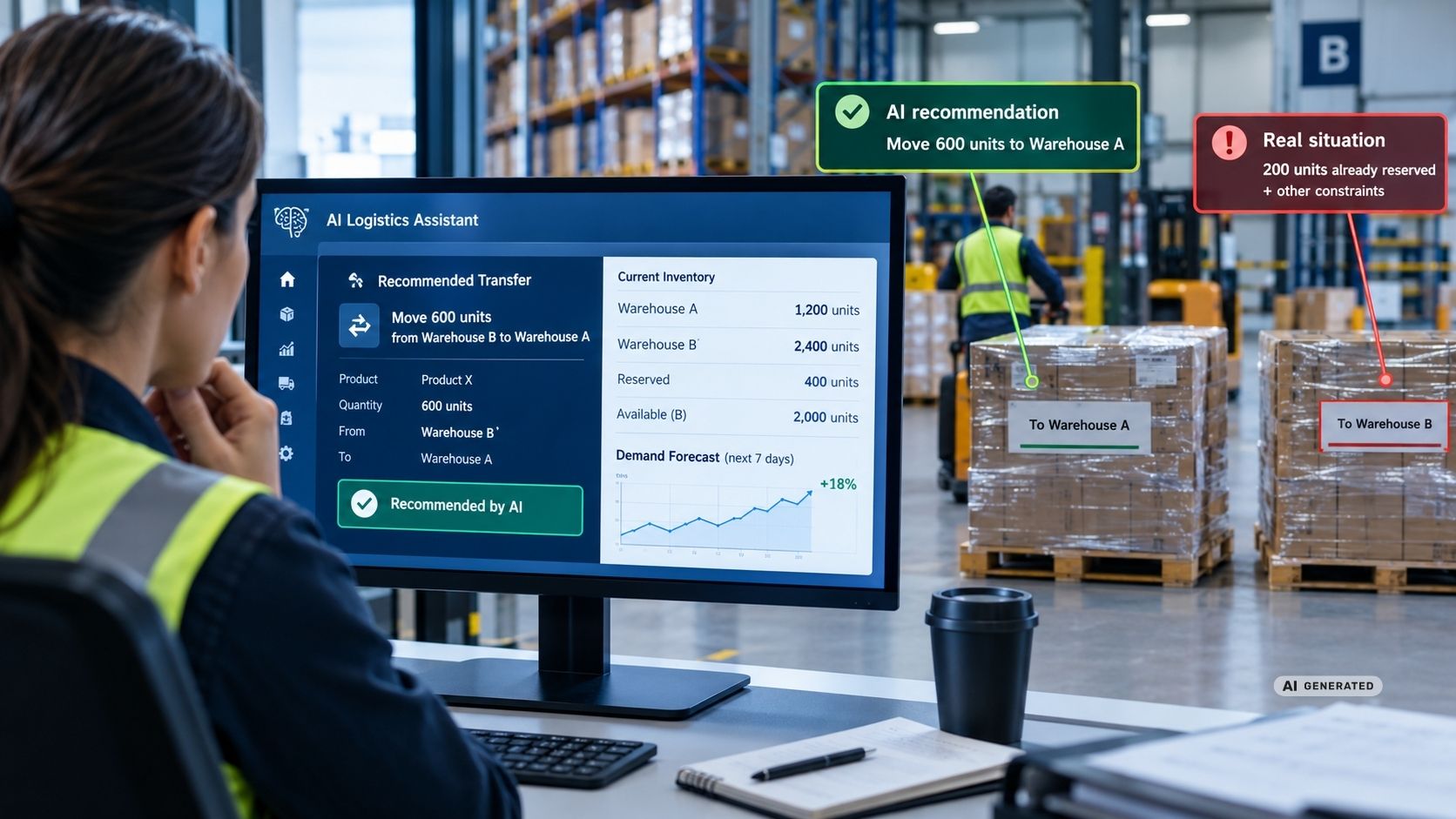
AI Hallucinations in Logistics: When AI Plans the Wrong Delivery
AI can analyze enormous amounts of logistics data — but it can also produce a convincing answer that is simply wrong. The critical question is not whether AI makes mistakes, but what happens when a wrong recommendation becomes an operational decision....
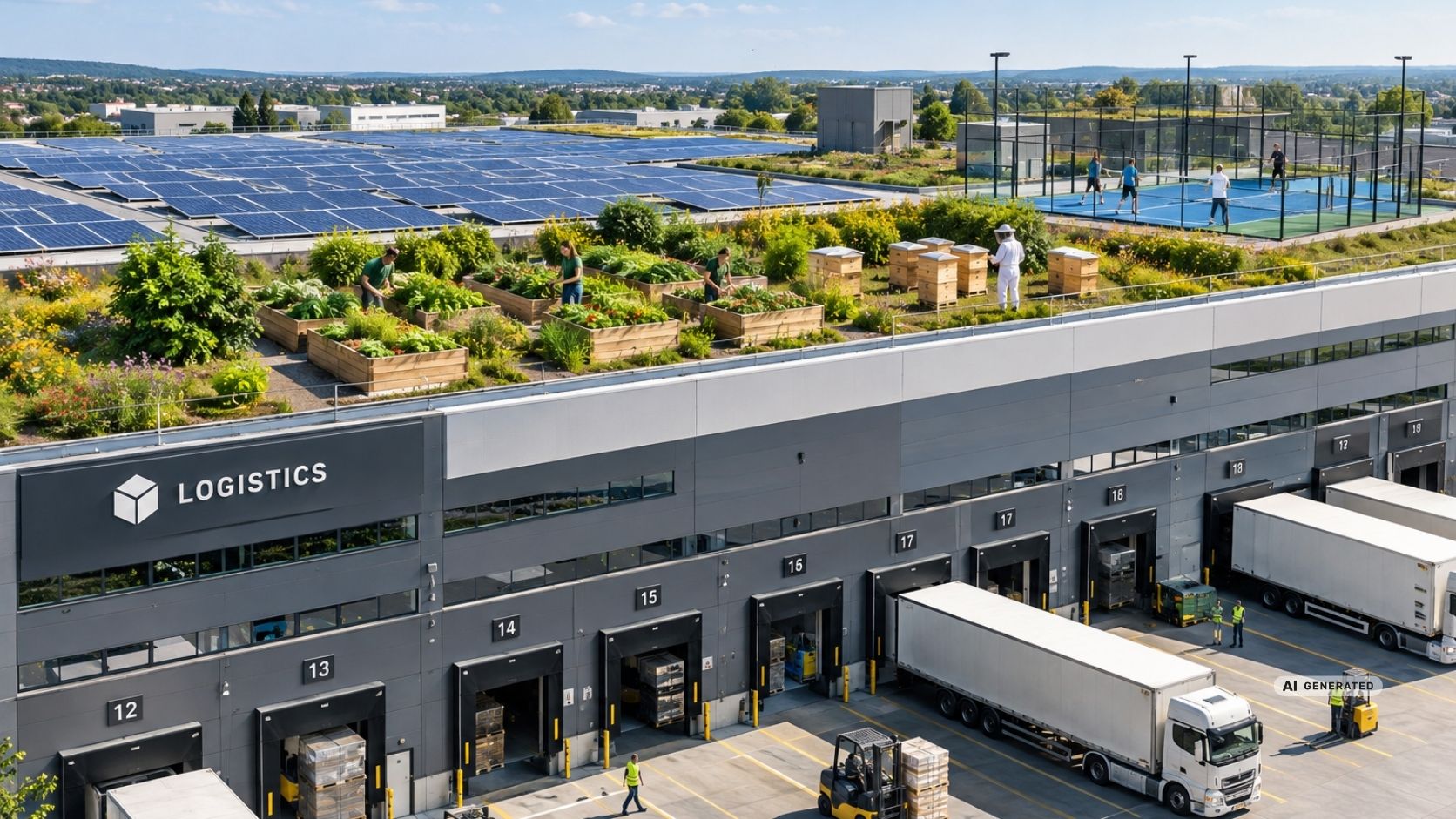
The Green Revolution on the Hall Roof: From Concrete Block to Ecological Power Plant?
Logistics roofs can do more than PV: greening, bees, urban farming and even sports areas turn unused roof space into multifunctional rooms....