




Time slot management in warehouse logistics
Table of contents
- Time slot management: The pacesetter of modern warehouse logistics
- Definition and strategic importance of the time window
- The technological basis: Time slot management systems (TSM)
- The structural component: logistics property and ramp design
- Time Window in Contract Logistics: Precision as a Competitive Advantage
- Profitability: Figures, data and the problem of "demurrage"
- FAQ: Practical questions about unloading at the hall
- Conclusion for practice
Time slot management: The pacesetter of modern warehouse logistics
In theory, logistics is a fluid process. In practice, it is often a fight against the clock on the ramp. The "time slot" describes the defined period of time in which a transport vehicle must appear at a logistics property for unloading or loading and is dispatched. What sounds simple is a highly complex control instrument in modern contract logistics.

Definition and strategic importance of the time window
A time slot is much more than just an appointment. It is the contractual and operational agreement between the warehouse operator and the carrier. The aim is to smooth incoming and outgoing goods (Heijunka principle) in order to avoid load peaks that could overwhelm staff or block the technology.
In warehouse logistics, the time window is used for capacity planning. Without control, 20 trucks would arrive at the same time on Monday morning, while the ramps are empty on Tuesday afternoon. The time window ensures an even utilization of resources (forklifts, gates, employees).
The technological basis: Time slot management systems (TSM)
A modern specialist portal must emphasise digitalisation: Manual Excel lists have long since been replaced by Time Slot Management Systems (TSM) in professional logistics. These cloud-based platforms allow freight forwarders to actively log into free slots.
- The advantage for the hall: transparency about the daily volume 24-48 hours in advance.
- Advantage for transport: Shorter downtimes and better planning of driving and rest times.
- Practical figure: The use of TSM systems can reduce waiting times at the ramp by an average of 20% to 35%.
The structural component: Logistics property and ramp design
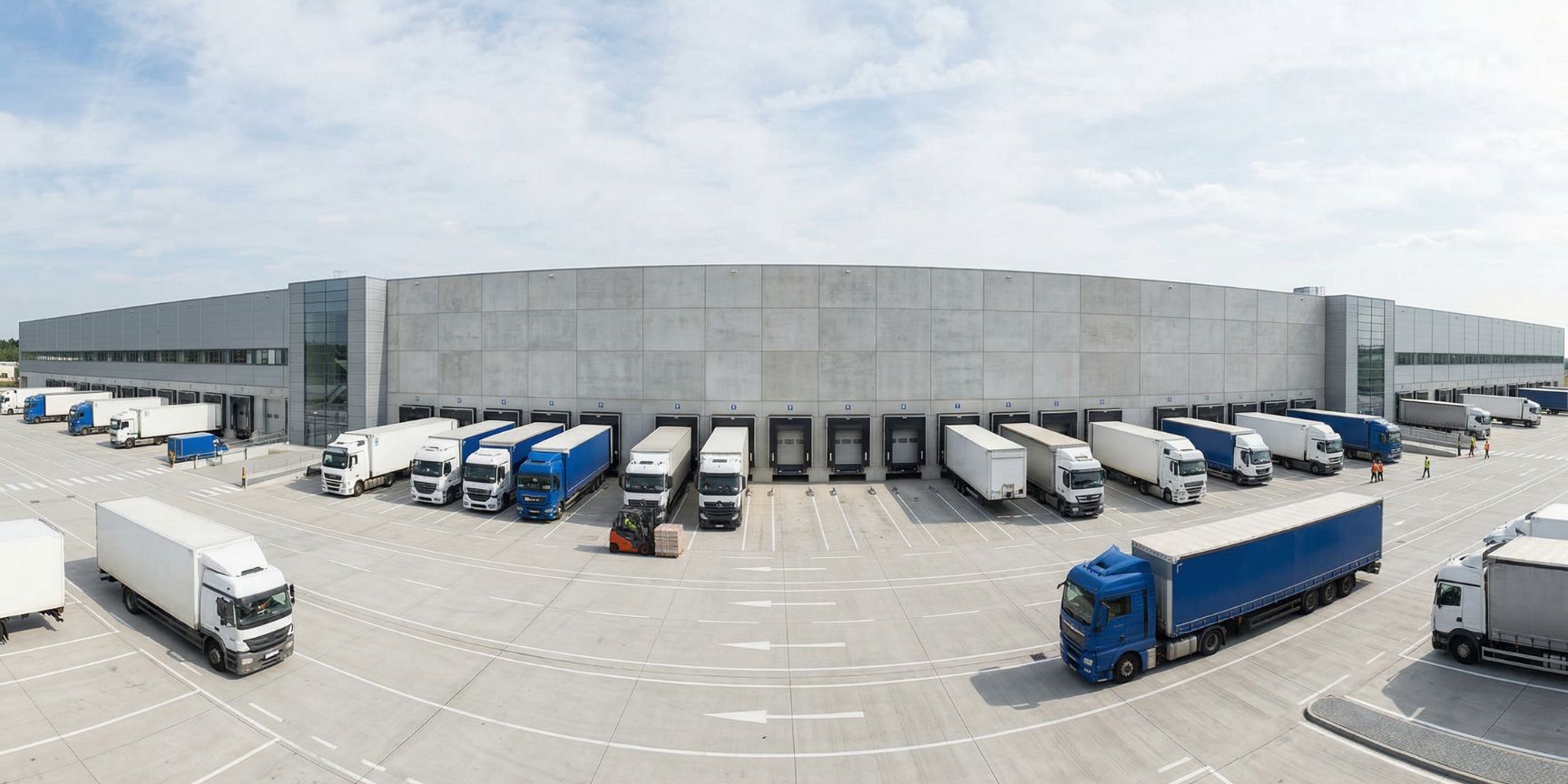
The quality of a time window begins with the architecture of the logistics property. A hall with too little manoeuvring space (yard) or an insufficient number of gates destroys any time window.
- Ramp rate: The rule of thumb in standard logistics is often one door per 500 to 800 m² of storage space. This figure is significantly higher for fast-moving consumer goods (FMCG) or cross-docking centers.
- Yard management: Before the truck drives up to the gate, it often has to go into a buffer zone. An efficient time slot model takes into account the time from "gate-in" (gate passage) to "docking" (ramping).
- Technical equipment: Dock levellers with feed and dock seals are standard, but affect the speed of unloading.
Time Window in Contract Logistics: Precision as a Competitive Advantage
In contract logistics, where service providers are often deeply integrated into their customers' production chains (e.g. automotive), the time window is sacrosanct. Here we often speak of just-in-time (JIT) or just-in-sequence (JIS) deliveries.
A missed time window of only 15 minutes can trigger a chain of recourse claims if the production line at the end customer comes to a standstill as a result. The time window is part of the Service Level Agreement (SLA) here. The depth of the issue is reflected in the penalization: If you miss your window, you lose your slot and are often only cleared at the end of the day or after rebooking.
Profitability: Figures, data and the problem of "demurrage"
Time is money in logistics. If a truck meets its time window, but the hall does not handle it, demurrage is incurred.
- Cost factor: Usual demurrage rates range between €50 and €100 per hour, depending on the vehicle type and contract.
- Unloading performance: An experienced team unloads a standard curtainsider (33 pallets) in approx. 30-45 minutes when unloading from the side. It often takes only 20 minutes via the ramp (rear unloading) with an electric pallet truck.
- Fact: Statistically speaking, truck drivers in Europe still spend approx. 20% of their working time with waiting – an enormous efficiency potential for optimized time windows.
FAQ: Practical questions about unloading at the hall
Question: What happens if a truck arrives outside the time window?
Answer: As a rule, the entitlement to immediate severance pay expires. The warehouse staff is legally and organisationally entitled to give preference to punctual vehicles. The delayed vehicle is "clocked in" as soon as a gap arises – which can often take hours.
Question: How big should a time slot be?
Answer: That depends on the turnover of goods. Standard slots are often 30, 45 or 60 minutes in size. It is important to allow for buffer times of around 10-15% in order to avoid chain reactions in the event of small delays.
Question: Who is liable for delays caused by the TSM?
Answer: This is often the subject of the ADSp (General German Freight Forwarders' Conditions). In principle, the ramp operator must provide the infrastructure in such a way that a booked slot can also be served. Documentation about the "time-stamp" (arrival/departure) is critical as evidence here.
Conclusion for practice
Effective time slot management is not an IT end in itself, but a necessity in order to optimally manage the scarce resource "ramp". For operators of logistics properties, this means ensuring that there is sufficient traffic space as early as the planning phase. For logisticians, it means promoting the discipline of partners through clear data and fair processes. If you analyze the data from your TSM system, you often find the biggest levers for cost reduction in the entire supply chain.