


Milk Run in Logistics
Table of contents
- 1. What Is a Milk Run? Definition and Basic Principle
- 2. External vs. Internal Milk Run in Practice
- 3. Importance for Warehouse Logistics: From Buffer Storage to Flow
- 4. Contract Logistics: Value-Added Services and Multi-User Control
- 5. Impact on the Logistics Property and Hall Architecture
- 6. Facts and Figures: The Measurable Benefit of the Milk Run Principle
- 7. Conclusion: The Milk Run as a Pacemaker Between Supply Chain and Hall
- 8. Frequently Asked Questions (FAQ) About the Milk Run
The milk run principle replaces uncoordinated single trips with scheduled round trips – find out how this proven supply concept reduces inventory, eases dock congestion and saves storage space in your logistics property.
At a time when storage space is scarce, land prices are high and supply chains are extremely sensitive, the timing of material flows determines the profitability of a site. A central instrument for avoiding inventory build-up and empty runs is the so-called milk run (German: Milchmann-Rundfahrt). Originally derived from classic milk delivery, where a van drops off full bottles in the morning and collects the empty ones at the same time, this principle has become a firm standard in modern production, warehouse and contract logistics.
1. What Is a Milk Run? Definition and Basic Principle
A milk run is a cyclical, demand-oriented transport and supply concept in which a means of transport (a truck on the road or a tugger train in the hall) calls at several sources (suppliers or warehouse zones) and sinks (production lines or customers) on a closed round trip according to a fixed schedule.
Instead of triggering a separate, often only partly loaded transport for every need, the milk run bundles small quantities of different goods. The decisive feature is the dual function: at every stop, the required material is delivered and, on the same trip, empties (returnable packaging, small load carriers, pallets) or returns are collected. This noticeably reduces empty runs and stabilises the material flow.
2. External vs. Internal Milk Run in Practice
In logistics practice, the concept is used on two levels that interlock seamlessly:
- External milk run (procurement and distribution logistics): A truck follows a fixed route to several suppliers in a region, collects part loads (LTL) and delivers them bundled to a central warehouse or production plant (area forwarder concept).
- Internal milk run (intralogistics): Within a logistics hall or plant site, a tugger train (a tow tractor with several trailers) supplies various assembly or packing stations from a central supermarket store on a fixed schedule. Typical intervals are 30 minutes for high-frequency assembly supply and 60 to 120 minutes for medium demand (Source: industrie-fachwissen.de, tugger trains in lean production – in German).
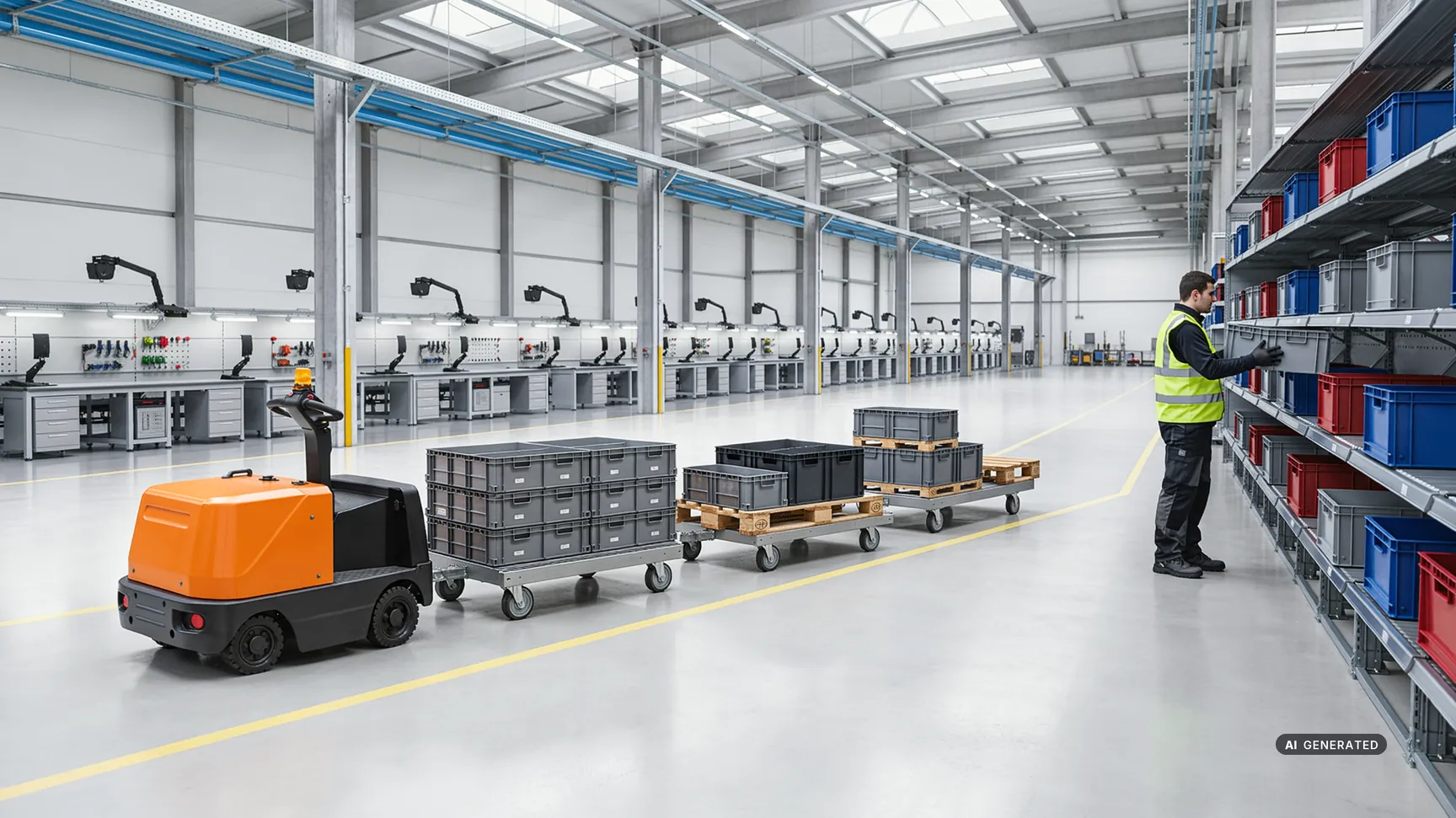
The tugger train as an internal milk run: a tow tractor supplies several stations on a fixed schedule and takes empties back on the same trip. This requires wide, intersection-free and level routes.
How warehouse logistics, intralogistics and transport logistics work together is explained in the blog post Understanding Logistics: How Warehouse, Intralogistics, and Transport Work Together.
3. Importance for Warehouse Logistics: From Buffer Storage to Flow
For classic warehouse logistics, introducing a milk run system means a paradigm shift. Without scheduled round trips, companies have to hold high safety stocks to cushion irregular truck deliveries.
With a milk run, the average storage time can fall considerably. Instead of large pallet quantities, exactly the quantities needed in the next time window are delivered (just-in-time / just-in-sequence). In goods receipt, the inspection and put-away effort is reduced because the shipments arrive pre-sorted and on standardised load carriers. As a rule, this means lower capital tied up in stock and relief for the warehouse management system (WMS).
4. Contract Logistics: Value-Added Services and Multi-User Control
For contract logistics providers (3PL), the milk run is a strategic tool for running complex outsourcing projects for industrial and retail companies economically. Service providers often operate so-called consolidation centres (cross-docks) near large production plants.
Here, the contract logistics provider bundles the inbound flows of various suppliers, takes on value-added services (VAS) such as quality checks, repacking, sequencing and kitting, and then organises the scheduled milk run directly to the customer's assembly line. In multi-user warehouses, this system also allows exact timing of dock occupancy, which helps to smooth staff peaks in goods receipt and goods issue.
5. Impact on the Logistics Property and Hall Architecture
A consistent milk run concept noticeably changes the structural requirements of a logistics property – a decisive factor in new development (greenfield) or when leasing existing space (brownfield):
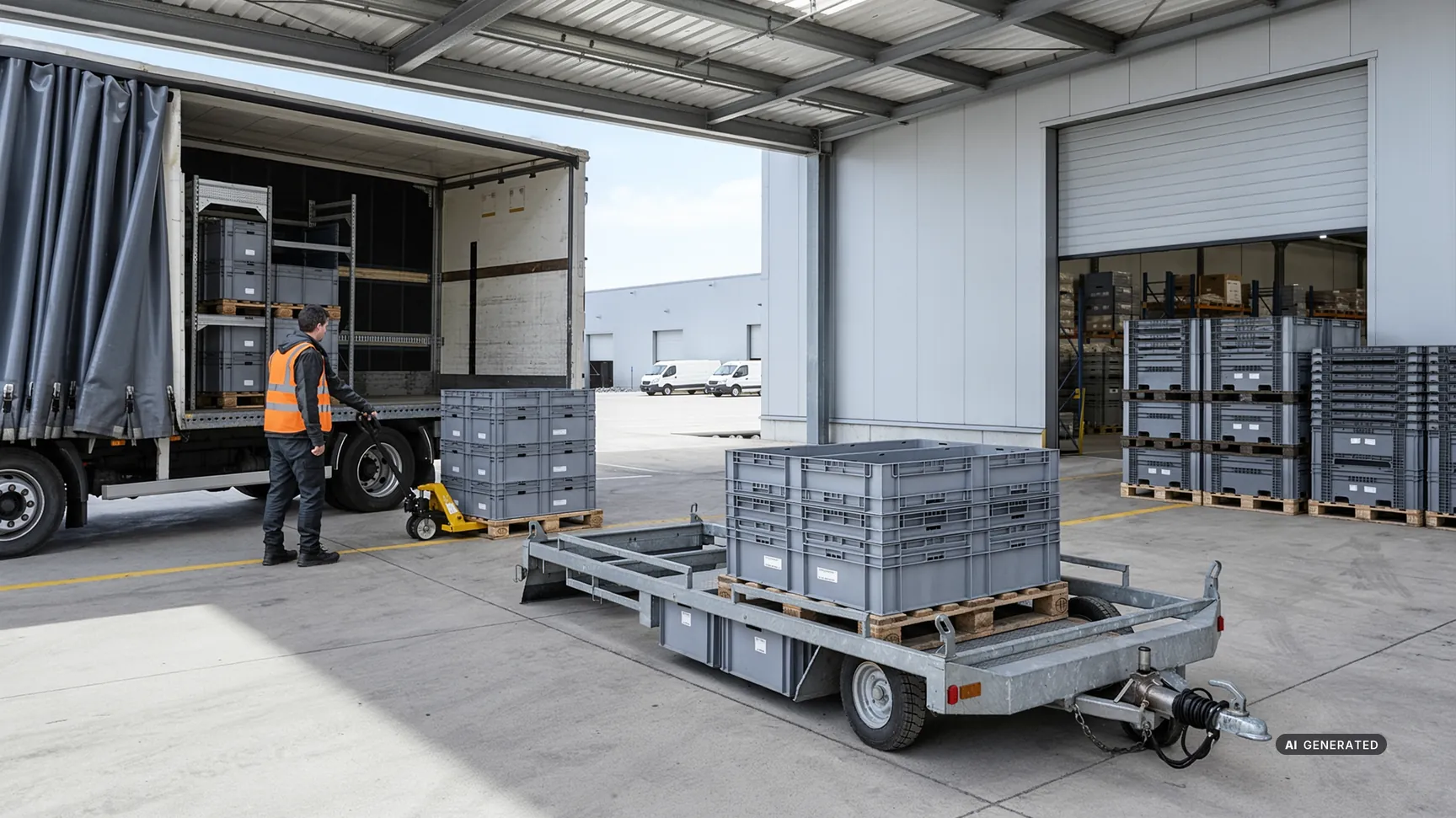
The external milk run arrives in its time slot: under the canopy, containers are unloaded from the side and empties are taken back on the spot, without a queue in the yard.
- Less storage space, more transshipment space: As safety stocks shrink, less classic high-bay racking area is needed. In return, the requirements for generous staging zones (provision and sequencing areas) and supermarket racks for fast access increase.
- Dock and yard design: With an external milk run, vehicles arrive exactly in their time slot (time slot management). Instead of countless waiting parking spaces in the yard, ground-level access (for fast side unloading of tugger train trailers) and covered loading and unloading zones (canopies) are in demand.
- Floor quality and route layout: Internal tugger trains and automated guided vehicles (AGV/AMR) require wide, intersection-free routes (one-way systems) and load-bearing, level industrial floors. The load capacity depends on the total train weight and axle loads and is agreed in advance with the manufacturer and the floor planner; flatness tolerances are based on DIN 18202, and stricter requirements often apply to AGV/AMR. Poor floors increase the risk of tipping and wear on the running gear (Source: DGUV Information 208-057, October 2020 – in German).
What uncoordinated deliveries and waiting times at the dock cost is shown in the blog post The Billion-Dollar Grave: Why Waiting Is the Biggest Unsolved Problem in Logistics. What matters for the load capacity and flatness of hall floors is described in the blog post The invisible hero of logistics: Why the hall floor determines success or failure.
6. Facts and Figures: The Measurable Benefit of the Milk Run Principle
Reliable figures on the milk run come mostly from industrial projects and practice reports. They are guide values, not guarantees, and depend heavily on the starting situation, route density and volume stability:
- Around 20 to 30% lower transport costs: By bundling part loads and avoiding empty runs, transport costs in industrial projects fell by about 30% on average through utilisation-oriented milk run planning (Source: TCW, Wildemann/Niemeyer, The milk run concept, 2004 – in German). At one automotive company, the average savings potential was 26%, and 58% for individual milk runs (Source: TCW Standpunkt No. XXIII, 2005 – in German). FLEXUS gives around 20% as an average when switching from non-optimised transport systems (Source: FLEXUS, milk run glossary – in German).
- 60–70% to around 90% utilisation: Standard truck tours are on average 60 to 70% utilised. With carefully planned milk run tours and constant transport volumes, an average utilisation of about 90% can be reached (Source: TCW, Wildemann/Niemeyer, The milk run concept, 2004 – in German).
- Less buffer space at the workstation: Shorter replenishment cycles reduce the number of containers at the supply points and thus the space required in production and logistics halls (Source: CIRP Annals 2020, In-plant milk-run design method). There is no reliable flat-rate figure for the space saving; it depends on cycle time, number of containers and layout.
- Lower emissions – with good utilisation: Fewer truck kilometres and electric tugger trains in the hall can reduce Scope 3 emissions and contribute to the ESG balance of the logistics property. However, the effect only occurs if the trains run fully loaded and on demand (Source: INDUSTRIAL Production, tugger train systems – Milkrun Goes Green – in German).
7. Conclusion: The Milk Run as a Pacemaker Between Supply Chain and Hall
The milk run replaces many individual transports with one scheduled round trip including the return of empties. It reduces inventory and empty runs, but requires route planning, time slots and hall layout to work together. Those who plan staging zones, docks and routes accordingly use space better and make the hall the pacemaker of supply.
8. Frequently Asked Questions (FAQ) About the Milk Run
Question: What is the difference between a milk run and classic cross-docking?
Answer: In cross-docking, goods are transshipped in a transshipment warehouse and forwarded immediately without storage. The milk run, by contrast, describes the transport system (the scheduled round trip with simultaneous return of empties). The two concepts often complement each other when a cross-dock serves as the start and end point for external milk run tours.
Question: When does it pay to introduce a milk run system?
Answer: A milk run is usually economical when several sources or sinks have to be supplied regularly (typically daily or several times per shift) with small to medium quantities that would not fill a full truck or forklift transport on their own.
Question: Which load carriers are best suited for milk runs?
Answer: Standardised, stackable and easy-to-handle containers such as small load carriers (KLT), wire-mesh boxes, roll containers or standardised Euro pallets are ideal because they allow fast loading and unloading at every stop and smooth collection of empties.
Question: How is a milk run controlled by IT?
Answer: Modern milk runs are controlled via a transport management system (TMS) for external tours and a warehouse management system (WMS) for internal tugger trains. Electronic Kanban signals (e-Kanban) or sensors on the racks can trigger replenishment automatically in the next cycle.
Question: What risks does the milk run principle involve?
Answer: Because buffer stocks are deliberately reduced, the system is sensitive to disruptions (e.g. traffic jams on the motorway, vehicle breakdowns or strikes). Precise route planning, buffer times in the schedule and digital real-time tracking (yard management) are therefore indispensable.
Question: Can milk runs in the hall also be automated?
Answer: Yes. In modern logistics properties, automated guided vehicles (AGVs) and autonomous mobile robots (AMRs) with automatic load transfer increasingly take over the role of classic manned tugger trains.
Your Ideal Logistics Warehouse
Browse listings for warehouse space, logistics real estate, industrial land, and contract logistics solutions.
Browse Exposés
Maximize Exposure for Your Warehouse Space
Showcase your logistics properties and attract qualified inquiries.
Discover Products