




Inventory Management at a Glance
Table of contents
- 1. What is inventory management? Definition, distinction and tasks
- 2. Replenishment methods: reorder point, fixed review period and ABC/XYZ matrix
- 3. Safety stock, service level and working capital: the key figures
- 4. Inventory management in contract logistics: the 3PL’s responsibility
- 5. Inventory management and logistics real estate: stock determines space
- 6. Frequently asked questions (FAQ) on inventory management
Inventory management controls which goods are available in what quantity, at what time and in which storage location – and so determines delivery capability, tied-up capital and the space needed in the warehouse. This overview explains the key replenishment methods, the formulas for reorder point and safety stock, service level, the ABC/XYZ matrix and the role of contract logistics providers and VMI.
1. What is inventory management? Definition, distinction and tasks
Inventory management covers all decisions and processes a company uses to plan, replenish, book and physically store raw materials, semi-finished and finished goods. It links procurement, intralogistics and distribution. While inventory controlling analyses, values and budgets stock in retrospect, inventory management steers the daily flow of goods – when, how much and where to replenish.
Its core tasks include:
- Replenishment planning: calculating and triggering purchase or production orders based on consumption, forecasts and lead time. In manufacturing this is often system-driven via MRP (material requirements planning).
- Stock recording: complete, ideally paperless recording of all receipts, transfers and issues via barcode, 2D or RFID scans in a warehouse management system (WMS).
- Maintaining planning parameters: regularly adjusting safety stock, reorder point, minimum and maximum stock to actual demand and changing lead times.
- Batch and expiry management: applying picking principles such as FIFO or FEFO, especially for food and healthcare products.
- Securing inventory accuracy: reconciling system stock with physical stock through perpetual or periodic stocktaking.
Which quantities count as inventory in the first place and how they are valued is explained in the guide Inventory in logistics. This page focuses on control.
2. Replenishment methods: reorder point, fixed review period and ABC/XYZ matrix
To avoid both stock-outs and overstock, companies use two basic methods that can be combined by item class.
Reorder point method
As soon as the available stock (physical stock plus open orders) reaches or falls below the reorder point, an order is triggered. The reorder point is calculated as follows:
Reorder point = average daily consumption × lead time (in days) + safety stock
Worked example: an item is picked 40 times a day on average, the lead time is 5 days and the safety stock is 44 units (see chapter 3). This gives 40 × 5 + 44 = 244 units. When available stock drops to 244 units, a reorder is placed; the safety stock buffers demand peaks and supplier delays during the lead time.
Fixed review period method
Here stock is reviewed and ordered at fixed intervals (for example weekly). The order quantity tops stock up to a target (maximum) level:
Order quantity = target stock − available stock − open orders
The target stock must cover demand for the review interval plus the lead time, plus safety stock. The method suits items ordered together from one supplier or delivered on fixed routes.
ABC/XYZ matrix: which method for which item?
The ABC analysis ranks items by their share of consumption value (A = high, C = low share). XYZ analysis ranks them by how regular consumption is, measured for example by the coefficient of variation (standard deviation ÷ mean): X = steady, Y = fluctuating, Z = sporadic. Each company sets its own class limits. Combined, this gives nine fields; the four corners show the logic:
- AX – high value, steady demand: replenish in sync with demand and at short intervals, low safety stock, well suited to Kanban or automatic order proposals.
- AZ – high value, sporadic demand: procure order-related wherever possible and monitor stock closely; high safety stock would be particularly expensive here.
- CX – low value, steady demand: automate the reorder point method with larger lot sizes; planning effort should be minimal.
- CZ – low value, sporadic demand: plan in a simplified way, for example with a more generous buffer or order-related; check regularly for slow movers.
3. Safety stock, service level and working capital: the key figures

In inventory management, safety stock and service level determine how reliably a warehouse can deliver and how much capital is tied up in stock.
Service level
The service level describes delivery readiness from stock. Two definitions are common:
- α service level (event-based): probability that no stock-out occurs during a replenishment cycle.
- β service level (quantity-based): share of demand quantity that can be delivered directly from stock (fill rate).
The right target depends on item class, customer expectations and the cost of a stock-out – there is no cross-industry standard value.
Safety stock: formula and worked example
For normally distributed, independent daily demand and a constant lead time, the α service level gives:
Safety stock = z × σday × √lead time
Here σday is the standard deviation of daily demand and z is the safety factor of the standard normal distribution: about 1.65 for 95%, 2.05 for 98%, 2.58 for 99.5% and 3.09 for 99.9%.
Worked example: σday = 12 units, lead time 5 days (√5 ≈ 2.24):
- 95%: 1.65 × 12 × 2.24 ≈ 44 units
- 98%: 2.05 × 12 × 2.24 ≈ 55 units
- 99.5%: 2.58 × 12 × 2.24 ≈ 69 units
- 99.9%: 3.09 × 12 × 2.24 ≈ 83 units
Moving from 95% to 99.5% therefore raises safety stock by about 56%, from 98% to 99.5% by about 26% – not a doubling, but a disproportionate increase that gets steeper with every further tenth of a percent. If lead time also varies, the formula must be extended to include that variation. How companies strategically increase safety stock in uncertain supply chains is covered in the guide Just-in-Case.
Inventory carrying cost rate
The carrying cost rate expresses what holding stock costs per year, relative to average inventory value. It includes capital costs, space and handling, insurance, shrinkage and obsolescence. Literature and systems mostly quote values between 15 and 25% (Source: cdb consulting, guide to the inventory carrying cost rate (German)). The range is useful as a plausibility check; for decisions, companies should derive their own rate. The guide Storage costs in logistics explains the cost types in detail.
Working capital
Working capital is current assets minus current liabilities. In operational terms (net working capital) it is usually calculated as inventories + trade receivables − trade payables. Every euro by which stock falls without hurting delivery capability frees up liquidity. Worked example: if average inventory value falls by €200,000, carrying costs at a rate of 20% drop by €40,000 per year. In addition, inventory coverage shows how many days current stock covers demand.
Inventory accuracy
All formulas assume that system stock is correct. A widely cited retail study shows how large the problem can be: of around 370,000 inventory records examined in 37 stores of one retailer, 65% were inaccurate (Source: DeHoratius/Raman, “Inventory Record Inaccuracy: An Empirical Analysis”, Management Science 2008). The figures cannot be transferred directly to warehouses with strict scanning – but the study shows how quickly planning ends up built on wrong data. How to avoid inventory discrepancies systematically is described in the blog post Inventory 2025: your path to strategic inventory quality.
4. Inventory management in contract logistics: the 3PL’s responsibility
When a company outsources to a contract logistics provider (3PL), responsibility for stock is shared: the provider manages stock quantities and physical handling, while ownership, valuation and usually replenishment planning remain with the client. Under German law this is generally a warehousing contract in which the warehouse keeper undertakes to store and keep the goods (Source: Section 467 German Commercial Code (HGB, German)); liability and inventory discrepancies are governed by the individual contract and agreed terms and conditions.
For replenishment to rely on accurate data, the following points should be settled contractually and technically:
- Leading system and reconciliation: Which system is authoritative – the provider’s WMS or the client’s ERP? How often is stock reconciled via the interface, and who resolves discrepancies?
- SLA metrics for inventory quality: for example inventory accuracy per storage location, put-away deadlines after goods receipt and notification duties when the reorder point is reached or stock is blocked.
- Stocktaking and discrepancies: stocktaking method (perpetual or periodic), client participation, tolerances and who bears shrinkage and shortages. Systematic gaps between book and physical stock are covered in the guide on phantom stock.
- Vendor Managed Inventory (VMI): With VMI the supplier takes over replenishment of stock at the customer based on consumption and stock data, usually within agreed minimum and maximum levels. The contract logistics provider supplies the stock data and executes the replenishment orders operationally. VMI is often combined with consignment stock, where goods remain the supplier’s property until withdrawn.
- Usage-based billing: With pay-per-pallet or pay-per-pick, the client pays for occupied pallet spaces and movements. Fluctuating stock thus becomes a variable cost – but minimum occupancy and peak surcharges should be checked carefully, see warehouse contracts: fixed rent, flex model or pay-per-pallet.
5. Inventory management and logistics real estate: stock determines space

Good inventory management reduces both tied-up capital and space needs, because every surplus pallet occupies warehouse space that must be paid for.
Every pallet that stays in the warehouse longer than necessary occupies a pallet space – and thus warehouse space that has to be paid for. Better-planned stock therefore reduces not only tied-up capital but also space requirements, and can defer investment in additional halls. How a warehouse’s total area is made up and which share is actually usable for storage is explained in the guide on gross storage space.
In terms of height, modern logistics buildings usually offer 10 to 12 m clear height under the trusses (Source: LÈMANS glossary on clear height (UKB, German)); this height can only be used economically with a properly planned racking and stock concept.
Within the warehouse, stock placement determines travel: in practice, 40 to 60% of order picking time is travel time (Source: bwl-lexikon.de, order picking times (German)). Fast movers therefore belong close to picking zones and goods-out, slow movers in reserve areas.
6. Frequently asked questions (FAQ) on inventory management
Question: What is the difference between inventory management and inventory controlling?
Answer: Inventory management is operational: it plans replenishment, books stock and handles put-away and picking. Inventory controlling analyses stock from a business perspective, values it, sets targets and monitors KPIs such as coverage, turnover rate and tied-up capital.
Question: How does a WMS prevent phantom stock?
Answer: Phantom stock means quantities recorded in the system that do not physically exist. A WMS reduces it through mandatory scanning at every storage location, plausibility checks during picking and perpetual stocktaking, for example whenever a location reaches zero.
Question: What role does artificial intelligence play in replenishment planning?
Answer: AI models analyse sales data, lead times, seasonality and other drivers, improving the demand forecast from which safety stock and reorder points are derived. McKinsey puts the potential for distributors at 20 to 30% less inventory (Source: McKinsey, “Harnessing the power of AI in distribution operations”, 2024); this is a consultancy estimate, not a guaranteed effect. More in the blog post How AI is transforming warehouse logistics and the supply chain.
Question: How does better inventory management affect warehouse operations?
Answer: Less overstock means free pallet spaces, fewer relocations and shorter travel when fast movers sit in zones close to goods-out. This relieves forklifts and loading docks and can defer or avoid renting additional space.
Question: What is the optimal level of safety stock?
Answer: There is no fixed value. Safety stock follows from demand variability during the lead time and the target service level. With the formula z × σday × √lead time it can be calculated per item and should be reviewed regularly.
Question: Why do growing retailers outsource inventory management to a contract logistics provider?
Answer: Investment in their own halls, racking and conveyor technology (CAPEX) is no longer needed; billing is usage-based as an operating expense (OPEX). Fluctuating stock can be handled flexibly via pay-per-pallet models, while the provider supplies staff, WMS and processes.
Question: How does location affect inventory management?
Answer: The closer a warehouse is to customers and efficient transport hubs, the shorter transport and replenishment lead times are. According to the formula, shorter lead times directly reduce the safety stock required, because demand variability has to be covered over fewer days.
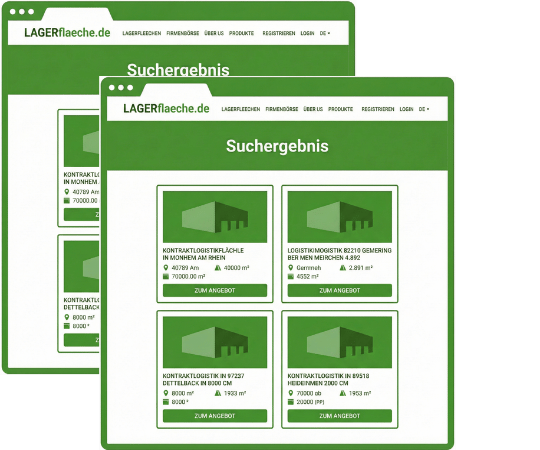
Your Ideal Logistics Warehouse
Browse listings for warehouse space, logistics real estate, industrial land, and contract logistics solutions.
Browse Exposés
Maximize Exposure for Your Warehouse Space
Showcase your logistics properties and attract qualified inquiries.
Discover Products