



Incoterms in Logistics
Table of contents
- 1. Fundamentals: How Incoterms Control the Physical Flow of Materials
- 2. Focus on Warehouse Logistics: Avoiding Liability Traps at the Loading Dock
- 3. Contract Logistics Perspective: Interfaces, Customs Clearance and SLAs
- 4. Impact on the Logistics Property: Hall Layout and Construction Requirements
- 5. Facts and Figures: Incoterms in Logistics Practice
- 6. Conclusion: Incoterms as the Interface between Contract, Warehouse and Building
- 7. Frequently Asked Questions (FAQ) about Incoterms in Logistics
International trade terms determine far more than the transport route – they control the entire physical flow of goods, the transfer of liability at the loading dock and the spatial requirements of modern logistics properties.
In global trade, the Incoterms (International Commercial Terms) of the International Chamber of Commerce (ICC) have defined since 1936 which obligations, costs and risks buyers and sellers bear when goods are transported. The current version (Incoterms 2020) comprises a total of 11 rules, divided into 7 multimodal rules (for all modes of transport) and 4 rules for sea and inland waterway transport only. While purchasing and sales often view these abbreviations primarily from a contractual perspective, they have their most profound effect directly at the loading dock of the logistics hall. The customs process itself – declaration, customs procedures and fees – is a topic of its own; this article is about what the rules mean for the dock, warehouse processes and the building.
1. Fundamentals: How Incoterms Control the Physical Flow of Materials
Each Incoterms rule determines two decisive points: the transfer of costs and the transfer of risk (the risk of loss of or damage to the goods). For operational warehouse logistics, this means a clear separation of responsibilities in goods receipt and goods issue:
- Collection term (E term – EXW): Under Ex Works, the seller’s obligation already ends once the packed goods are made available on its own premises. Loading the collecting truck legally lies at the buyer’s risk.
- Main carriage not paid (F terms – FCA, FAS, FOB): Under Free Carrier, the seller – if the place of delivery is on its own premises – is responsible for loading onto the means of transport provided by the buyer and for export clearance.
- Main carriage paid (C terms – CPT, CIP, CFR, CIF): The seller arranges and pays for the main carriage, but the risk already passes earlier: under CPT and CIP on handover to the first carrier, under CFR and CIF when the goods are loaded on board the vessel.
- Arrival terms (D terms – DAP, DPU, DDP): Here the seller bears costs and risk up to the agreed place of destination (e.g. the buyer’s warehouse). Delivered Duty Paid (DDP) is particularly demanding, as the seller also handles import customs clearance and local taxes in the country of destination.
2. Focus on Warehouse Logistics: Avoiding Liability Traps at the Loading Dock
In day-to-day intralogistics, Incoterms that are not applied correctly regularly lead to insurance gaps and operational congestion. A classic example is the difference between EXW and FCA: in practice, the seller’s warehouse staff often load the buyer’s truck as a courtesy or to save time, even though EXW was agreed in the sales contract. If a pallet falls off the dock leveller in the process, the question of liability is disputed: formally, the buyer bears the risk, but in practice disputes and coverage gaps loom because the seller carried out the loading. The ICC therefore recommends agreeing the loading risk in advance or choosing FCA (Source: ICC Academy, FCA & EXW Incoterms® 2020 explained). FCA (Free Carrier) is therefore regarded by logistics experts as considerably more practical for road transport, as for delivery at the seller’s premises loading is clearly assigned to the seller.
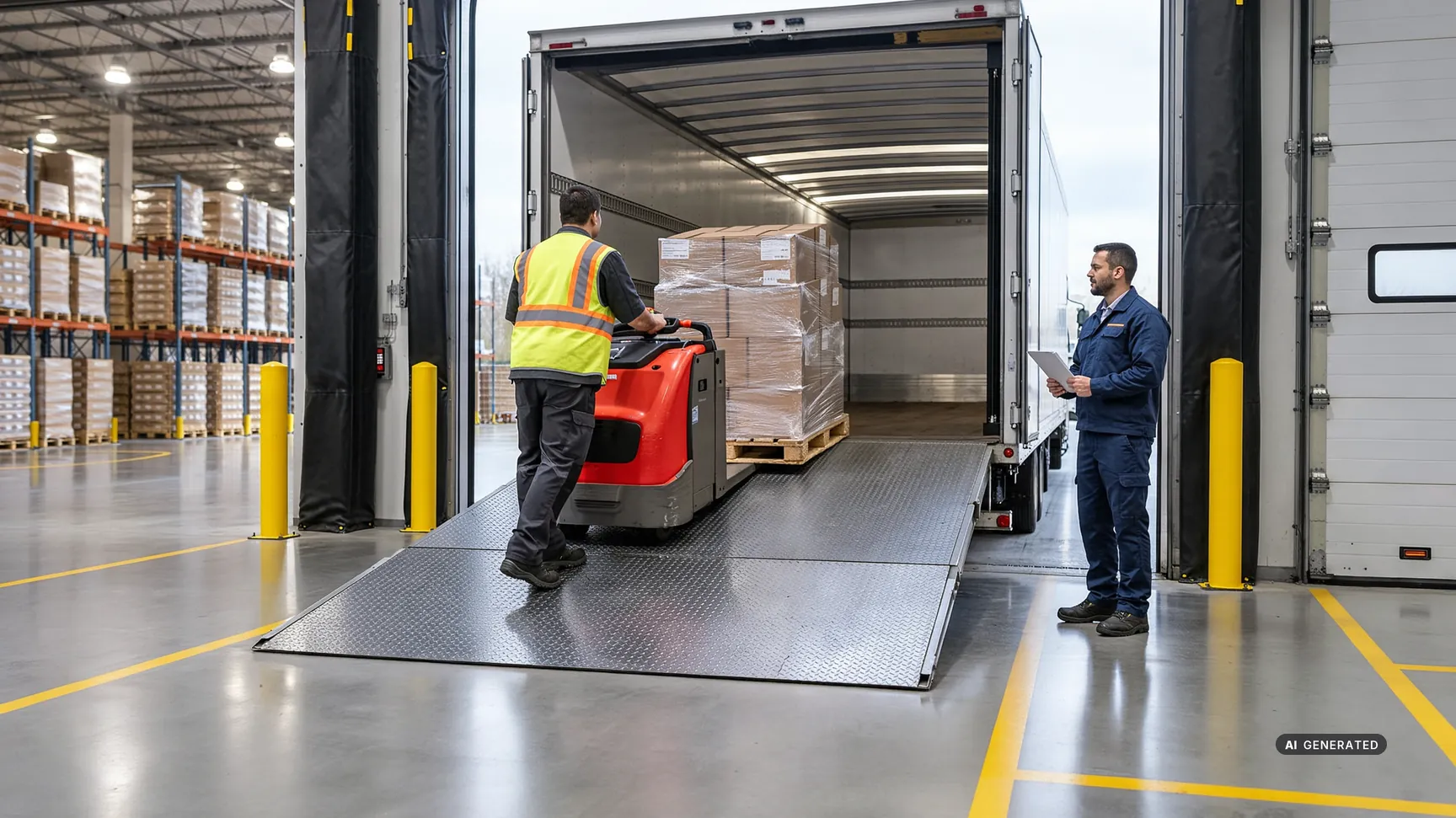
Who is liable during loading? The Incoterm governs the transfer of costs and risk at the dock: under FCA, loading at the seller's premises clearly rests with the seller, whereas under EXW it should be agreed in the contract beforehand.
In addition, the DPU (Delivered at Place Unloaded) rule significantly affects resource planning in goods receipt: here the seller owes not only delivery to the dock but also the physical unloading of the goods in the destination hall.
3. Contract Logistics Perspective: Interfaces, Customs Clearance and SLAs
For contract logistics providers (3PL), Incoterms form the foundation for designing service level agreements (SLAs) and billing models:
- Customs clearance and fiscal representation: If a contract logistics provider acts as a fulfilment partner for international retailers (e.g. in cross-border e-commerce under DDP terms), it often takes over the customs declaration, the management of bonded warehouses and the handling of import VAT.
- Value added services (VAS): Depending on the rule, it varies who provides the export and import documents, export packaging and freight documents – and this is reflected in the scope of services in the logistics contract. While under EXW the work often consists only of picking and staging in the shipping zone, under C and D terms the provider often also takes on transport management, export packaging and the preparation of certificates of origin and freight documents, depending on the contract.
- Documentation requirements: Particularly with FCA in sea freight (a new feature of Incoterms 2020), the parties can agree that the buyer instructs its carrier to issue an on-board bill of lading to the seller after loading, which is essential for letter-of-credit transactions and for the release of payment.
How the EU Customs Data Hub will digitally change customs clearance for logistics providers and freight forwarders is described in the blog article The Customs Revolution: Why the EU Customs Data Hub Is Changing the Logistics World Forever.
4. Impact on the Logistics Property: Hall Layout and Construction Requirements
The trade terms chosen have a direct effect on space planning and the structural equipment of a logistics property:
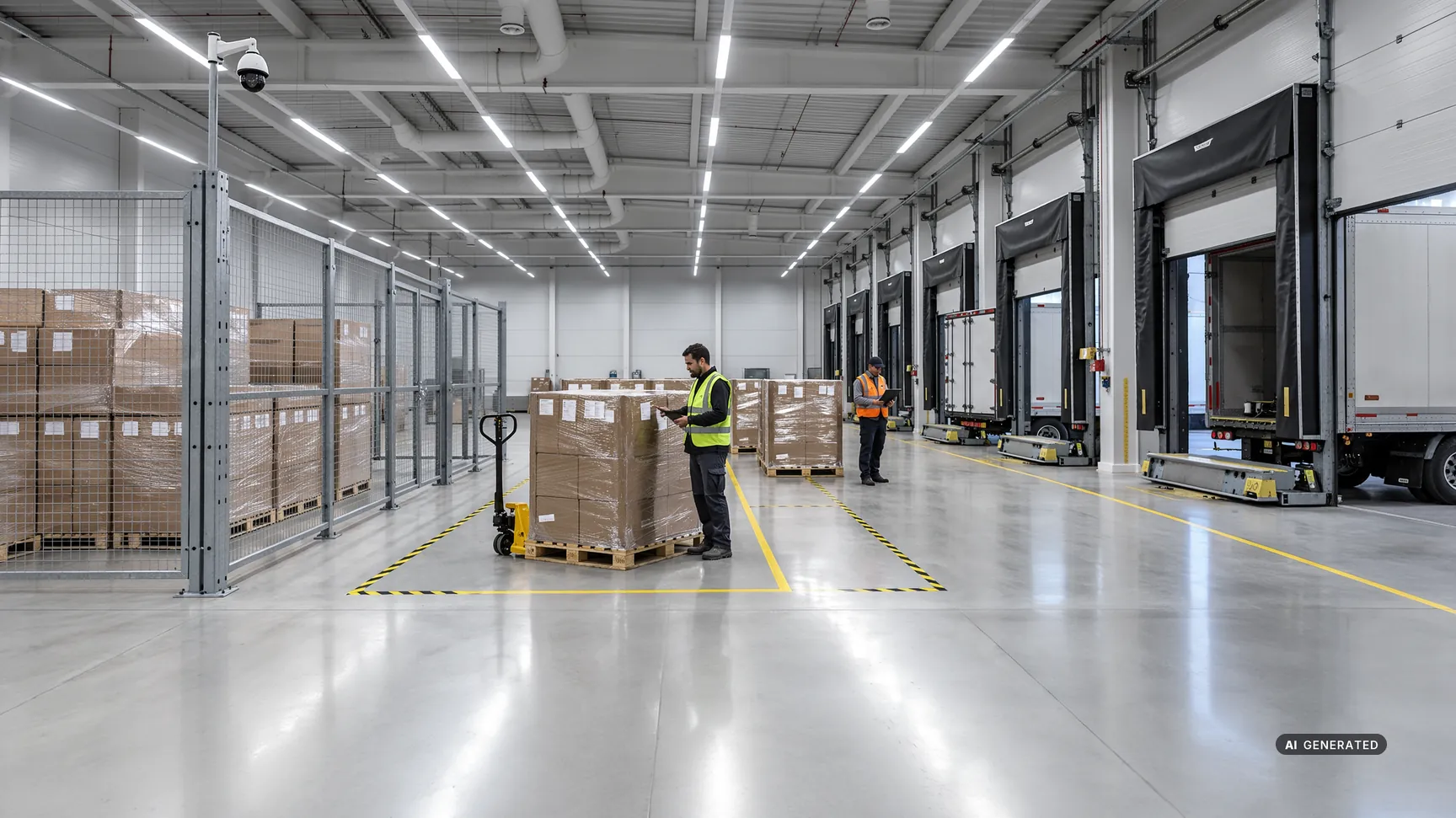
The trade term shapes the building: a high share of EXW and FCA shipments calls for generous staging zones behind the dock doors, while uncleared third-country goods need a delimited, monitored bonded-warehouse zone.
- Bonded warehouse infrastructure: Companies that work intensively with DAP, DPU or uncleared third-country goods need hall space that meets the requirements for a private customs warehouse under the Union Customs Code (formerly: open bonded warehouse) – depending on the authorisation, for example with delimited areas for uncleared stock, access control and CCTV surveillance (Source: German Customs (zoll.de), customs warehousing procedure – in German).
- Buffer and staging areas: With a high share of EXW or FCA in goods issue, generous staging zones must be planned behind the loading doors, as the collection times of external hauliers often fluctuate considerably.
- Door density and yard logistics: High throughput frequencies under D terms require efficient yard management and at least one loading door per 1,000 m² of hall space (a common rule of thumb for logistics properties suitable for third-party use; Source: L.Immo online, third-party usability – in German) in order to avoid demurrage & detention charges for waiting trucks and containers.
What waiting times at the dock cost in practice is shown in the blog article The Billion-Dollar Grave: Why Waiting Is the Biggest Unsolved Problem in Logistics.
5. Facts and Figures: Incoterms in Logistics Practice
- 11 rules: The Incoterms 2020 rule set comprises 11 standardised abbreviations. In the Digital Guide of ICC Germany and the law firm Luther, FCA and the D rules DPU, DAP and DDP are among the most frequently recommended rules, whereas EXW is rarely recommended (Source: ICC Academy, Incoterms® 2020 Digital Guide, February 2025).
- 30 to 90 minutes: Typical waiting time of a truck at the dock in Germany, according to a survey of 95 transport and logistics companies by SCI Verkehr (Source: DVZ, 23 August 2022 – in German). If responsibilities for unloading and load securing are clarified in advance through precise Incoterms (e.g. DAP vs. DPU) and stored in slot management, this time can be reduced.
- 10-year revision cycle: Since 1980, the ICC has revised the rules roughly every ten years (1980, 1990, 2000, 2010, 2020; Source: ICC, Incoterms Rules history). No date has been set for the next version; at the same rhythm, it would be expected around 2030. Until then, Incoterms 2020 remains the standard, and older versions can still be agreed in contracts.
6. Conclusion: Incoterms as the Interface between Contract, Warehouse and Building
Incoterms are decided not only in the sales contract but at the dock: they determine who loads, who unloads, who clears customs and from when the buyer bears the risk. Anyone who aligns trade terms, warehouse processes and hall layout avoids liability disputes, demurrage charges and coverage gaps – and plans space, doors and bonded warehouses to match the terms actually used.
7. Frequently Asked Questions (FAQ) about Incoterms in Logistics
Question: Does an Incoterm also govern the transfer of ownership of the stored goods?
Answer: No. Incoterms govern only the transfer of risk and costs as well as transport and customs obligations. The legal transfer of ownership (e.g. retention of title in a consignment warehouse) must be agreed separately in the sales contract or the contract logistics agreement.
Question: Why do logistics experts advise against EXW (Ex Works) in cross-border transactions?
Answer: Under EXW, for deliveries to third countries the foreign buyer must file the export customs declaration in the seller’s country. In practice, the buyer often lacks the tax registration there, while the seller without proof of export runs into problems with the VAT exemption. FCA is the legally safer alternative here. How customs formalities and bonded warehouses affect the movement of goods to and from the United Kingdom is shown in the blog article Warehousing in England (UK) - The New Post-Brexit Reality.
Question: Which Incoterms are suitable for transport with your own trucks?
Answer: Since Incoterms 2020, the rules FCA, DAP, DPU and DDP expressly allow for transport using the buyer’s or seller’s own vehicles, without an external carrier having to be involved.
Question: What changed for the CIP rule in Incoterms 2020?
Answer: For Carriage and Insurance Paid To (CIP), the minimum insurance cover was raised significantly. The seller must now take out all-risks cover under the Institute Cargo Clauses (A), which is particularly relevant for high-value industrial goods and electronics in contract logistics.
Question: How do Incoterms affect insurance cover in the logistics hall?
Answer: The transfer of risk marks the moment from which the buyer bears the risk, so its transport or warehouse insurance must be in place from then on. If the Incoterm and the policy are poorly aligned, dangerous coverage gaps arise during handling at the dock.
Question: When does the DPU (Delivered at Place Unloaded) rule make sense?
Answer: DPU is the only rule under which the seller owes unloading at the place of destination. It is ideal for project logistics, heavy machinery or construction site deliveries where the recipient has no cranes or heavy-duty forklifts of its own.
Your Ideal Logistics Warehouse
Browse listings for warehouse space, logistics real estate, industrial land, and contract logistics solutions.
Browse Exposés
Maximize Exposure for Your Warehouse Space
Showcase your logistics properties and attract qualified inquiries.
Discover Products