


Inclusion opportunity: Why logistics lacks the courage to use the largest reservoir of personnel
Table of Contents
- "Comfort Inclusion": Why We Systematically Overlook External Talent
- The Hierarchy of Prejudices: Differentiation at the Corporate Levels
- Economic Necessity Instead of "Nice-to-have": The Advantages
- The Fear of the "unterminable": Disadvantages and Myths
- Thinking Outside the Box: International Comparison
- The Future: Can Innovations Help?
- Practical Example: The Unconventional Path to Contract Logistics
- Conclusion: Inclusion as a Competitive Advantage
Is inclusion in German companies just an image campaign or a lived reality? A look at the bare figures reveals an inconvenient truth: According to official data from Aktion Mensch and the Federal Employment Agency, only 35.5 percent of people with severe disabilities are employed. By comparison, the rate for the population as a whole is 76.7 percent [source: Aktion Mensch Inklusionsbarometer].
This gap of over 40 percentage points is not only a social indictment, but also an economic negligence in view of demographic change. Especially in personnel-intensive industries such as logistics, warehouse logistics and the real estate industry, companies complain about a lack of young talent. But studies show that applicants with disabilities are hired less often, are hardly promoted and are often passed over despite having the same or higher qualifications.
This article takes a deep look at why "courage" is often lacking more than the ramp, what opportunities the logistics and real estate industry in particular misses and how looking beyond national borders opens up new perspectives.
"Comfort Inclusion": Why We Systematically Overlook External Talent
In Germany, inclusion is usually taken seriously where it is "convenient" or where the legislator leaves no choice. Many representative bodies for severely disabled employees (SBV) and HR departments do an excellent job – but this support often focuses primarily on long-term employees who fall ill or acquire a disability in the course of their ongoing employment. This is where the social conscience and the duty of care (company integration management) come into play.
But what happens to qualified applicants from outside? They often bounce off a glass wall. An unconventional curriculum vitae, a gap due to rehabilitation times or the mere reference to a degree of disability (GdB) often lead to immediate discarding.
The biggest bottleneck is not the disability, but the courage of the decision-makers.
There is a lack of courage to really recognize competence, even if it does not come in the standard format. There is a lack of courage to break away from prejudices that inclusion automatically means underperformance. In the process, many HR decision-makers forget a statistical reality: a disability can affect anyone. At any time. Be it due to an accident, a stroke or a chronic illness.
Logistics & Real Estate: Where are the hidden jobs?
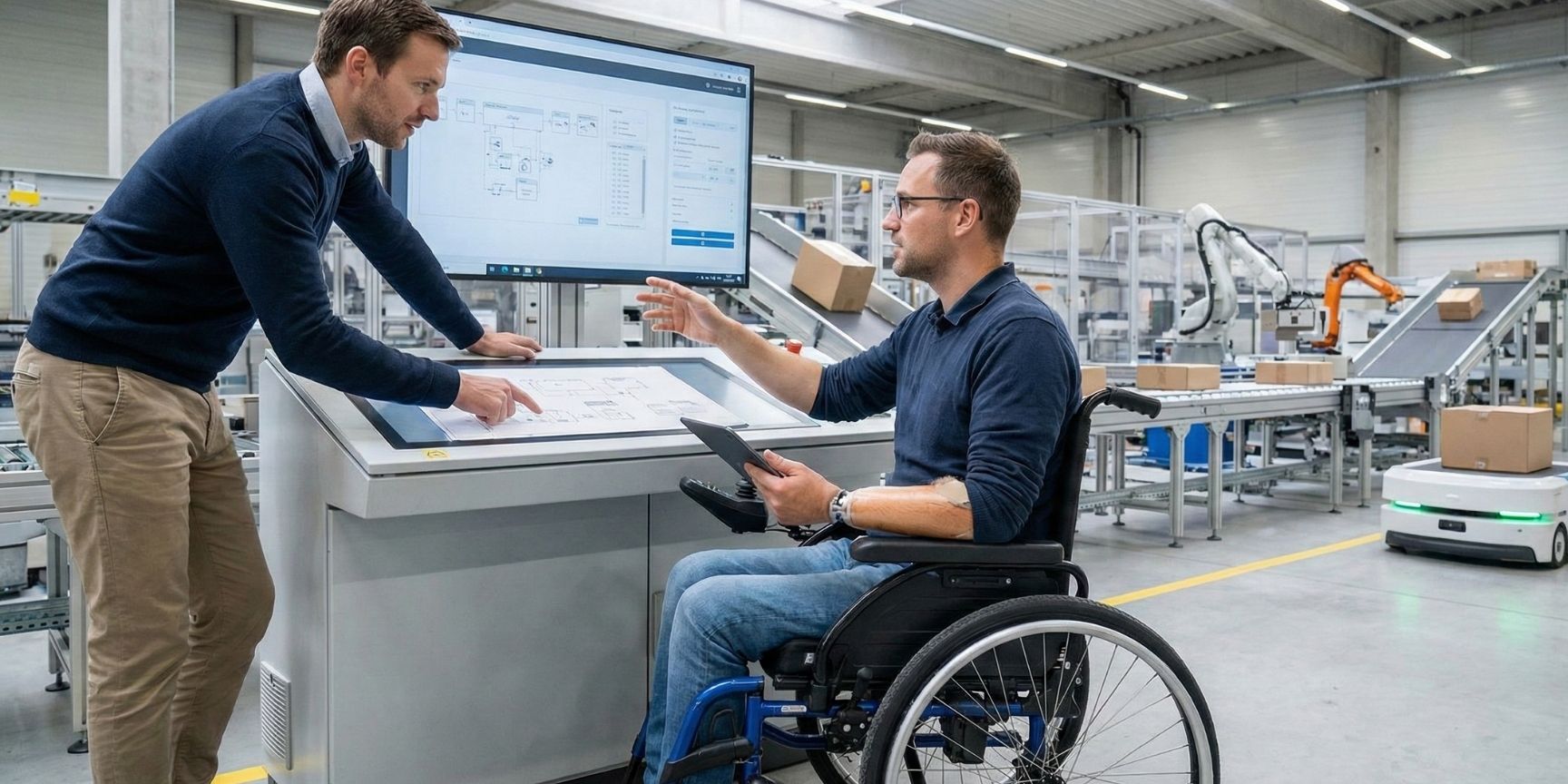
The logistics, contract logistics and real estate industries are often considered physically demanding ("back-breaking jobs"). But this image is outdated. Automation, digitization and new job profiles are creating huge niches for people with a wide variety of disabilities.
Warehouse logistics and contract logistics
Here, the prejudice often prevails that you have to be able to "lift heavy".
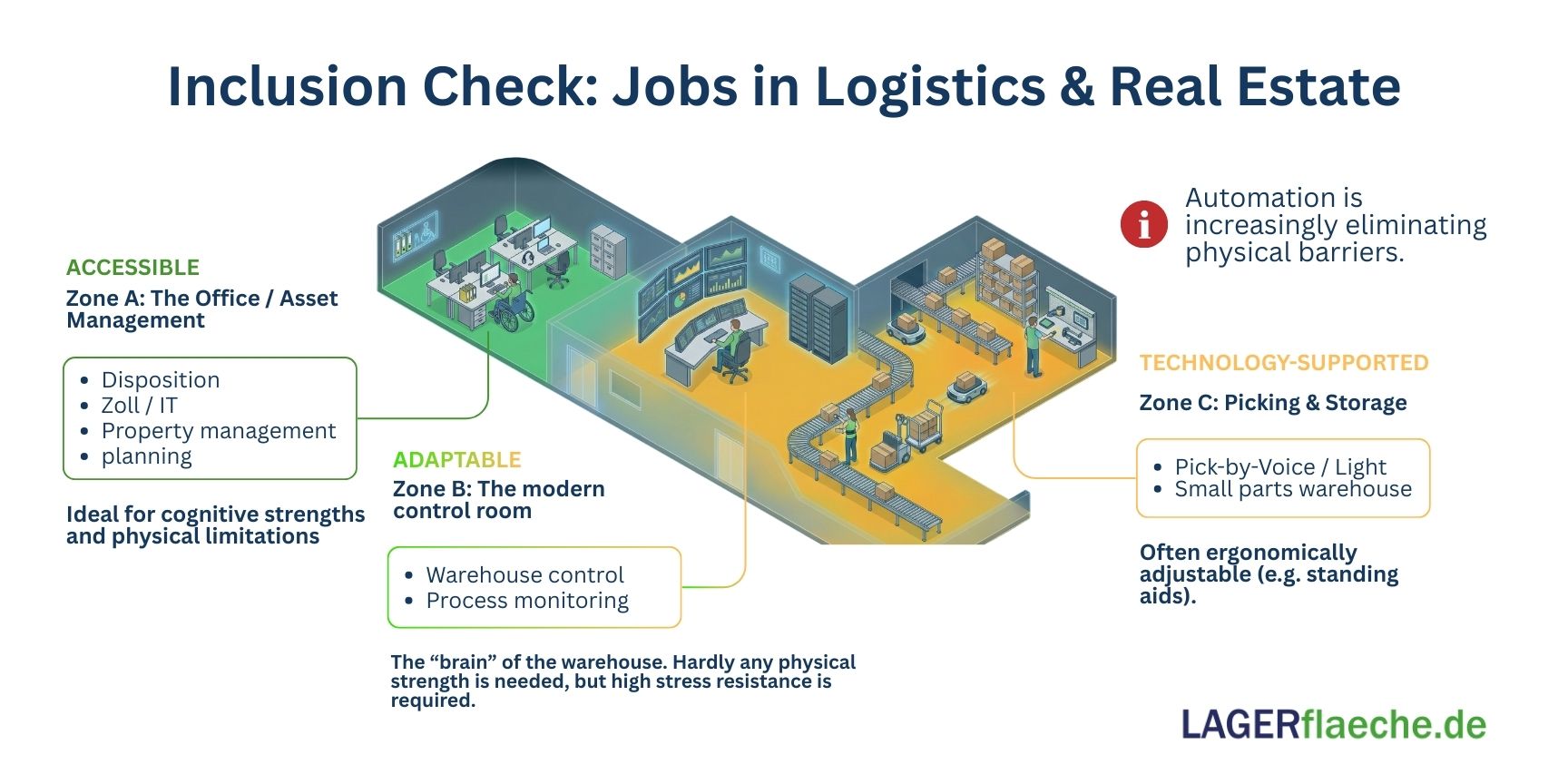
- Picking: Pick-by-light or pick-by-voice systems enable people with hearing or learning disabilities to work highly efficiently.
- Forklift driving & industrial trucks: Modern equipment is often so ergonomic that it can also be operated by people with walking disabilities.
- Dispatch & control center: These "brain centers" of logistics do not require physical strength, but cognitive strength, stress resistance and planning talent. An ideal place for people with physical disabilities.
Logistics Real Estate & Real Estate
This sector is strongly influenced by administration and planning.
- Asset management: The management of real estate portfolios is digital. Analytical skills count here.
- Facility management (planning): Not the cleaning itself, but the control of the service providers.
- Architecture & construction planning: Who better to plan barrier-free logistics properties than architects who are themselves dependent on accessibility? Here, the disability becomes a direct professional competence ("Expertise by Experience").
Graphical overview: Potential analysis by area
| Area | Activity | Barriere-Status | Suitable for |
| Warehouse | Small parts warehouse / Packing | Medium (standing aids possible) | Physical limitations |
| IT/Administration | Dispatcher / Customs Clearance | Low (office workplace) | Wheelchair users, neurodivergence |
| Real Estate | Property Management | Low (remote possible) | Chronic diseases |
| Driving | Truck (customized) | High (but technically solvable) | Amputations (with conversion) |
[Source: Own compilation based on logistics requirement profiles]
The Hierarchy of Prejudices: Differentiation at the Corporate Levels
How do the opportunities differ at the different levels of the company? Paradoxically, the willingness to be included often decreases the higher you climb in the hierarchy, even though the physical demands there decrease.
- Blue collar (commercial): Here, the willingness to hire people with learning disabilities ("helper activities") is often higher, as the shortage of skilled workers strikes most brutally here. However, it often fails due to safety concerns in warehouse traffic.
- White collar (clerical): This is where most inclusive jobs (accounting, IT) are found. Accessibility is usually provided by elevators and ergonomic furniture.
- Management & C-Level: This is where the air gets thin. Managers with visible disabilities are a rarity. Why? Because disability is often unconsciously associated with "weakness" or "need for help" – the opposite of what is expected of a "strong leader".
The fallacy of resilience: Managers with disabilities in particular often have exactly the soft skills that companies are looking for in the VUCA world (volatility, uncertainty, complexity, ambiguity): resilience. Those who master their life with a disability have often learned to find solutions to problems that others do not even see and to cope with setbacks. This is crisis management in action.
Economic Necessity Instead of "Nice-to-have": The Advantages
What are the benefits for a company to make an effort to attract employees with disabilities? Inclusion is not a charity event. In an ageing society that cannot fully compensate for the labor shortage through migration, it is a survival strategy.
- Access to talent: If you ignore 10-15% of the population, you are missing out on high potentials.
- Higher loyalty: Studies often show a significantly higher length of service among employees with disabilities. In logistics, where fluctuation is high, this saves massive recruiting costs.
- Innovative strength: Diverse teams (and this includes "disability") solve problems more creatively. A neurodivergent employee may be more likely to see process errors in the flow of goods than a neurotypical colleague.
- ESG & Investors: In the real estate industry (logistics real estate funds), investors are increasingly paying attention to the "S" in ESG (Social). A high inclusion rate improves the rating and financing conditions.
"Companies that excel in the inclusion of people with disabilities record an average of 28 percent higher sales, twice as much net income and 30 percent higher profit margins." [Source: Study "Getting to Equal: The Disability Inclusion Advantage", Accenture & Disability:IN, 2018]
The Fear of the "unterminable": Disadvantages and Myths
Where do companies think the disadvantages lie? If you ask HR managers in freight forwarders or real estate companies behind closed doors, the same arguments always come up:
- Protection against dismissal: probably the biggest obstacle. Companies fear that they will "never get rid of an employee with a severe disability" if the performance is not right.
- Fact check: The special protection against dismissal does not mean that it cannot be terminated. He only requires the approval of the Integration Office. In the case of redundancies for operational reasons or real misconduct, the offices agree in about 80% of cases.
- Performance: The concern about frequent absences due to illness.
- Fact check: Statistically speaking, people with disabilities are not absent significantly more often than the average. Often the opposite is true, as motivation is higher.
- Costs for conversions:
- Fact check: These costs are almost entirely covered by the integration offices or the pension insurance.
Thinking Outside the Box: International Comparison
What are the differences in European or global comparisons and why?
Germany relies heavily on a compulsory and levy system. Companies with 20 or more employees must employ 5% severely disabled people or pay a compensatory levy. Many companies prefer to pay ("buy out") instead of inclusion.
USA: Civil rights instead of quotas
In the USA, there is no quota like in Germany, but there is the Americans with Disabilities Act (ADA). This is an anti-discrimination law with sharp teeth.
- Difference: The focus is on "reasonable accommodation". Those who are qualified must get the job, obstacles must be removed. In US logistics (e.g. Amazon USA), the topic of diversity is often more visible than in Germany, also because of the fear of lawsuits.
France: Stricter enforcement
France has a similar quota system to Germany (6%), but in recent years it has massively increased its fines ("AGEFIPH") and closed loopholes. In addition, there are strong campaigns that frame inclusion as part of the national identity ("Liberté, Égalité, Fraternité").
Japan: Inclusion as social harmony
In Japan, there is the system of "Special Subsidiaries". Large corporations (including logistics giants) set up subsidiaries that are specifically geared to the needs of people with disabilities in order to meet the quota of the parent company.
- Criticism: This creates jobs, but often leads to segregation (separation) instead of real inclusion in the regular workplace.
Scandinavia (Sweden): Universal Design
Here, the focus is less on quotas and more on a strong welfare state and "universal design". Workplaces are designed from the outset in such a way that they can be used by everyone. The employment rate of people with disabilities is traditionally higher in Sweden than in Germany.
The Future: Can Innovations Help?
What does the future probably look like? Technology is the greatest equalizer of the 21st century. Especially in logistics, we are facing a revolution in inclusion through technology:
- Exoskeletons: Active support corsets allow people with back problems or muscle weakness to work in warehouse logistics by physically neutralizing the load.
- Collaborative robots (cobots): The robot takes over the lifting, the human takes control. Physical strength becomes irrelevant.
- Teleoperation: Forklifts can already be controlled from the home office (similar to drones). This allows a wheelchair user to operate a 40-tonne crane without leaving their disabled-friendly home.
- AI and neurodivergence: AI-powered tools help people with dyslexia to document errors or support autistic people in structuring working days.
Practical Example: The Unconventional Path to Contract Logistics
To illustrate the utility value, we outline a scenario of how it could ideally run – and is running more and more often:
Case study: Lisa M., 38 years old.
Background: Lisa was a freight forwarder's clerk until she suffered a walking disability due to an accident and was dependent on a wheelchair.
The problem: In her old company, the warehouse office on the 1st floor was without an elevator. She became unemployed.
The application: She applied for a position in "Customer Service" at a contract logistics company. Her CV showed a gap of 2 years (rehab/unemployment).
The courage: The HR manager invited her despite the gap.
The solution:
- Workplace: A height-adjustable table was purchased (subsidy from the Integration Office: 100%).
- Activity: Lisa not only took over customer service, but also became the interface between the warehouse control center and customers due to her practical experience. She understood the "language" of the warehouse workers.
- Result: Lisa optimized route planning because she deeply penetrated processes. The company gained a loyal specialist, and turnover in the department decreased.
Conclusion: Lisa's disability was irrelevant to the job in the office, but her resilience and experience were priceless.
Conclusion: Inclusion as a Competitive Advantage
It's time for the logistics and real estate industry to rethink its definition of "high performers." The rate of 35.5% is not a law of nature, but the result of missed opportunities. Companies that now have the courage to embrace unconventional resumes as an opportunity and embrace technologies like AI and robotics will be the winners in the talent battle.
Inclusion is feasible. It is financially viable. And it pays off.
Latest Blog Posts
Stay up to date with the newest trends, insights, and tips in warehouse and logistics. Our latest articles help you navigate the industry with confidence.
Dual-Use Logistics Real Estate - When Civil Efficiency Meets National Security Strategy
Beyond the Big-Box: Why Dual-Use properties are becoming the new frontline of resilient logistics and national security....
Energy Blackout or Self-sufficiency Boom? Logistics at the Crossroads in 2026
Energy Security 2026: Turning the silent bottleneck of German logistics into a competitive advantage through self-sufficiency....
The Logistics Real Estate Market in Transition - Leasing, Ownership or Sale-and-Lease-Back?
Concrete or Cash? Discover why the asset-light strategy is dominating the 2026 logistics market and how to master the shift from ownership to liquidity....
Speculative Project Development - Courage to Take Risk or Strategic Necessity
Fortune favors the bold: Why building before signing a tenant is the ultimate power move in today’s logistics market....