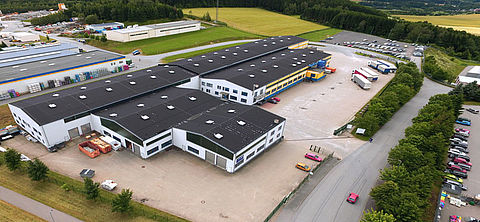
Kontraktlogistik in Elterlein
Object no.: 9929
Warehousing (warehouse with management)
Germany
09481 Elterlein
Price on request
Secure your supply chain against fluctuations, avoid cost-intensive plant downtimes and optimize your material flow with a tailor-made commercial property. Find the warehouse location that fits your value chain exactly.

A warehouse facility tailored to your industry optimizes throughput times and ensures the operational flexibility of your operation. Regardless of whether you are looking for a specialized buffer warehouse for raw materials, a temperature-controlled site solution for intermediate production or a high-tech industrial property for fulfillment – our specialist portal gives you direct access to the relevant B2B providers.
Object no.: 9929
Warehousing (warehouse with management)
Germany
09481 Elterlein
Price on request
Object no.: 9601
Warehousing (warehouse with management)
4210 Brnik - Aerodrom
Price on request
Object no.: 4497
Warehousing (warehouse with management)
Germany
50829 Köln-Ossendorf
Price on request
Object no.: 3436
Rental
Austria
8700 Leoben
Price on request
Object no.: 3603
Rental
Germany
67578 Gimbsheim
Price on request
» What is a Production Warehouse and What Functions does it Fulfil?
» Technical Requirements for a Modern Warehouse Location for Production
» Operational Warehouse Processes and Digitalization in Manufacturing
» Scalability and Outsourcing of Production Processes
» Cost Factors and Rental Models for Industrial Space
» Advantages and Challenges of a Production Warehouse
» Frequently Asked Questions About the Production Warehouse

A production warehouse is a specialized storage area that is physically or systemically directly connected to a company's manufacturing process. The main task of this site solution is to promote the entire production process smoothly, efficiently and economically. Depending on their position in the value chain and the specific scope of functions, these warehouse centers can be divided into three main categories:
Upstream warehouse objects are strongly production-oriented, while intermediate and downstream zones have a clear sales orientation. The intelligent use of these areas shortens delivery times and massively optimizes capital commitment and general space requirements.

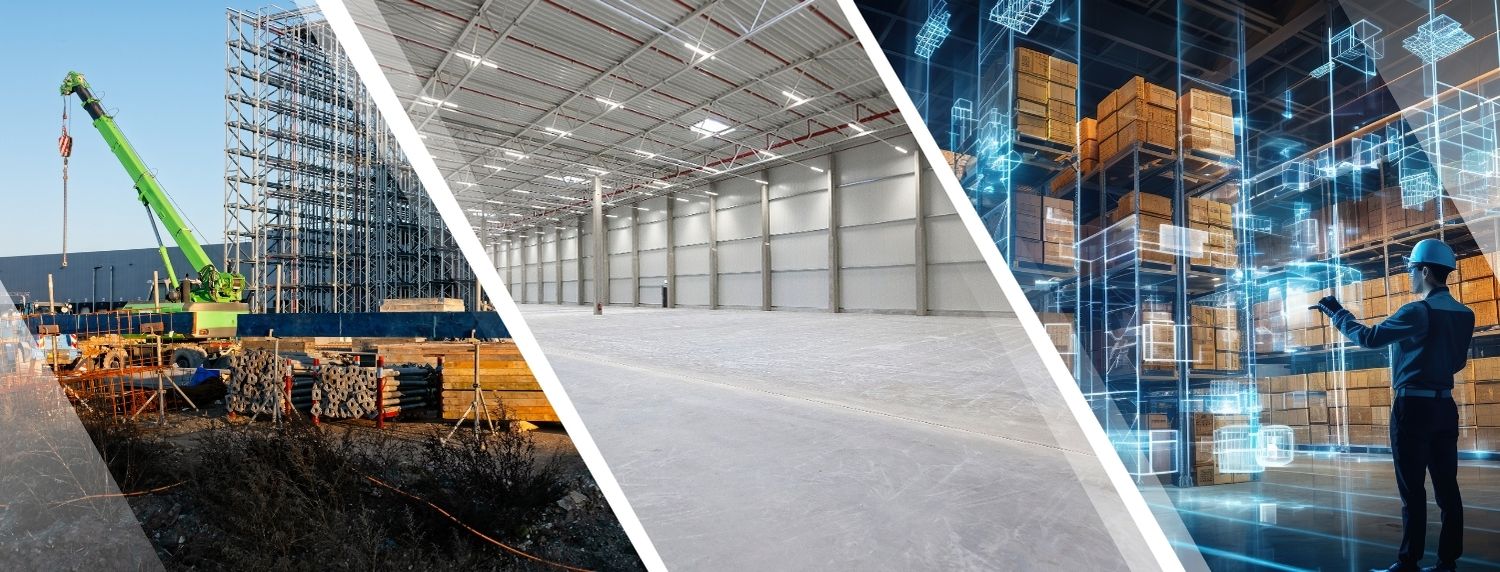
An industrial property that is integrated into the production must meet completely different specifications than pure distribution centers. The choice of the right storage space depends on strict structural and technical criteria:
Although demand-synchronous production (just-in-time or just-in-sequence) is more in demand than ever in modern industry, most companies cannot do without dedicated storage solutions. Especially in the automotive industry or in seasonal business, the quick physical buffer is essential for survival.
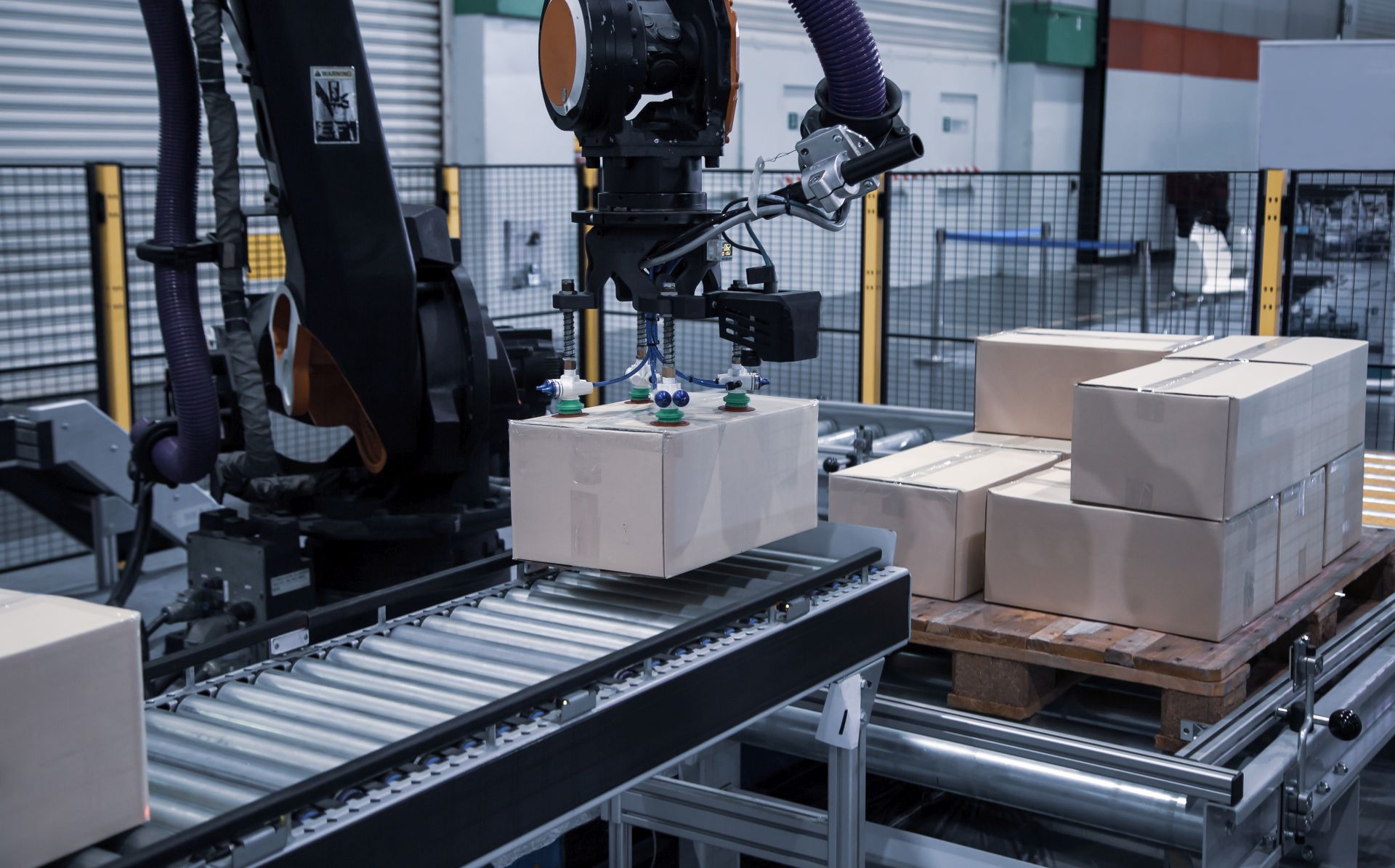
Digitalization controls these processes: Modern warehouse management systems (WMS) communicate in real time with the ERP (Enterprise Resource Planning) systems of production. Technologies such as automated guided vehicles (AGVs), RFID scanning and automated Kanban racking systems ensure that the right component is available on the production line to the second.
Prevent expensive production interruptions and inefficient material flows through strategically perfectly planned buffer and interim storage facilities. LAGERflaeche.de brings you directly together with the right B2B decision-makers and providers.
More and more companies are outsourcing parts of their manufacturing supply to specialized service providers. Such outsourcing or fulfillment solutions offer the advantage that the manufacturer can focus on its core business. Logistics service providers often take on extensive value-added services in the rented warehouse. This includes the pre-assembly of assemblies, strict quality checks or the sequential repackaging of components before they are delivered to the main plant.
If you want to rent or operate a production warehouse, you have to calculate various OPEX costs (operating expenses) in addition to the classic cold rent. The costs for energy, maintenance and facility management are usually higher in production environments than in pure distribution halls.
The market for commercial real estate is responding to these challenges with flexible rental models. In addition to the classic, long-term lease agreements, pay-per-pallet models or short-term leasable location solutions are increasingly establishing themselves in order to be able to scale quickly during order peaks.
Setting up a specialized warehouse area is a strategic choice that offers clear advantages but also takes into account economic aspects:
Above all, the automotive industry, mechanical and plant engineering and the pharmaceutical industry. Companies with strong seasonal fluctuations (e.g. food or textiles) also urgently need storage solutions to continuously utilize their production during quieter phases and to build up buffers for the peak season.
Prices vary greatly depending on the region, transport connections and technical equipment. A hall with a crane runway, heavy-duty floor and WGK approval is naturally significantly higher in price per square meter than a simple block warehouse.
The biggest levers are the optimization of the hall layout, the introduction of digital process control (WMS), automation (e.g. through driverless transport systems) and, if necessary, the outsourcing of peripheral processes to external service providers in order to convert fixed costs into variable costs.
In addition to strict occupational health and safety and fire protection guidelines (Workplace Ordinance), specifications for the storage of hazardous substances (TRGS) are extremely important. Digital aspects also play a role: When networking warehouse and production data, GDPR requirements and IT security standards must be complied with.