
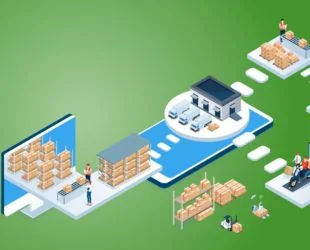



VAS Zones in Warehouse Logistics
Table of contents
- 1. Definition: VAS and the VAS zone – service and space
- 2. Which VAS processes need which space and technology?
- 3. Importance for warehouse logistics and intralogistics
- 4. VAS zones in contract logistics: flexible for multiple clients
- 5. Structural requirements for the logistics property and hall
- 6. Facts and figures on VAS zones in practice
- 7. Frequently asked questions (FAQ) about VAS zones
VAS zones are the areas of a logistics property where traditional warehousing is complemented by finishing, assembly and kitting processes on site – and how they are planned decides whether these value-added services pay off.
1. Definition: VAS and the VAS zone – service and space
Value-added services (VAS) are the services themselves, meaning every activity that goes beyond simple "pick & pack". The VAS zone (value-added services zone), by contrast, is the space where these services are delivered: a structurally, technically or organisationally separated functional area within a logistics property or on a managed open-air storage yard. Unlike conventional storage areas, which are designed for putaway and fast handling (TUL processes: transport, handling, storage), it is tailored to workstations, equipment and short distances. How value-added services have developed in logistics as a whole is explained in our blog article More than just transport: How value-added services are changing logistics forever.
2. Which VAS processes need which space and technology?
Which services take place in a VAS zone depends on the industry. What matters for planning is what each process requires in terms of space, workstations and technology:
| Process | Workstation and space | Technology and infrastructure |
| Kitting & co-packing (sets, promotional packs, displays) | Modular packing tables, space for roll containers and displays, buffer for components | Scanners, label printers, Wi-Fi connection to the WMS |
| Pre-assembly & product customisation (assemblies, country-specific inserts, software updates) | Assembly benches with parts supply, separate clean areas | Power outlets, network for software installation, ESD protection for electronics where needed |
| Quality control & refurbishment of returns | Inspection stations with separate storage for released and blocked goods | Test rigs, compressed air, good lighting for visual inspections |
| Labelling & packaging (EAN, price labelling, customs documents, export packaging) | Packing lines and open floor space for large crates | Packaging machines, high-voltage power, labelling units |
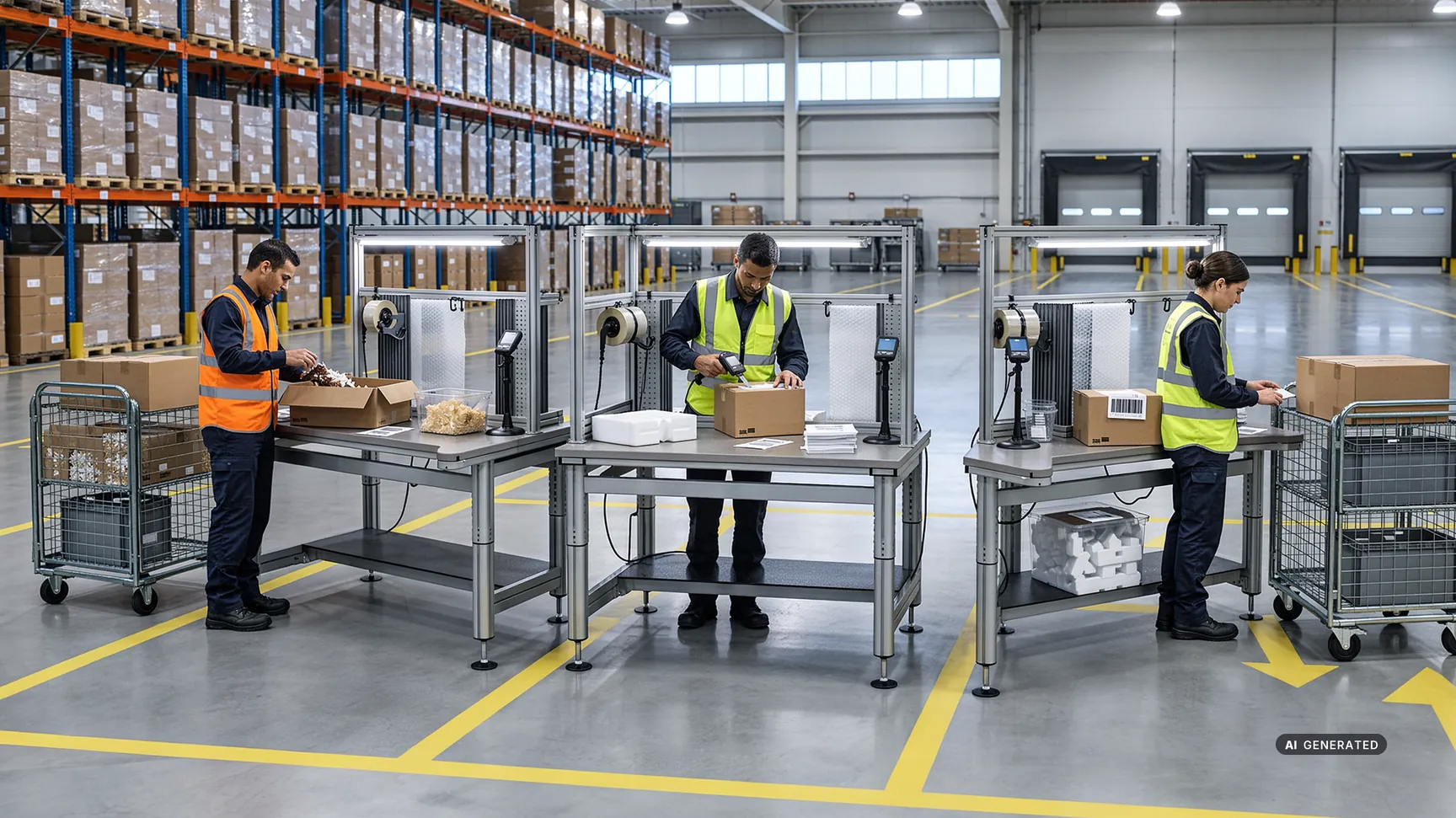
Each VAS process places its own demands on workstation, space and technology – and these drive the planning of the zone.
3. Importance for warehouse logistics and intralogistics
In modern warehouse logistics, VAS zones are a key lever for process speed. Integrating finishing stations into the material flow eliminates time-consuming and costly interim transports to external co-packers or assembly companies. Depending on the hall layout (e.g. U-shape or I-shape flow), VAS zones are strategically placed between the picking zone and goods-out or close to goods-in. A seamless link to the warehouse management system (WMS) ensures that finishing orders are triggered automatically and stock movements are booked in real time.
4. VAS zones in contract logistics: flexible for multiple clients
For contract logistics providers (3PL), value-added services are an important way to stand out from pure price competition for pallet spaces. For the space itself, the key requirement is adaptability: in multi-user warehouses, i.e. halls in which several clients are served in parallel, customers, product ranges and order profiles often change within a few months. The pros and cons of shared and exclusively used warehouses are compared in our article Shared Warehouse vs. Dedicated Warehouse. Proven principles include:
- Modular equipment: Mobile, height-adjustable packing tables and plug-in shelving can be rearranged without construction work.
- Mobile conveyor technology: Roller conveyors and roll containers instead of fixed systems allow new material flows within a few days.
- Variable partitions: Mesh or lightweight walls separate client areas and can be moved.
- Pre-installed infrastructure and reserve space: Power, compressed-air and data connections on a grid, plus buffer areas next to the zone, take on additional workstations during seasonal peaks (e.g. Black Friday) or when a new client starts up.
5. Structural requirements for the logistics property and hall
A standardised warehouse ("grey box") often does not meet the technical requirements for intensive VAS processes without modifications. Project developers and tenants therefore look for specific parameters when selecting a property:
Mezzanine floors: Since small-scale kitting and packing processes do not need 12 metres of clear height, VAS zones are often set up on mezzanines above the dock or picking areas. Floor loads of 5 to 10 kN/m² are common in the industry.
Workplace quality & climate: Unlike fully automated high-bay warehouses, VAS zones are labour-intensive. The German Workplace Ordinance and the Technical Rules for Workplaces require sufficient daylight and a visual connection to the outside as well as suitable artificial lighting (ASR A3.4, e.g. rooflights or windows), plus draught-free heating and ventilation. Under ASR A1.5, floors must be even and slip-resistant; ergonomic mats at standing workstations are useful but not mandatory. Why such ancillary areas help determine the success of a property is explained in our article Why ancillary rooms in logistics real estate determine your success.
Fire protection & infrastructure: Large quantities of cardboard and packaging materials increase the fire load, which calls for high-performance ESFR sprinkler systems and, where necessary, separate fire compartments. A dense IT and power supply (high-voltage power, compressed air, Wi-Fi/5G) is also needed for test rigs and packaging machines.
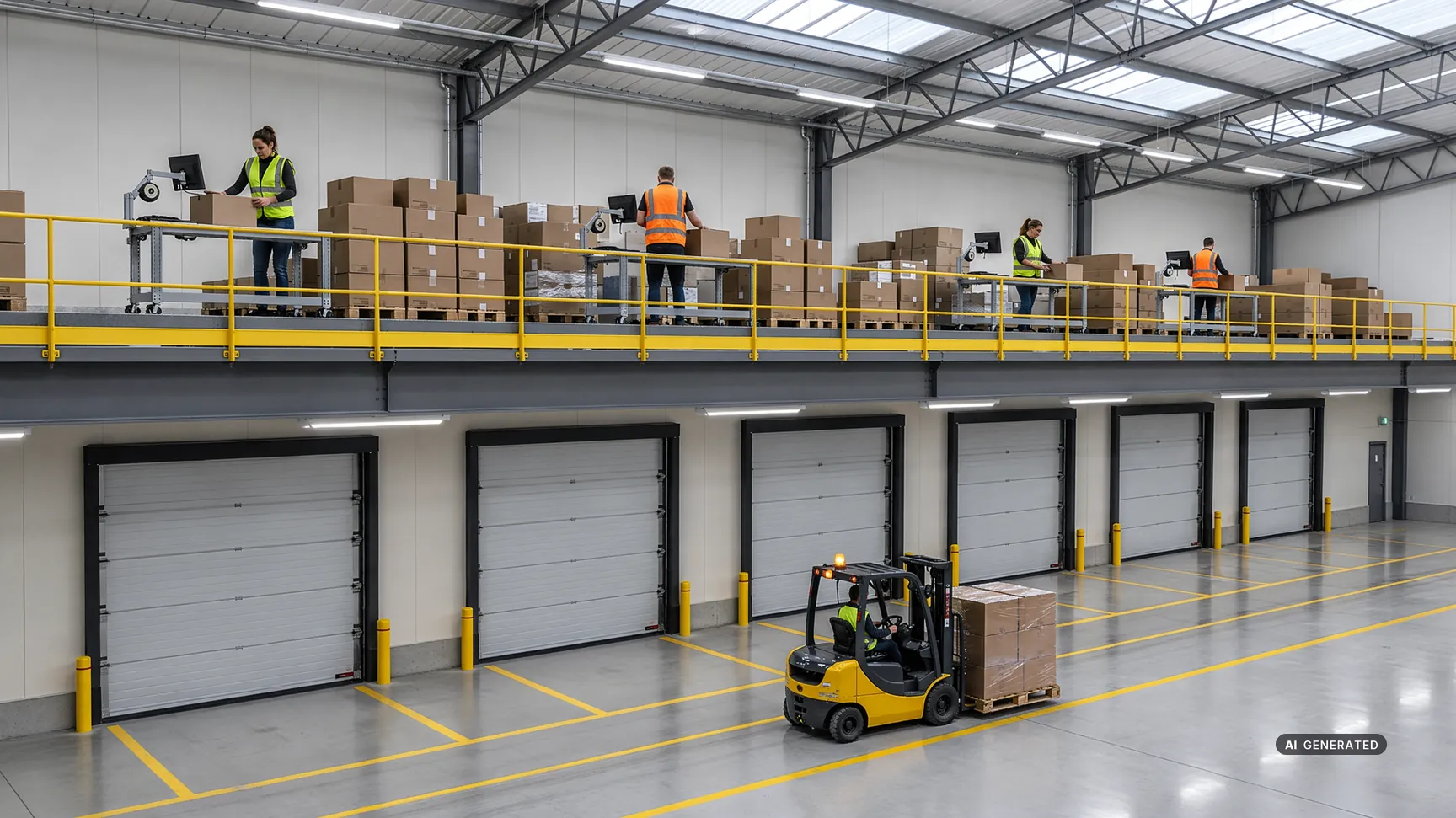
On a mezzanine, the VAS zone gains space without blocking the material flow on the ground floor – provided load capacity, lighting and fire protection are right.
6. Facts and figures on VAS zones in practice
Share of floor space: In modern e-commerce and contract logistics properties, VAS, packing and returns areas take up around 10 to 25 % of the total hall floor area (including mezzanine levels), based on practical experience.
Reduced lead time: Integrating pre-assembly and kitting into the central warehouse can shorten the supply chain lead time by 40 to 60 % compared with external outsourcing, based on project experience.
Need for welfare space: Because VAS zones require more staff, the need for office, break and sanitary areas rises from the usual 3 to 5 % to up to around 10 % of the total lettable area, and even more for very labour-intensive processes.
7. Frequently asked questions (FAQ) about VAS zones
Question: What is the difference between a picking zone and a VAS zone?
Answer: In the picking zone, items are simply taken from stock and combined into a customer order. In the VAS zone, the product itself is physically altered, inspected, assembled, repacked or individually labelled.
Question: Where is the best place for VAS zones in a logistics hall?
Answer: Ideally, VAS zones sit directly in the main material flow between picking and the goods-out zone, or on a mezzanine level above the marshalling area. This avoids unnecessary cross transports and crossing traffic with forklifts.
Question: How large does a VAS zone need to be?
Answer: The starting point is the number of workstations occupied at the same time during peaks, multiplied by the area per workstation including material supply and aisles. Add buffers for packaging material and blocked goods plus a reserve for peaks. Example: 20 packing stations at around 15 m² each come to about 300 m², or rather 350 to 400 m² with buffer and reserve.
Question: What load capacity does a mezzanine need for VAS work?
Answer: For manual packing tables, light shelving and roll containers, a load capacity of 5 kN/m² (approx. 500 kg/m²) is usually sufficient. If heavy test rigs, pallet trucks or automated packaging lines are used, 7.5 to 10 kN/m² is required.
Question: Can VAS zones also be set up on open-air storage yards?
Answer: Yes. In heavy-load, mechanical engineering or automotive logistics, value-added services such as seaworthy export packaging (shrink-wrapping), container stuffing or vehicle preparation (pre-delivery inspection) take place on paved outdoor areas.
Question: What role does the warehouse management system (WMS) play in the VAS zone?
Answer: The WMS controls work orders in the VAS zone, specifies which inserts or labels are needed, checks work steps by barcode scan and, once finished, books the finished item number (SKU) back into stock.
Your Ideal Logistics Warehouse
Browse listings for warehouse space, logistics real estate, industrial land, and contract logistics solutions.
Browse Exposés
Maximize Exposure for Your Warehouse Space
Showcase your logistics properties and attract qualified inquiries.
Discover Products