Commission-free offer
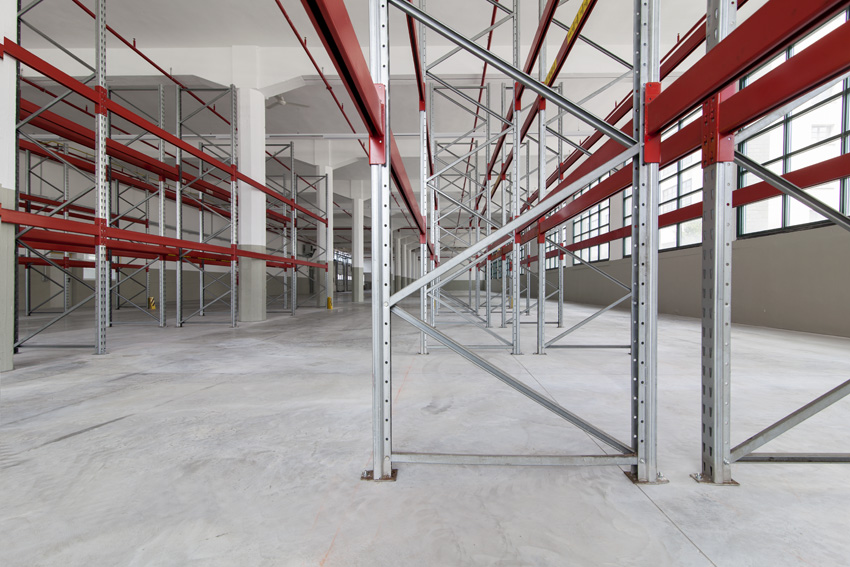
Lagerfläche ab 500 qm in beheizbarer und gesicherter Logistikhalle in Greven ab sofort zu vermieten.
Object no.: 9547
Logistics real estate
Rental
Germany
48268 Greven
6600.00 m²
Price on request

Trimodal excellence at the interface of the European economic centers
Object no.: 9547
Rental
Germany
48268 Greven
Price on request
Object no.: 9405
Warehousing (warehouse with management)
Germany
49086 Osnabrück
Price on request
» Whether renting storage space in Frankfurt am Main or renting a warehouse in Frankfurt am Main: LAGERflaeche.de
» Your reliable, precise and experienced partner for contract logistics in Frankfurt am Main
» Individual and holistic support in warehouse logistics in Frankfurt am Main
» Uncomplicated and fast, get online support for your logistics
» Find warehouse logistics and contract logistics service providers in Frankfurt am Main
Is a location just a dot on the map, or the decisive competitive advantage in your supply chain? In the case of the Rheine freight village (GVZ), the answer is clear. Located in the northern Münsterland region, Rheine has developed from a classic industrial city into one of the most efficient logistics hubs in North Rhine-Westphalia.
This factual text analyzes the GVZ Rheine in depth. We take a look behind the scenes of the infrastructure, shed light on the hard economic facts from tax rates to land prices and clarify why this location is considered a "hidden champion" of logistics in expert circles.
The Rheine freight transport center is not simply a collection of halls. It is a planned intermodal hub strategically located between the Ruhr area, the Netherlands and the seaports in the north. It acts as an interface for broken traffic and efficiently bundles freight flows.
The Rheine freight village is characterized by its polycentrality. It is embedded in the strong economic region of Münsterland, but benefits massively from its proximity to Lower Saxony. For years, the Rheine Development Corporation for Economic Development and Urban Development (EWG) has pursued a strategy that focuses not only on land sealing, but also on value-adding logistics.
Why is Rheine a GVZ and not just an industrial park? The classification as a freight village is based on the strict connection to at least two, ideally three modes of transport (road, rail, water) and the presence of transhipment terminals as well as logistics-related service providers on site. Rheine meets these criteria through its trimodal orientation par excellence.
Location is not a variable in logistics, but the foundation. Rheine is located in the northern part of North Rhine-Westphalia, directly on the state border with Lower Saxony. This positioning makes the GVZ a gateway location.
Here are the most important data summarized for a quick overview:
| Category | Facts / Figures |
| Location | North Rhine-Westphalia, border triangle (NRW, NDS, NL) |
| Highway | A30 (direct), A31 (approx. 10 km) |
| Rail | KTR (KombiTerminal Rheine), electrified main lines |
| Water | Dortmund-Ems Canal (suitable for large motor ships) |
| Modality | Trimodal (road, rail, water) |
| Trade tax | 445% (as of 2024) |
| Mite level (Neubau) | approx. 6.00 - 7.50 €/m² |
| Logistics region | Münsterland / Osnabrück |
| Special feature | Excellent cross-border connections (Netherlands) |
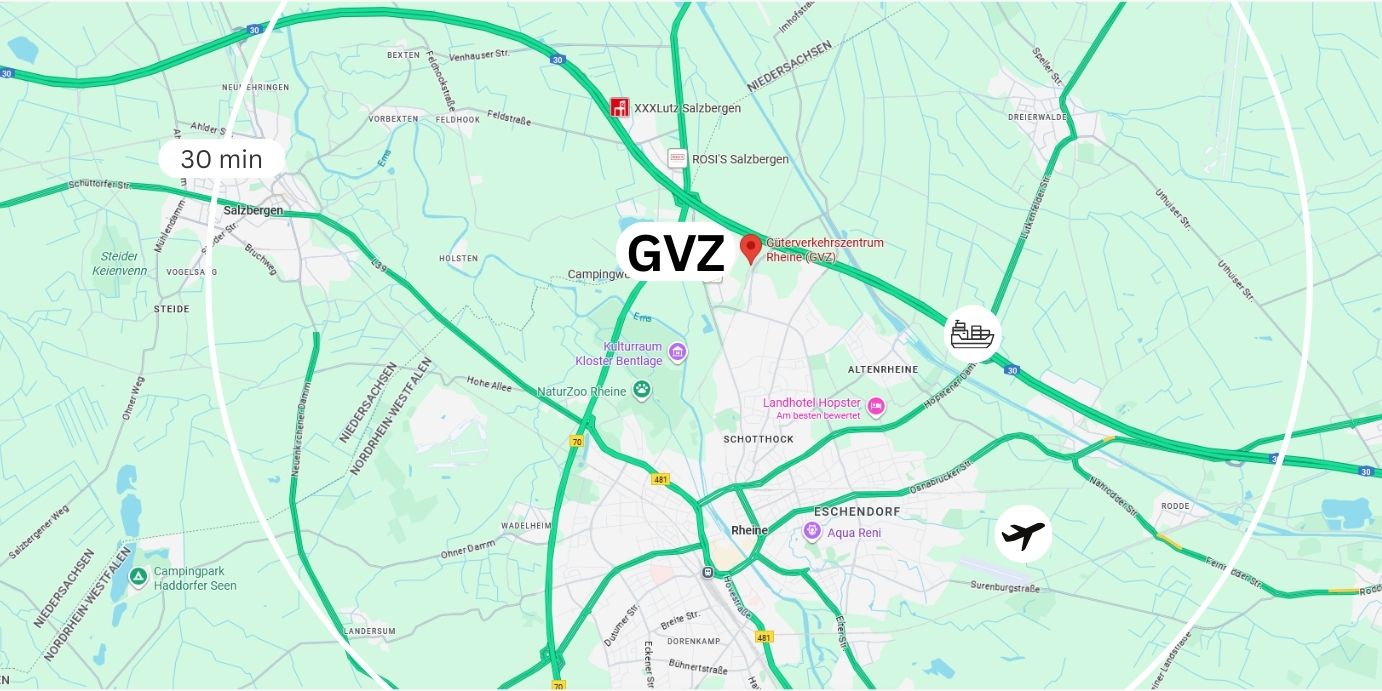
The real strength of the GVZ Rheine lies in its trimodality. Only a few locations of this size can boast such a closely interlinked connection of road, rail and waterway. How do these gears interlock?
The GVZ is optimally connected to the long-distance road network.
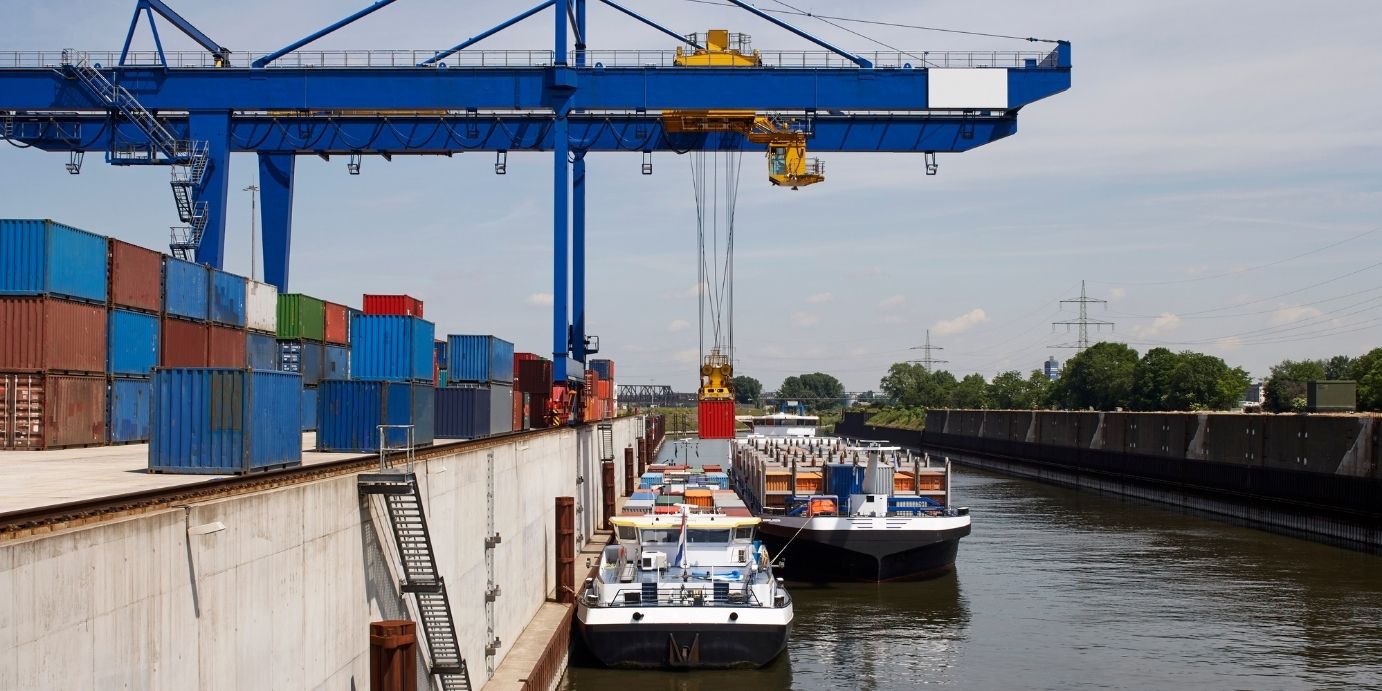
The centerpiece is the KombiTerminal Rheine (KTR).
The Rheine Canal Port on the Dortmund-Ems Canal (DEK) completes the trio.
Important question for shippers: Is trimodal handling in Rheine operationally seamless? Yes. The spatial proximity of the harbor basin and the KLV terminal (often only a few hundred meters) enables extremely short distances for the "pre-carriage" and "on-carriage" within the freight village.
In the rankings of Germany's top logistics regions (e.g. according to Fraunhofer SCS), Rheine is often assigned to the Münsterland/Osnabrück cluster. Why is this region part of the Champions League?
For investors and tenants, the hard figures are decisive. How does Rheine fare in the cost comparison?
(Note: The following figures are based on 2023/2024 market values and may fluctuate. Sources refer to general surveys of EWG Rheine and logistics market reports NRW).
The tax burden is a decisive factor in the choice of location. Rheine positions itself here in the medium to upper range, which reflects the high quality of its infrastructure.
Compared to the "hotspots" such as Düsseldorf or Hamburg, Rheine is attractively priced, but is attracting attention due to the high demand.
→ Osnabrück Freight Center
→ Europark Coevorden-Emlichheim Freight Center
→ Herne Emscher Freight Center
The ecosystem in the Rheine freight village is diversified. There is no dangerous monoculture, but a healthy mix of contract logistics, trade and industry.
Key players on site
Economic dynamism
Rheine is growing. The demand for space often exceeds supply. The city is reacting to this by designating new commercial areas (e.g. Rheine-R, Rheine-Nord), which are logistically connected to the GVZ. The focus shifts from "mass" to "class": preference is given to companies that create jobs and offer high value-added services instead of pure transshipment halls.
A GVZ without staff is useless. What does the job market in Rheine look like?
The challenge: As almost everywhere in Germany, there is a shortage of skilled workers in Münsterland, especially among professional drivers and warehouse logistics specialists. The unemployment rate in the Steinfurt district is traditionally low (often below 5%).
The opportunity (catchment area): Rheine scores with its large catchment area. As a medium-sized center, the town attracts workers from rural Emsland and northern Münsterland.
Strategic advantage: Compared to the metropolitan regions of Cologne/Düsseldorf or Munich, wage costs are at a more moderate level, while at the same time high morale and employee loyalty to the companies in the region.
Even though Rheine itself does not have an airport, the connection to air freight is guaranteed.
The GVZ Rheine is a prime example of a functioning infrastructure policy. While other regions complain about the traffic collapse, Rheine offers alternative options due to the real trimodality.
The future of the Rheine freight village will be shaped by the further digitalization of the terminals and the expansion of the hydrogen infrastructure in Münsterland. If you are looking for a robust, crisis-proof and scalable location, there is no way around Rheine.
Commercial property, logistics property and contract logistics in Hesse at a glance - LAGERflaeche.de!
Object no.: 10182
Rental
Germany
34399 Oedelsheim
Price on request
Object no.: 10181
Rental
Germany
34385 Bad Karlshafen-Helmarshausen
Price on request
Object no.: 10104
Warehousing (warehouse with management)
Germany
64646 Heppenheim
Price on request
Object no.: 10073
Warehousing (warehouse with management)
Germany
34582 Borken
Price on request