
Commission-free offer

Kontraktlogistikfläche Osnabrück
Object no.: 9405
Contract logistics
Warehousing (warehouse with management)
Germany
49086 Osnabrück
12000.00 m²
16000 (PP)
Price on request

The trimodal hub in the northwest
Object no.: 9405
Warehousing (warehouse with management)
Germany
49086 Osnabrück
Price on request
» Location analysis: Osnabrück freight village – The trimodal hub in the northwest
» General Description: More than just an Industrial Park
» Infrastructure: The Backbone of the Site
» Key Facts & Special Features at a Glance
» Modality: Why Trimodality is Key
» Location of the GVZ & Top Logistics Region: The "Gate Function"
» Economic Development & Settled Enterprises
» Rental and Land Prices: A Market under Pressure
» Tax Rates: City vs. Surrounding Area
» Labor Force and Skilled Workers Situation
» Conclusion: Is Osnabrück worth it as a Location?
Osnabrück is often referred to as the "hidden reserve" of German logistics, but for experts, the region has long been a pulsating heart of European supply chains. If you look at the map of German logistics, you can't get past this hub. But what makes the Osnabrück freight village – specifically the area around the port and the adjacent industrial areas – such a resilient location? Is the region still competitive despite the increasing shortage of land and skilled workers?
This non-fiction text offers an in-depth analysis of the infrastructure, cost structures and strategic advantages of the GVZ Osnabrück. We not only illuminate the shiny façade of the "top logistics region", but also provide hard facts for investors, logistics managers and site planners.
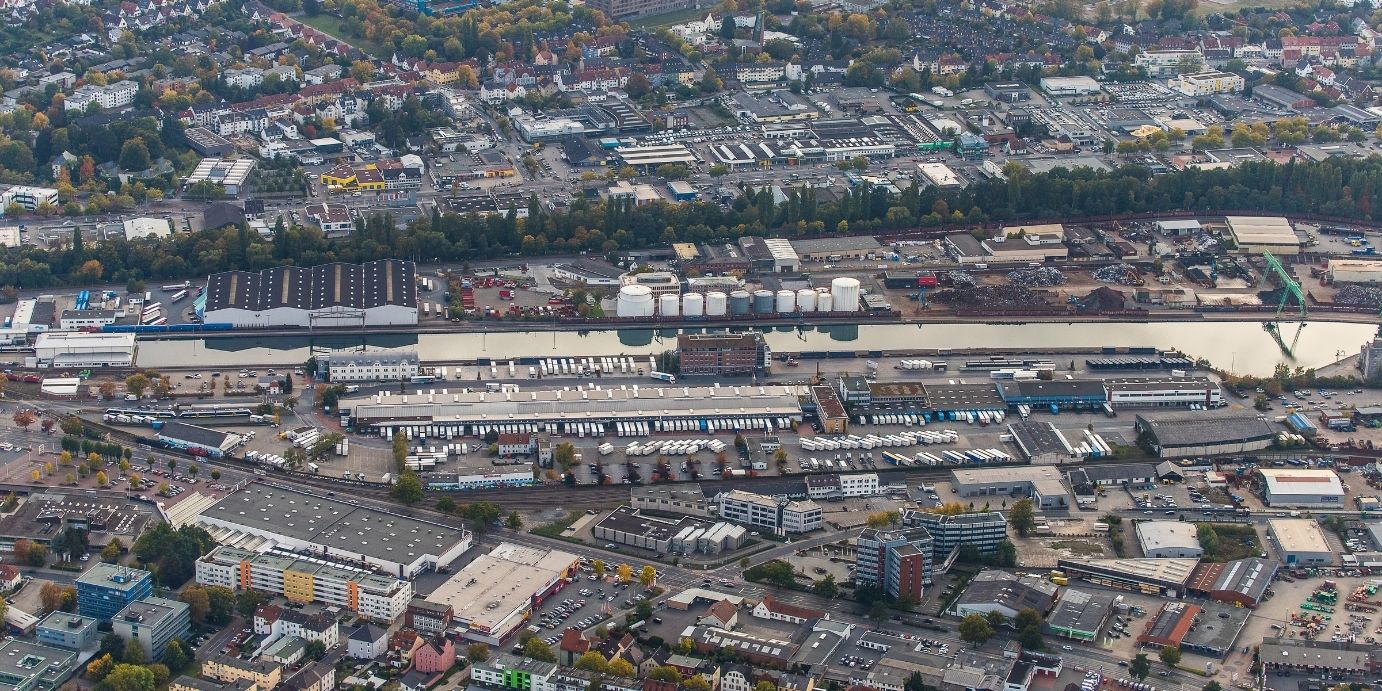
When talking about the "GVZ Osnabrück", it is in fact not a single, fenced area, as may be the case in other cities. Rather, it describes the functional cluster around Osnabrück's city harbour and the directly connected industrial estates in the districts of Hafen, Pye and the neighbouring municipalities.
The site acts as a classic interface (hub) for cargo handling in northwestern Germany. Historically grown by the textile and metal industry, the area has been transformed into a modern service centre. Not only storage takes place here; this is where value-added services are generated. The close integration of urban areas and the capacities of the surrounding municipalities (in the so-called "suburbs") creates a hybrid logistics area that enables both city logistics and international distribution.
Important question for site searchers: Does the location offer pure storage space or networked ecosystems? Answer: Osnabrück is characterized by an extremely networked ecosystem in which freight forwarders, contract logistics companies and CEP services (courier, express, parcel) work next door to each other.
Infrastructure is Osnabrück's decisive USP (Unique Selling Proposition). The region benefits from a historically favourable location on the major trade routes, which has been cemented in modern times by motorways and rail networks.
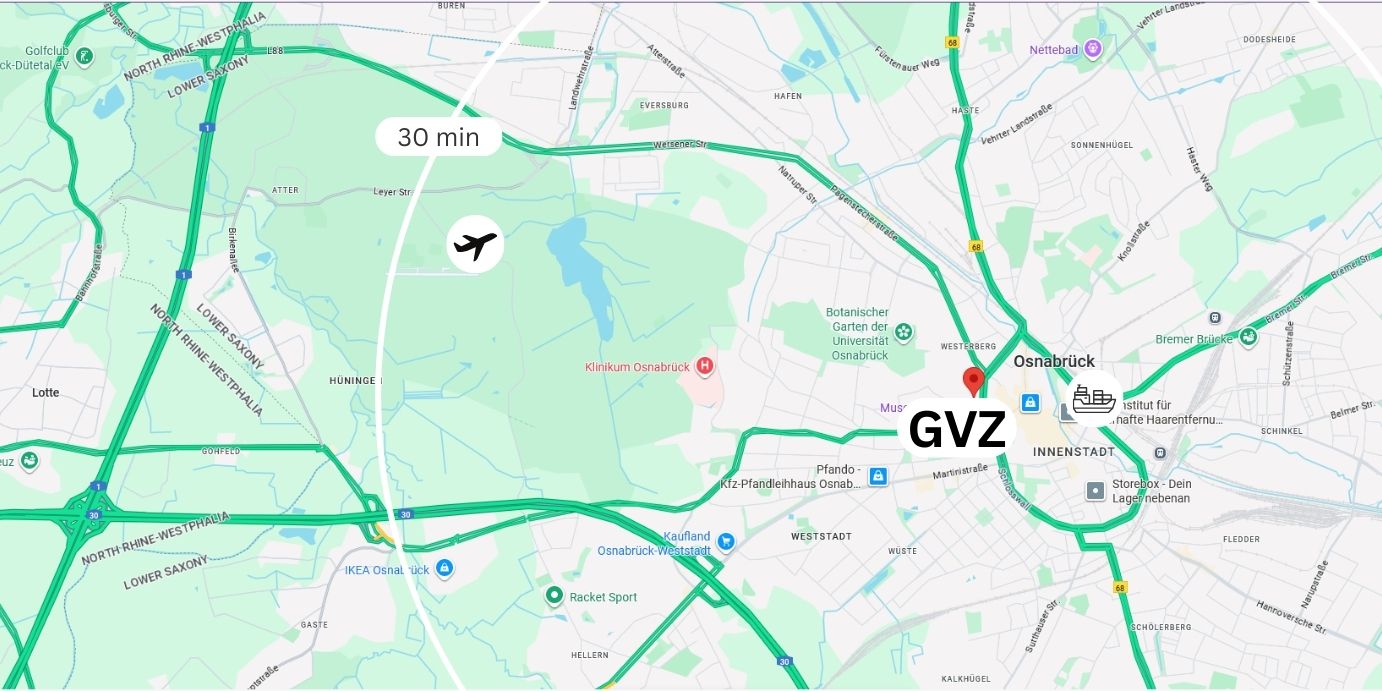
Osnabrück is located at one of the most important motorway junctions in Europe, the Lotter Kreuz. This is where the north-south axis and the west-east axis intersect:
This constellation enables trucks to reach and return to the major German seaports as well as the industrial heart of North Rhine-Westphalia and the Benelux countries within the legal driving times.
The heart of rail-bound freight transport is the Container Terminal Osnabrück (CTOS). It has been extensively modernised and expanded (commissioning of the extension around 2021).
The Port of Osnabrück is an inland port on the Osnabrück branch canal, which flows directly into the Mittelland Canal .
Münster/Osnabrück Airport (FMO) is only about 30 kilometres to the south. Although FMO is primarily a passenger airport, it offers important belly freight capacities and serves as a location for express service providers. It is fully equipped for pure cargo charters.
Here are the hard facts condensed for the quick reader:
| Category | Facts / Figures |
| Type | Trimodal freight village (road, rail, water) |
| Motorways | A1, A30, A33 (Lotter Kreuz) |
| Container Terminal | CTOS: Capacity approx. 150,000 load units/year, warehouse 2,000 TEU |
| Port turnover | Handling approx. 1.2 - 1.5 million tons (rail & ship) p.a. |
| Tax (city) | Trade tax: 440 % |
| Tax (Surrounding Area) | Trade tax: approx. 360 - 390 % |
| Research | Osnabrück University of Applied Sciences (Logistics Management), ICO InnovationsCentrum |
| Feature | Strong presence of Fashion Logistics and Food Logistics |
Special features & innovation: Osnabrück is increasingly distinguishing itself as a green logistics hub. The container terminal is powered by green electricity. In addition, there are pilot projects for hydrogen trucks and e-mobility in city distribution, promoted by the proximity to innovative municipal utilities and the university's research.
→ Warehouse Salzgitter
→ Warehouse Goslar
→ Warehouse Göttingen
The GVZ Osnabrück is a trimodal location. This means that goods can be handled between the three modes of transport: ship, rail and truck.
Why is this important? In times of driver shortage and CO2 reduction targets (green logistics), the modal shift is no longer a "nice-to-have", but an economic necessity. A special feature of the Osnabrück terminal is its operator structure: The CTOS is operated by a consortium in which local logistics giants such as Hellmann Worldwide Logistics, Koch International and Nosta as well as the municipal TBOS are involved. This guarantees that the infrastructure is precisely tailored to the needs of the local economy and is not controlled by external corporate interests.
Osnabrück is regularly listed in the rankings of the Fraunhofer Working Group for Supply Chain Services (SCS) as part of the top logistics region "Münster/Osnabrück".
The region is also part of the "Hanseatic Axis", which makes it strategically indispensable for the hinterland connection of the German seaports.
Osnabrück's economic DNA is characterized by owner-managed medium-sized companies that have become global players. There is hardly any other city of this size in Germany that has such a high density of large logistics headquarters.
Economic trend: The trend is moving away from pure transport to contract logistics. Companies are locating their e-commerce fulfillment centers here because the cut-off times (latest order time for next-day delivery) are very convenient due to the central location.
→ Bremen Freight Center
→ Emsland Freight Center
→ Hannover-Lehrte Freight Center
The high attractiveness has its price. Space in the direct port area is in short supply (brownfields). Expansion often takes place in the surrounding area (greenfields), but even here the space is becoming scarce.
Note: Prices are subject to strong fluctuations depending on the micro location and current interest rate developments. A concrete valuation always requires an up-to-date broker's report.
For investors, it is crucial to look at trade tax. This shows a clear difference between the independent city of Osnabrück and the district.
This tax differential means that space-intensive warehouse logistics tend to migrate to the district, while administration-intensive headquarters functions and city logistics remain in the city.
The Osnabrück/Emsland region traditionally has a high employment rate.
The analysis shows that the Osnabrück freight village is much more than a transit station. The combination of trimodal infrastructure, the strategically unbeatable location at the intersection of the A1/A30 and a grown entrepreneurial structure makes the location extremely resilient.
Although costs (rents and taxes in the city) have increased, the utility justifies this investment for companies that rely on fast turnaround times and multimodality. If you are looking for purely cheap storage space, you will move further into the depths of Lower Saxony – but if you want to operate high-performance logistics with connections to world markets, you will find optimal conditions in Osnabrück.
Next step for interested parties: Would you like a detailed list of the currently available commercial space in the district of Osnabrück or a contact list of the economic development department for a specific settlement project? I can help you identify the right contacts.
Commercial property, logistics property and contract logistics in Hesse at a glance - LAGERflaeche.de!
Object no.: 10182
Rental
Germany
34399 Oedelsheim
Price on request
Object no.: 10181
Rental
Germany
34385 Bad Karlshafen-Helmarshausen
Price on request
Object no.: 10104
Warehousing (warehouse with management)
Germany
64646 Heppenheim
Price on request
Object no.: 10073
Warehousing (warehouse with management)
Germany
34582 Borken
Price on request