
Commission-free offer
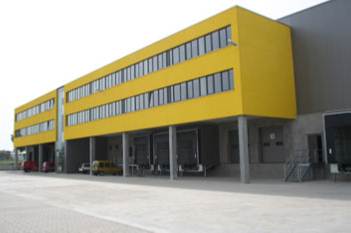
Kontraktlogistik bei Hannover
Object no.: 4498
Contract logistics
Warehousing (warehouse with management)
Germany
30855 Hannover/Langenhagen
21000 m²
Price on request

Germany's digital revolving door for combined transport.
Object no.: 4498
Warehousing (warehouse with management)
Germany
30855 Hannover/Langenhagen
Price on request
» Key Facts and General Description of the Location
» The Location: At the Epicentre of European Traffic Flows
» Infrastructure and Modality: The Bimodal Heart "MegaHub"
» Top Logistics Region Hanover-Braunschweig: Why here?
» Local Companies and Economic Development
» Hard Location Factors: Rent, Property and Tax Data (as of 2024/2025)
» The Situation of Workers and Skilled Workers
» Conclusion and Practical Benefits for Decision-makers
The Hanover-Lehrte freight village is no ordinary logistics park. It is the beating heart of one of Europe's most dynamic logistics regions and the physical manifestation of Germany's transport transition. Instead of spreading over hundreds of hectares with countless freight forwarding halls, this location concentrates its power on a single, revolutionary point: the MegaHub Lehrte.
For logistics decision-makers, investors and freight forwarders, the question is no longer whether combined transport (CT) is coming, but where it works most efficiently. Why is this location, east of Hanover, considered the epicentre for future-proof cargo handling? This non-fiction text analyzes the hard and soft factors of the GVZ Hanover-Lehrte, from its unique infrastructure to tax data to the tense skilled worker situation.
The Hanover-Lehrte freight village, often used synonymously with the MegaHub, is located on a total area of around 35 hectares (source: Deutsche GVZ-Gesellschaft mbH). In contrast to traditional, space-intensive freight villages, which are primarily designed for warehousing and distribution, Lehrte is designed as a high-performance transshipment point.
The site was not developed as a "greenfield", but strategically built on the site of the former, historically important Lehrte marshalling yard. This revitalisation of a railway wasteland is a prime example of sustainable land use.
The primary and almost exclusive focus of the GVZ is on the handling of loading units (containers, semi-trailers) in combined transport. It serves as a "hub-and-spoke" system that bundles, sorts and redistributes national and international flows of goods. Deutsche Bahn, as the main player via the "MegaHub Lehrte Betreibergesellschaft mbH", has invested massively here to transform a bottleneck in the German rail network into a high-performance hub.
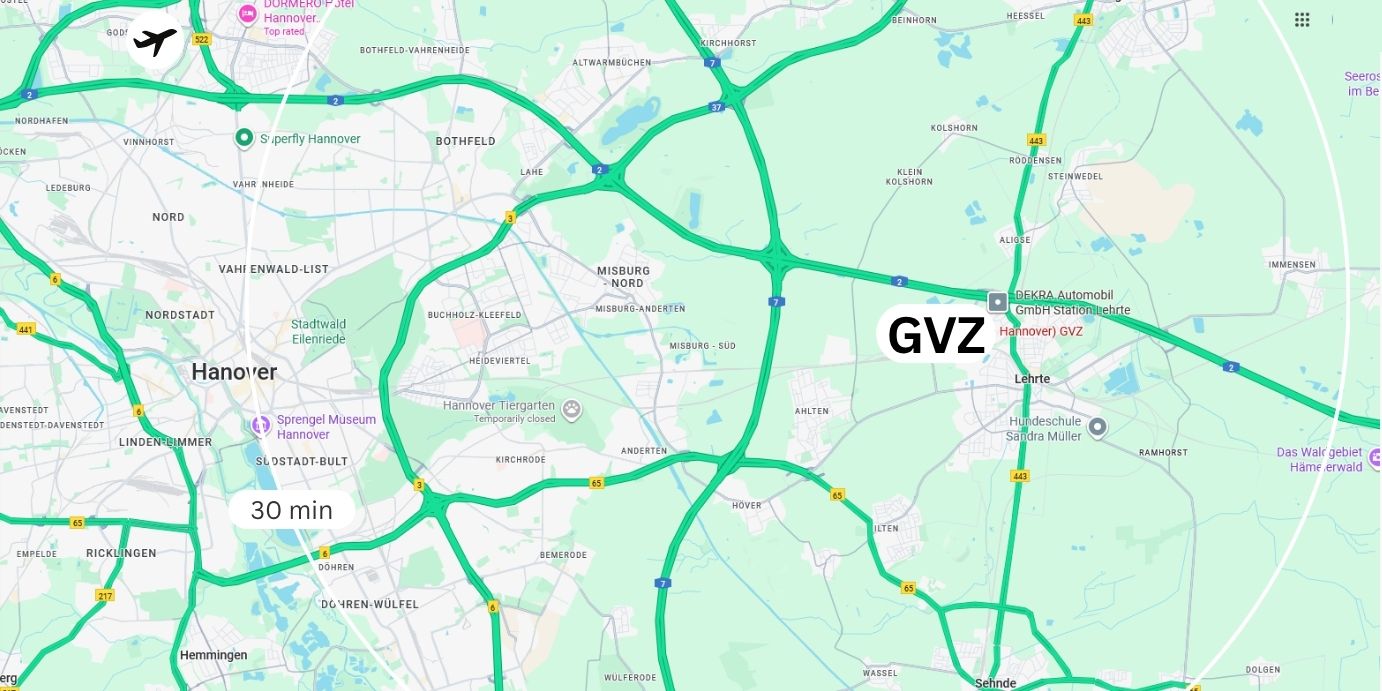
Perhaps the greatest strength of the GVZ Hanover-Lehrte is its macrogeographical location. Location decisions in logistics are inextricably linked to the "last mile" and the connection to main traffic arteries.
This location minimizes lead and lead times on the road and positions the freight village as an ideal consolidation point for goods from all directions.
→ Warehouse Göttingen
→ Warehouse Wolfsburg
→ Warehouse Hanover
The question of modality is quickly answered in Lehrte: The GVZ is a bimodal (road/rail) top location with a strategically excellent connection to the trimodal waterway (Port of Hanover) and air (HAJ). The real innovation, however, lies in the way the rail connection was realized.
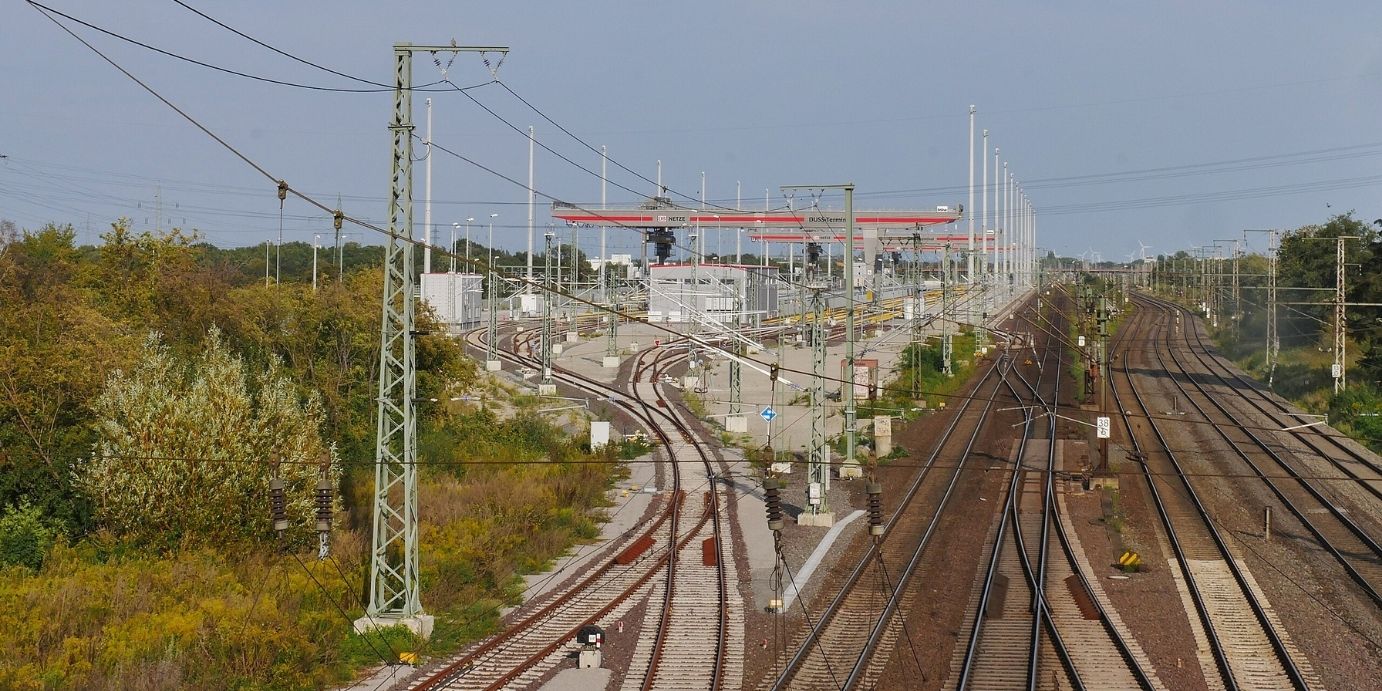
The site's unique selling point (USP) is the MegaHub Lehrte, which went into full operation in 2021 after an investment of around 170 million euros by the federal government and Deutsche Bahn.
Thanks to this technology, loading units can be handled directly from train to train or from truck to train and vice versa, without the need for the trains to leave the facility or be regrouped. This enables the so-called "night jump": A container that arrives in Lehrte in the evening can be sorted overnight and reaches its destination in Germany or neighbouring countries the next morning.
The annual handling capacity of the facility is designed for up to 269,000 loading units (TEU or semi-trailer). According to Deutsche Bahn, this has the potential to shift up to 384,000 truck journeys per year from road to rail.
The Hanover-Lehrte freight village is not a solitaire; it is the anchor point of the Hanover-Braunschweig-Göttingen-Wolfsburg metropolitan region. This region has been considered one of the top 3 logistics regions in Germany for years.
The reasons for this top position are manifold:
The Lehrte freight village is the logical consequence of this density. It was built to bundle the enormous flow of goods that flows through this region or is created here more efficiently, quickly and sustainably.
The economic development of the location is the MegaHub. While other freight forwarders have a colourful mix of freight forwarders, contract logistics companies and trading warehouses, the Lehrte freight village focuses on transshipment. The main player is DB Cargo or the operating company.
However, the "ecosystem" around the GVZ benefits massively. In the city of Lehrte and the surrounding industrial estates (e.g. Lehrte-Ost), numerous logistics service providers have settled to organize the pre- and on-carriage to the MegaHub. These include companies with a focus on warehouse logistics, transport and specialised service providers. Well-known names that operate an important location in the city of Lehrte (not necessarily directly on the GVZ site) are, for example:
The economic development is thus less characterized by new settlements in the GVZ itself (the 35 hectares are largely occupied by the transshipment facility), but by the magnetic effect on the surrounding industrial estates. The investment of 170 million euros was an initial spark for the entire regional logistics industry.
For investors and companies willing to settle here, costs are often the deciding factor. How does Lehrte compare to other hotspots?
Prices for logistics properties in the Hanover region have risen sharply in recent years due to extremely high demand and the shortage of space. Lehrte is in the upper third of this market.
An often underestimated, but significant cost factor is the municipal assessment rates. The city of Lehrte has adjusted its assessment rates for 2025.
According to the official assessment rate statute of the city of Lehrte (valid from 01.01.2025), the following rates apply:
The trade tax rate of 480% can be classified as high in a regional and national comparison. The state capital of Hanover, for example, is at 480%. This signals that the city is aware of its strong economic position and high demand, but represents a relevant cost block for companies.
→ Bremen Freight Center
→ Emsland Freight Center
→ Europark Coevorden-Emlichheim Freight Center
Image Credit: Fuhbär / CC BY-SA 4.0
A top location needs top personnel. The Hanover logistics region has a large reservoir of workers. According to statistical data, around 31,500 people are employed in the logistics industry in the Hanover region alone, subject to social security contributions.
But the situation is tense. As in the rest of Germany, there is an acute shortage of skilled workers in the Hanover region, especially in:
Competition for qualified personnel is fierce. This is also reflected in salaries. According to the Remuneration Atlas of the Federal Employment Agency, the median salary for a "Warehouse Logistics Specialist" in the city of Hanover is approx. €3,841 (gross, full-time). This value is significantly above the Lower Saxony average (approx. €3,194) and shows that companies in the state capital and its surrounding area (such as Lehrte) have to dig deeper into their pockets to find and retain staff.
At the same time, the region is characterized by an aging workforce in logistics, which will further increase the pressure on recruiting junior staff in the coming years.
The Hanover-Lehrte freight village is not an all-rounder location for every logistics company. It is a highly specialized, technology-driven terminal for combined transport.
The Hanover-Lehrte freight village is the successfully implemented promise to make freight transport in Germany faster, more efficient and more environmentally friendly. It is an investment in the future that comes at a price – but offers invaluable strategic value at the heart of European commodity flows.
Commercial property, logistics property and contract logistics in Hesse at a glance - LAGERflaeche.de!
Object no.: 10182
Rental
Germany
34399 Oedelsheim
Price on request
Object no.: 10181
Rental
Germany
34385 Bad Karlshafen-Helmarshausen
Price on request
Object no.: 10104
Warehousing (warehouse with management)
Germany
64646 Heppenheim
Price on request
Object no.: 10073
Warehousing (warehouse with management)
Germany
34582 Borken
Price on request