


Commission-free offer
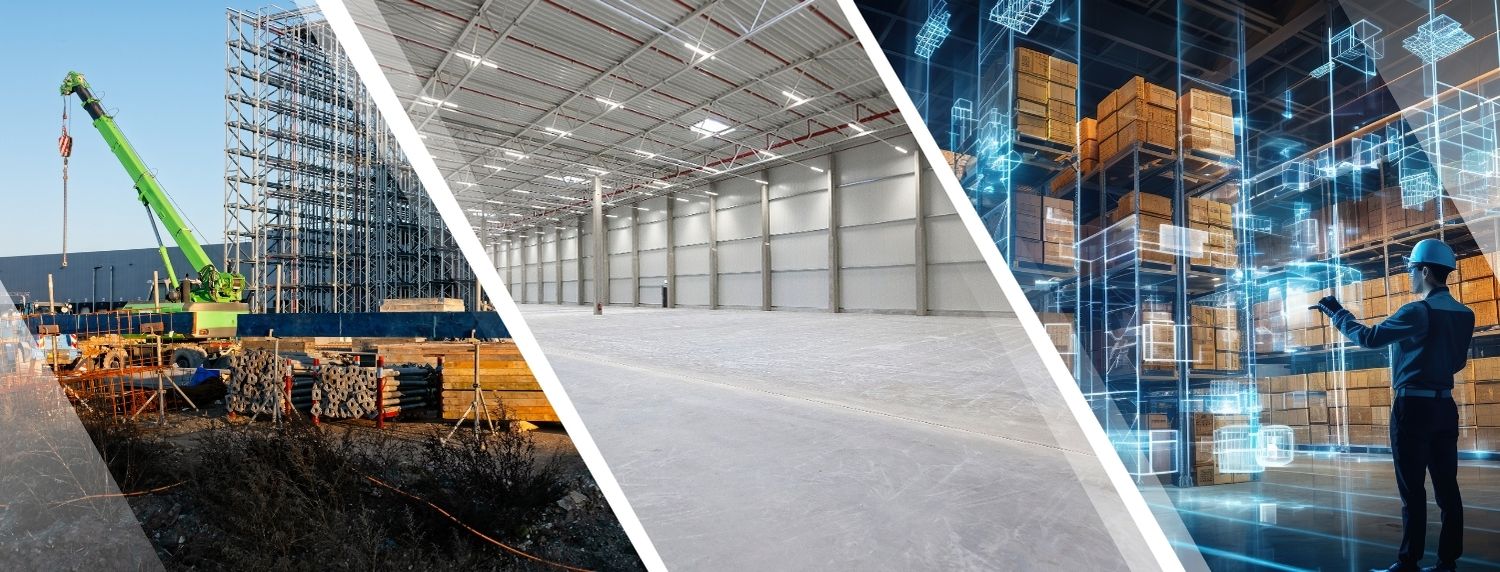
Gewerbehalle in attraktiver Lage
Object no.: 10182
Logistics real estate
Rental
Germany
34399 Oedelsheim
16.000 m²
Price on request

Bavaria's automotive logistics heartbeat
» The Ingolstadt freight village: Bavaria's automotive logistics heartbeat
» Key facts of the GVZ Ingolstadt at a glance
» Location and accessibility: At the heart of Bavaria's value creation
» The infrastructure axis: bimodality as a strategic advantage
» The Audi factor: A freight transport center as an integral part of the work» Hard Facts for Investors: Land and Rent Price Analysis
» Economic Environment: Taxation and Development
» Top logistics region: Why Ingolstadt is (more than just) Audi
» The human factor: The labor and skilled worker situation
» Conclusion: A high-performance location with a clear focus
In the dynamic field of European logistics hotspots, there are locations that impress with their sheer size, and there are locations that define what "efficiency" means through their strategic precision and deep integration into high-performance supply chains. The Ingolstadt freight village (GVZ) undeniably belongs to the second category. It is much more than just a transshipment point for goods; it is an integral part of one of the most complex and successful automotive production in the world.
This non-fiction text serves as a comprehensive location description and analysis for logistics experts, investors and companies who want to understand the strategic importance of the Ingolstadt freight village. What makes this location, which was developed in 1995 by IFG - Wirtschaftsförderungsgesellschaft Ingolstadt , one of the leading logistics centres in Europe? Is it just the direct proximity to Audi or do other factors play an equally decisive role? We take a deep dive into the infrastructure, cost structures and real market conditions that characterise this location.
Before we go into the detailed analysis, here are the most important key data that form the foundation of the site:
| Operator | IFG - Wirtschaftsförderungsgesellschaft Ingolstadt mbH |
| Total area | approx. 118 hectares (net area) |
| Modality | Bimodal (road / rail) |
| Core infrastructure | Direct KLV terminal (combined loading traffic) |
| Dominant sector | Automotive logistics |
| Main settlers | Audi AG and its system suppliers/logistics service providers |
| Special feature | Direct, in-plant bridge connection to the Audi plant |
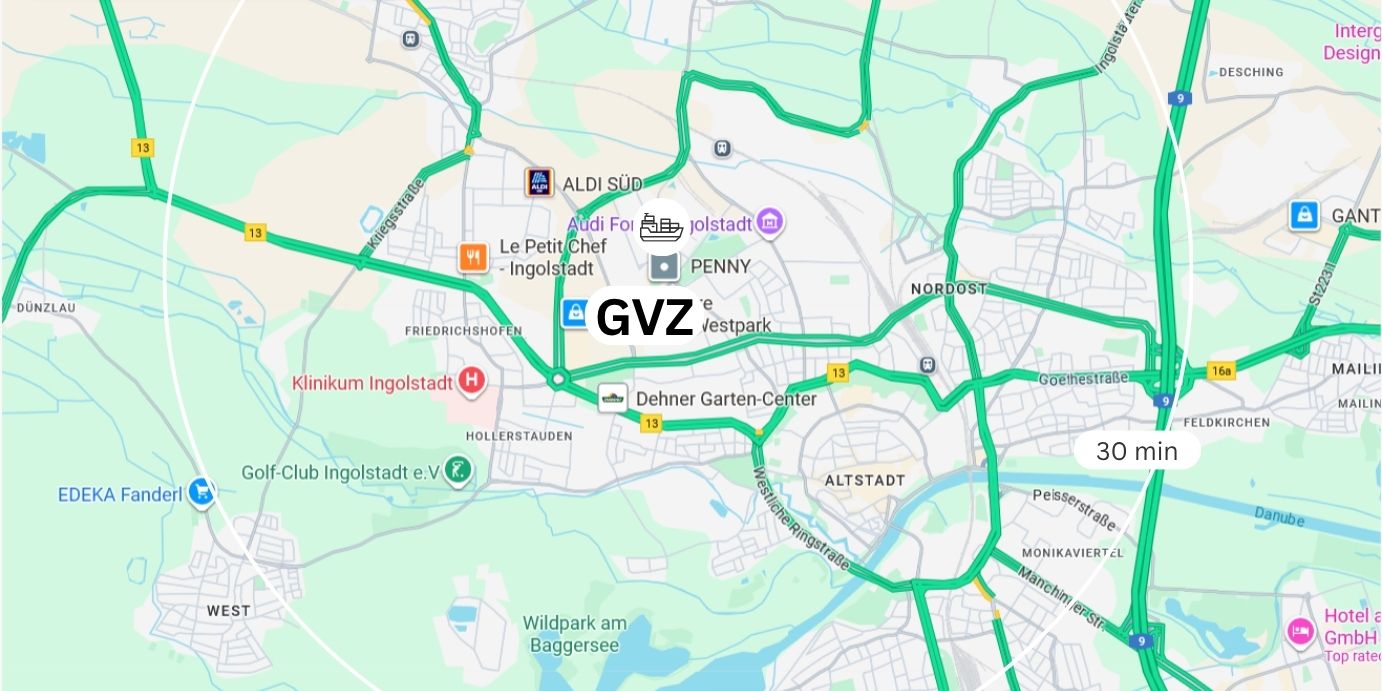
The strategic importance of a logistics location always begins with its geography. The Ingolstadt freight village is located in the north of the city of Ingolstadt, in the heart of Bavaria, and is positioned exactly between the metropolitan regions of Munich and Nuremberg.
The road connection is a prime example of efficiency. It is defined by short distances to Germany's most important transport axes:
This first-class connection ensures minimal transport times on the "last mile" to the motorway and enables flexible, high-frequency truck control – a basic prerequisite for just-in-time (JIT) and just-in-sequence (JIS) delivery to automotive production.
The true strength of the GVZ Ingolstadt and its decisive competitive advantage lies in its perfect bimodal orientation.
The heart of the GVZ is the high-performance KLV terminal (combined loading traffic), which is integrated directly on the site. Operated by DUSS (Deutsche Umschlaggesellschaft Schiene-Straße mbH), this terminal acts as an interface between long-distance rail transport and short-distance truck distribution.
The terminal has several loading tracks (six according to Wikipedia data) and is directly connected to the main Munich–Nuremberg line. This enables daily, direct block train connections to German and European economic centres and seaports (e.g. Hamburg, Bremerhaven, Rotterdam).
For the local companies, above all Audi, this means:
The location is bimodal (road/rail) and not trimodal. Although the Danube flows through Ingolstadt and the port of Kelheim/Saal is not far away, the GVZ itself does not have a direct water connection.
Is that a disadvantage? For the specific focus of the GVZ Ingolstadt: No. The site was not designed for bulk cargo handling (such as ores or coal), but for the high-frequency, fast and precise parts logistics of the automotive industry. Here, the cycle times and flexibility of road and rail are superior to the slower cycles of inland shipping. The decision to opt for a purely bimodal concept was a deliberate strategic focus on the needs of the automotive supply chain.
For time-critical freight, especially in the global spare parts business or in the event of production bottlenecks, air freight connections are essential.
The nearest international cargo airport is Munich Airport (MUC) "Franz Josef Strauss".
In addition, Nuremberg Airport (NUE) (approx. 90 km) offers another option, especially for intra-European freight. For the logistics companies in the freight village, this means convenient redundancy and quick access to global air freight capacities.
You can't talk about the Ingolstadt freight village without mentioning Audi AG. The GVZ was built primarily with the aim of optimising and consolidating the logistics processes of the neighbouring main plant and covering external logistics and production space requirements.
The GVZ is basically an outsourced part of the Audi plant. It houses a large number of module and system suppliers as well as logistics service providers (3PL/4PL) that are directly involved in Audi's production processes. Names such as LGI Logistics Group International GmbH and various other specialized service providers operate consolidation centers, assembly lines and warehouses here.
However, recent developments, such as Dachser's announcement that it will open a new logistics center for industrial and consumer goods in Ingolstadt (planned for 2025), show that the location is also becoming more attractive for network logistics companies beyond its pure automotive ties.
What makes the Ingolstadt freight village special in terms of construction and concept?
For companies considering a settlement, the costs for land and real estate are decisive. But what is the market like in such a sought-after region?
Demand in the Ingolstadt freight village has consistently exceeded supply for years. The IFG, as a developer and broker of land in the GVZ, often only issues official prices "on request", as the allocation is strategic.
However, the free market for logistics real estate and commercial real estate in the Ingolstadt region is clearly defined: it is expensive and space is extremely scarce.
Analysis for Ingolstadt: The Ingolstadt freight village is priced well above the level of Nuremberg. Due to the extreme demand, the direct Audi connection and the proximity to Munich, a prime rent in the range of €8.50/m² to €10.00/m² can be expected for new-build logistics space. The IHK location survey of 2023 confirms this: Local companies cite "high lease costs" and "lack of commercial space" as the biggest obstacles to growth.
Practical conclusion: If you want to go to the Ingolstadt freight village, you have to be prepared to pay premium prices. The site is not sold on price, but on its irreplaceable strategic function.
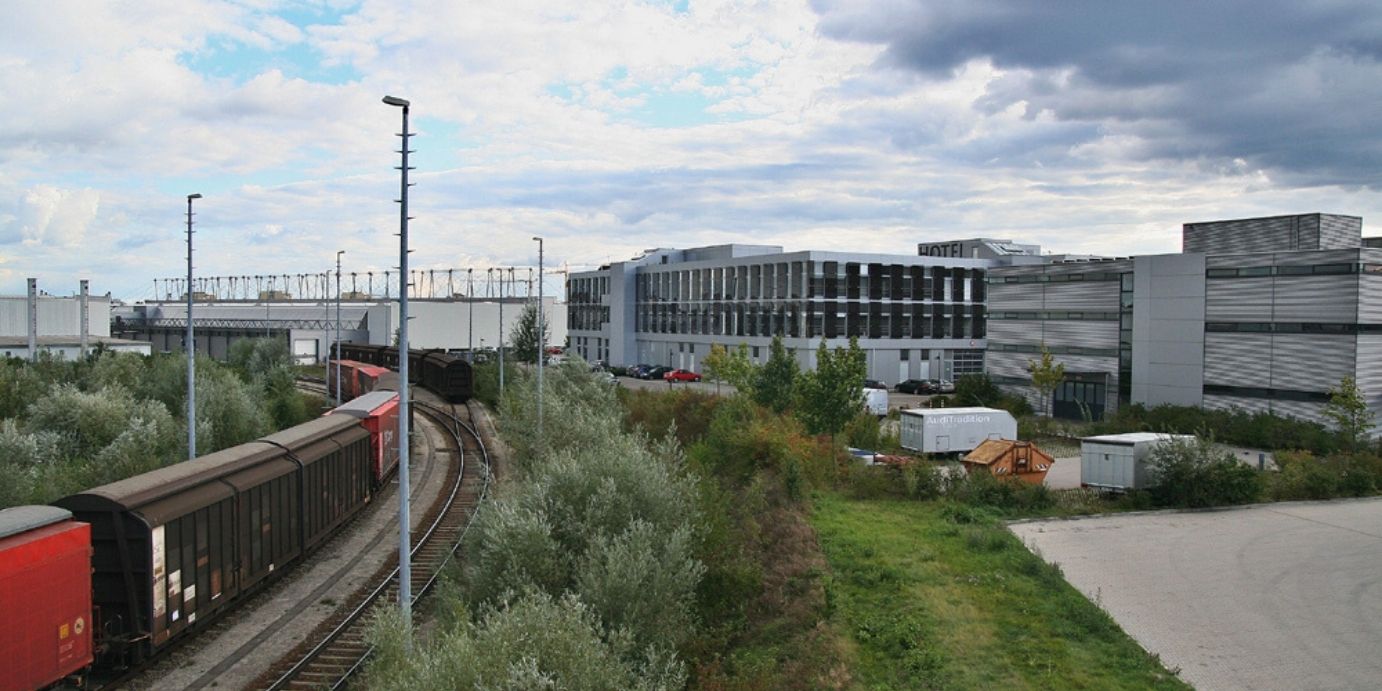
Image Credit: Sese_Ingolstadt | CC-SA-3.0
In addition to real estate costs, municipal taxes are a decisive factor.
The city of Ingolstadt applies the following assessment rates (as of 2024/2025):
Analysis: A trade tax rate of 400 points is in line with the Bavarian and German average for cities of this size. It is neither a bait (as is often the case in rural areas) nor a prohibitively high rate (as in some metropolises, e.g. Munich with 490%). For companies, this is a solid, calculable value that is considered fair in view of the outstanding infrastructure and economic power. (Source: Federal Statistical Office / City of Ingolstadt, 2024).
The economic development of "Region 10" (Ingolstadt and the surrounding area) is one of the most dynamic in Germany. In the renowned Prognos Future Atlas, which evaluates the future viability of all 400 German districts, the city of Ingolstadt regularly occupies top positions (e.g. 4th place in the 2022 ranking).
The region often leads in the categories "Competition & Innovation" and "Strength". This economic robustness, driven by the automotive and technology industries, ensures a stable order situation, but also the aforementioned pressure on the real estate and labor market.
The question of why Ingolstadt is a top logistics region can now be answered in summary. It is the synergy of five core elements:
Perhaps the most critical and challenging aspect of the Ingolstadt location is the labor market.
The region is booming, unemployment is traditionally extremely low. For local companies, this is both a blessing and a curse. The market for qualified workers is empty.
The Chamber of Industry and Commerce for Munich and Upper Bavaria provides clear (and alarming) data for Ingolstadt in its 2023 location survey:
A company planning to settle in the Ingolstadt freight village must have a proactive personnel strategy:
At the same time, the location benefits from the excellent reputation of the Technical University of Ingolstadt (THI) and the WFI, which produce highly qualified graduates in the fields of logistics, supply chain management and industrial engineering. However, the competition for these "high potentials" is just as intense.
The Ingolstadt freight village is not an all-purpose logistics park. It is a highly specialized center for automotive logistics and technologically demanding industries trimmed for maximum efficiency.
Its strengths – bimodal perfection, proximity to the A9 and symbiotic relationship with Audi – are second to none. However, these strengths come at a price: high real estate costs and an extremely tight market for skilled workers.
For companies whose business model relies on high-frequency deliveries to southern German industry or on the use of efficient rail corridors, the Ingolstadt freight village offers strategic value that can justify the high costs. It is and remains a location for Champions League logistics.
Commercial property, logistics property and contract logistics in Hesse at a glance - LAGERflaeche.de!
Object no.: 10182
Rental
Germany
34399 Oedelsheim
Price on request
Object no.: 10181
Rental
Germany
34385 Bad Karlshafen-Helmarshausen
Price on request
Object no.: 10104
Warehousing (warehouse with management)
Germany
64646 Heppenheim
Price on request
Object no.: 10073
Warehousing (warehouse with management)
Germany
34582 Borken
Price on request