
Commission-free offer

Kontraktlogistikfläche Osnabrück
Object no.: 9405
Contract logistics
Warehousing (warehouse with management)
Germany
49086 Osnabrück
12000.00 m²
16000 (PP)
Price on request

A specialized textile warehouse forms the dynamic backbone of every successful supply chain in the fashion industry. Whether flat-packed goods, accessories or hanging clothing – the fast and error-free processing of seasonal fashion items requires a highly flexible storage solution.
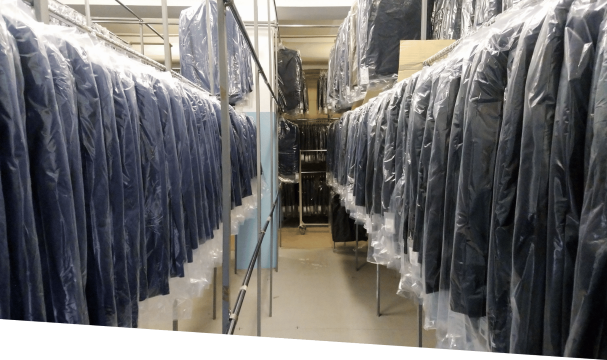
The market for sophisticated industrial real estate in the apparel industry is fast-paced and highly competitive. Discover current vacancies on our matching platform that are precisely tailored to your specific requirements in textile fulfillment. Filter offers by location, technical building equipment and the availability of customer-specific value-added services.
Object no.: 9405
Warehousing (warehouse with management)
Germany
49086 Osnabrück
Price on request
» What is a textile warehouse?
» Shelving systems and intralogistics for clothing
» Value Added Services (VAS): The refinement of fashion logistics
» Returns management: The supreme discipline of the location solution
» Technical requirements for the commercial property
» Digitization and automation in the warehouse center
» Rental models, scalability and cost factors
» Frequently Asked Questions (FAQ) about the Textile Warehouse
A textile warehouse is a specialized type of warehouse that is primarily designed for the storage, picking and processing of clothing, fabrics and textile accessories. The physical basis for such a warehouse center is usually a classic dry warehouse. Such ambient locations are specially designed for e-commerce and the trade in clothing. They do not require active temperature control, but reliably protect the sensitive textiles from direct weather influences such as rain, snow or UV radiation.
Intralogistics in a textile warehouse must ensure quick access to an enormous variety of items (SKUs).

The mere storage of boxes is no longer sufficient in the modern clothing industry. In order to secure competitive advantages, companies rely on specialized service providers who integrate value-adding activities directly into the commercial property. Industry-specific value-added services include:
Returns management is the absolute biggest challenge in textile e-commerce. Around 20 to 40 percent of fashion items ordered online are returned by consumers. Dedicated returns hubs are therefore set up in a modern warehouse solution. Here, specialists collect the returns, carry out quality checks and professionally refurbish the goods before they are returned to local inventory. Efficient reverse logistics in one's own industrial property not only protects margins, but also significantly improves the ecological balance.
Anyone looking for a storage area for textiles must carefully evaluate the building fabric. A modern storage center for fashion items must meet strict infrastructural requirements.
In a textile storage area, the humidity is usually not actively regulated, but often settles between 40% and 65% in line with the outdoor climate. Since clothing is very sensitive to dirt, the cleaning concept of the hall is essential. Especially in e-commerce logistics, an extremely large amount of packaging material and fine dust accumulates due to permanent cardboard abrasion, which makes ongoing maintenance cleaning of the picking aisles absolutely necessary.
Avoid rigid fixed costs, inefficient returns processes and unsuitable storage areas. Choosing the exact right commercial property is the key to a profitable and scalable fashion brand. LAGERflaeche.de is a B2B platform that connects you directly with real estate developers and certified service providers.
The rapid development of fashion trends calls for an IT-controlled fulfillment solution. A powerful warehouse management system (WMS) controls paperless picking and assigns each garment a route-optimized place via barcode or RFID. For highly fluctuating, rapidly changing assortments – as is common in the fashion industry – location solutions are increasingly benefiting from modular grid systems. These allow the physical division of the industrial property to be adapted to new collections in a highly dynamic manner.
Since the clothing industry is subject to strong seasonal fluctuations (e.g. summer/winter collection, Black Friday), flexible rental models are becoming established. Instead of rigid fixed costs, specialized service providers offer models such as pay-per-shelf (rent per shelf) or pay-per-pick (transaction-based billing). Certain logistics regions have established themselves as real fashion hubs: For example, service providers at the Leipzig warehouse location focus strongly on fashion logistics and e-commerce fulfillment. Locations in Belgium are also highly specialized and in demand for cross-border cross-docking of fashion products.
A shelving storage system is ideal for small-scale, unpalletized goods, cartons and textiles. It offers ergonomic, direct access to each individual fashion item and is perfectly designed for manual picking processes.
Typical value-added services in a textile site solution include iron-on textiles, quality control, labeling, and brand-specific set formation.
In the fashion industry, around 20 to 40 percent of items ordered online are returned. A professional returns hub within the commercial property efficiently prepares these goods (refurbishment) in order to get them back on sale as quickly as possible and stop margin losses.
Clothing is usually stored in a classic dry warehouse, which protects against the weather but does not require active cooling. The humidity there is usually within a safe range between 40% and 65%.
Yes, by outsourcing to specialized partners, you can use models such as pay-per-pick or pay-per-shelf. This means that you only pay for the warehouse space and transactions that you actually use in the respective season.
West
Rent a production hall in Frankfurt
Warehouse in Cologne
Industrial warehouse in Saarbrücken
South
Find Logistics Space in Munich
Storage Space in Nuremberg
Logistics Hall in Stuttgart
Rent Warehouse in Freiburg
Rent Warehouse Space in Italy
Logistics Hall in Austria
Storage Space in the Netherlands
Warehouses in France
Search Storage Space in Poland
Renting halls in Switzerland
Find logistics premises in Belgium
Storage in Bulgaria
Renting warehouses in the UK
Search for warehouse properties in Croatia
Logistics warehouses in Romania
Logistics centres in Russia
Search for warehouse locations in Slovenia
Rent warehouse space in Slovakia
Logistics property in Spain
Find storage space in Hungary
Rent a warehouse in the Czech Republic
Storage facility in Denmark