




Commission-free offer

500 qm Halle und 2000 qm Freifläche in 99869 Emleben
Object no.: 2480
Logistics real estate
Rental
Germany
99869 Emleben
14000.00 m²
Price on request

At the Erfurt freight transport center, road, rail and, depending on the site, inland waterways come together. On LAGERflaeche.de you will find warehouses, open storage areas and contract logistics within 50 km, offered by owners, operators and logistics providers. Your enquiry goes directly to the provider.
Object no.: 2480
Rental
Germany
99869 Emleben
Price on request
» Freight Transport Centre (GVZ) Erfurt: Analysis of the logistics heart in the middle of Germany
» General description: More than just a transshipment point
» Location: The Invaluable Advantage of Centrality
» Infrastructure and modality: The bimodal powerhouse
» Top Logistics Region Germany: The Facts Behind the Title
» Economic conditions: prices, taxes and development
» Companies located there: A "Who's Who" of logistics
» Workforce and skilled workers: The decisive resource
» Special features and key facts at a glance
» Conclusion
» Frequently asked questions about the Freight Transport Center Erfurt (FAQ)
In recent decades, the Erfurt freight village has developed into one of the most important logistics hubs not only in Central Germany, but throughout Germany. But what exactly makes this location so successful? Is it just the central location or is there more to the rise to become a top logistics region? This non-fiction text dives deep into the structures, conditions and potentials of the GVZ Erfurt and provides a comprehensive description of the location for logistics experts, investors and companies.
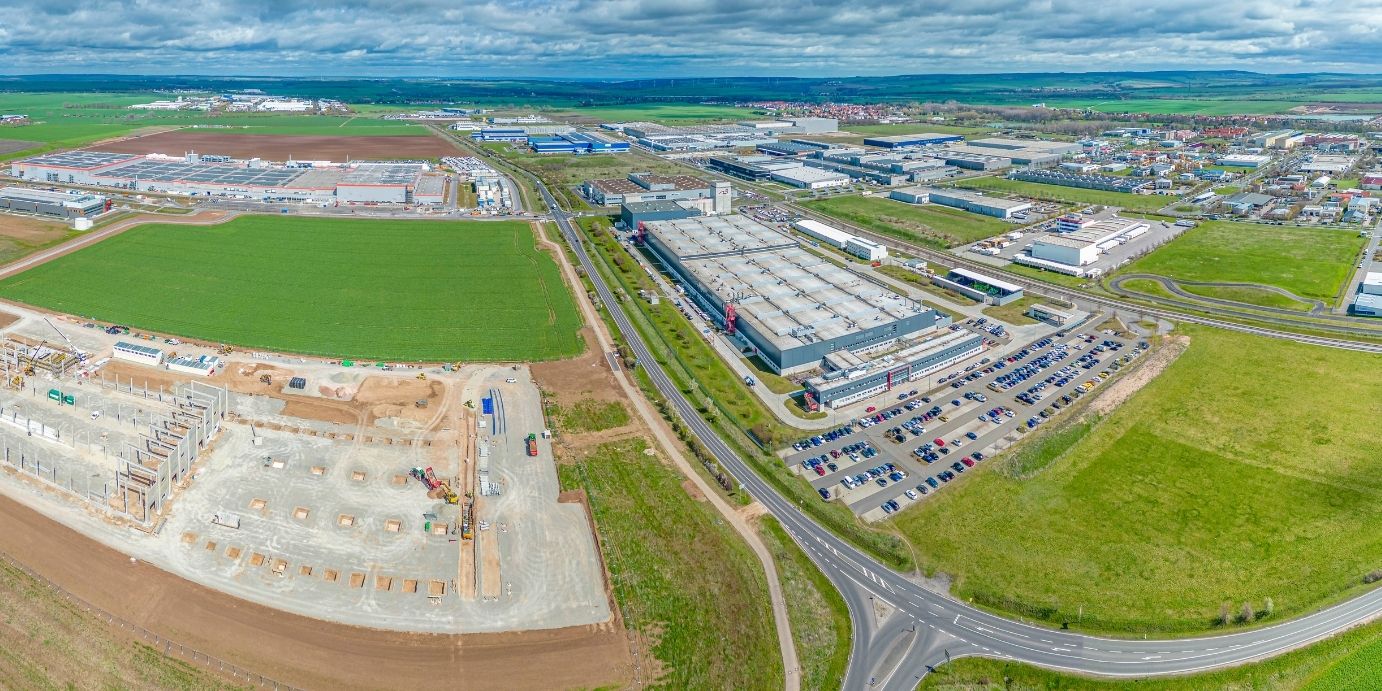
The GVZ Erfurt is a planned large-scale commercial area that is specially tailored to the needs of traffic- and logistics-intensive companies. On a total area of around 280 hectares gross (218 hectares net), it combines logistics and distribution centres, service companies and the manufacturing industry. The aim of a freight village is to intelligently bundle freight transport and to efficiently link the modes of transport road, rail and, if necessary, waterways in order to create synergies and relieve the burden on the environment.
The Erfurt model is a prime example of a successful implementation of this concept. It acts as a central hub for the national and international movement of goods and, thanks to the concentration of logistics service providers, freight forwarders and industrial companies, offers an exceptional density of logistics know-how and services in one place.
Probably the most obvious strength of the GVZ Erfurt is its geographical location. In the "green heart" of Germany, at the intersection of important European transport axes, the location offers unsurpassed accessibility.
Why is this central location so crucial in practice? For logistics companies, time equals money. From the Erfurt freight village, almost all German conurbations can be reached overnight. This enables late cut-off times for goods receipt and fast distribution. Within a truck driving radius of eight hours, around 80 million consumers in Germany and neighboring countries such as Poland, the Czech Republic and the Benelux countries can be supplied. This reach makes Erfurt an ideal location for e-commerce centers, central warehouses and European distribution hubs.
→ Warehouse Schmalkalden
→ Warehouse Eisenach
Warehouse Thuringia
A top location alone is not enough. The quality of a logistics location is largely determined by its infrastructural connections. Here, the Erfurt freight village scores with a direct and efficient link between road and rail modes of transport.
Is it a bimodal or trimodal GVZ? The Erfurt freight village is designed as a bimodal location , as it links road and rail. A direct waterway connection (trimodality) is not available due to the geographical conditions in Thuringia.
The Erfurt freight village has been awarded several times by the German GVZ Society (DGG) as the leading freight transport centre in Germany and Europe. This ranking is based on a variety of criteria that go beyond the mere size of the area.
What are the criteria for a top ranking? The assessment takes into account, among other things:
Erfurt convinces in all these points. The dynamic development, the high demand for space and the successful settlement of international top players confirm the quality and future viability of the location. (Source: DGG ranking, various years).
The "hard facts" – i.e. costs and the economic environment – are of decisive importance for a location decision.
→ Berlin Freight Center
→ Dresden Freight Center
→ Emsland Freight Center
The quality of a location can best be seen in the companies that set up shop there. The GVZ Erfurt is home to an impressive mix of logistics service providers, trading companies and industry. Some of the most well-known names include:
This concentration of industry leaders creates a unique ecosystem. Synergies are created in personnel recruitment, in the use of services and in the exchange of knowledge.
The best infrastructure is of no use without the people who operate it. What is the situation on the labour market in the Erfurt region?
The region of Central Germany has traditionally had a high potential of motivated workers. The unemployment rate is at a moderate level. However, the competition for qualified specialists – especially professional drivers, warehouse logistics specialists and forwarding agents – is also noticeable here.
The availability of personnel remains a challenge, but the framework conditions in the region are solid to master it.
What ultimately sets the Erfurt freight village apart from other locations? It is often the special details that make the difference.
(Sources: City of Erfurt, Logivest, umschlagbahnhoefe.de, as of 2026)
The Erfurt freight transport centre is much more than just a point on the map. It is a highly functional, integrated logistics ecosystem that benefits from its strategic location, excellent bimodal infrastructure and professional management. The combination of reach, competitive costs and a dynamic business environment rightly makes it one of the leading logistics locations in Europe. For companies that want to optimize their supply chains for the European market, there is hardly any way around a detailed analysis of the potential that lies dormant in the heart of Germany.
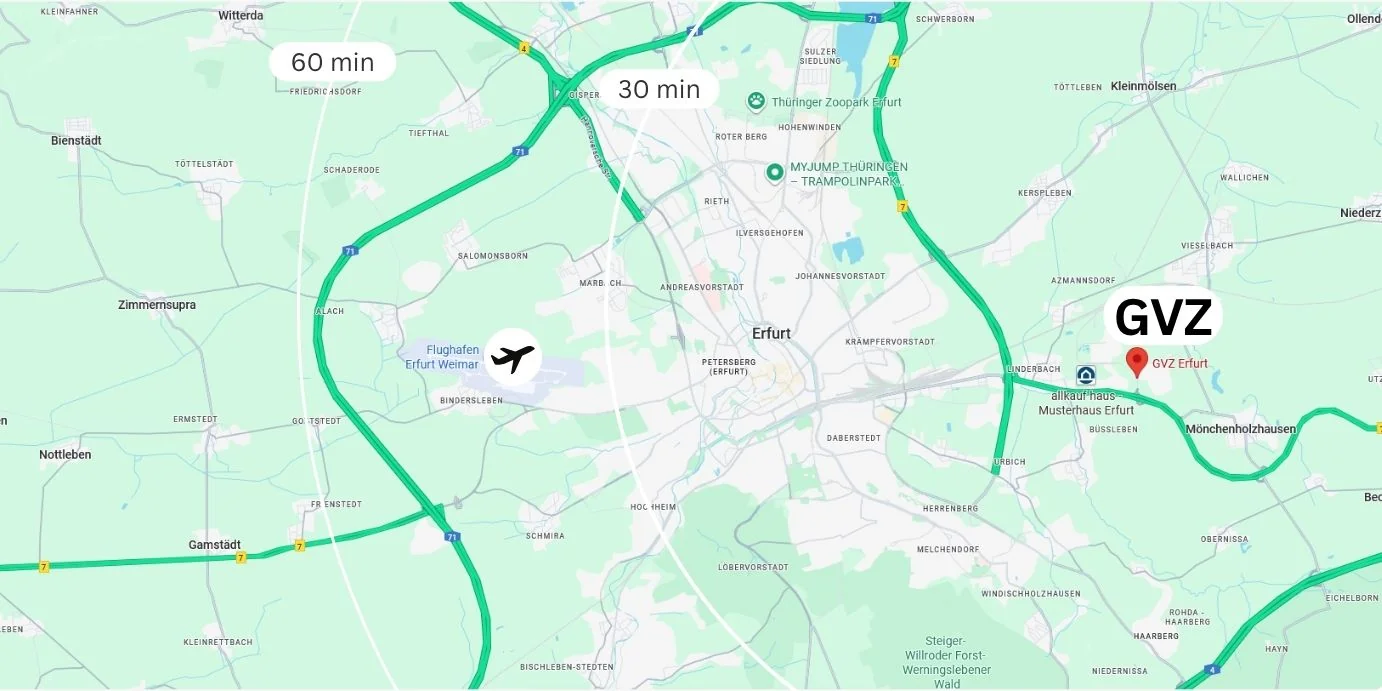
The GVZ is located in the east of Erfurt on the B7, around 5 km from the Erfurt-Vieselbach junction of the A4 and about 10 km from the Erfurt-Nord junction of the A71. The Erfurt-Vieselbach CT terminal provides the rail connection. Erfurt-Weimar Airport is around 12 km away.
According to the REALOGIS rent map (H1/2026), rents for new logistics buildings from 10,000 m² in the Erfurt market are €5.00 to €6.00 per m², and €4.00 to €5.20 per m² for existing space. In 2026 the city of Erfurt levies a trade tax rate of 470 % and a property tax B rate of 565 %. The actual rent depends on building quality, location and lease term.
Well-known users include Zalando with around 120,000 m² of logistics space and Zeitfracht, which moved its logistics business from Berlin to Erfurt in 2020. Netto and Panasonic have also set up in Erfurt. According to the city of Erfurt, around 85 companies with about 6,000 employees work in the area.
The terminal is operated by DUSS and has three transshipment tracks of 370 m each and two gantry cranes. Around 35,000 loading units were handled there in 2022, and capacity is to rise to about 42,000 loading units by 2030. A large share of the volume comes from furniture and retail logistics.
No, the GVZ is located in the east of the city near Vieselbach and is connected via the Erfurt-Vieselbach junction of the A4. The Erfurter Kreuz industrial area is a separate site of LEG Thüringen near Arnstadt. The two areas are often confused, but they offer different plots and connections.
Commercial property, logistics property and contract logistics in Hesse at a glance - LAGERflaeche.de!
Object no.: 10182
Rental
Germany
34399 Oedelsheim
Price on request
Object no.: 10181
Rental
Germany
34385 Bad Karlshafen-Helmarshausen
Price on request
Object no.: 10104
Warehousing (warehouse with management)
Germany
64646 Heppenheim
Price on request
Object no.: 10073
Warehousing (warehouse with management)
Germany
34582 Borken
Price on request
West
Rent a production hall in Frankfurt
Warehouse in Cologne
Industrial warehouse in Saarbrücken
South
Find Logistics Space in Munich
Storage Space in Nuremberg
Logistics Hall in Stuttgart
Rent Warehouse in Freiburg
Rent Warehouse Space in Italy
Logistics Hall in Austria
Storage Space in the Netherlands
Warehouses in France
Search Storage Space in Poland
Renting halls in Switzerland
Find logistics premises in Belgium
Storage in Bulgaria
Renting warehouses in the UK
Search for warehouse properties in Croatia
Logistics warehouses in Romania
Logistics centres in Russia
Search for warehouse locations in Slovenia
Rent warehouse space in Slovakia
Logistics property in Spain
Find storage space in Hungary
Rent a warehouse in the Czech Republic
Storage facility in Denmark