Commission-free offer
Kontraktlogistikfläche in Berlin
Object no.: 9817
Contract logistics
Warehousing (warehouse with management)
Germany
10178 Berlin
15000.00 m²
Price on request

The Berlin-Brandenburg metropolitan region consists of four cooperating locations
Object no.: 9817
Warehousing (warehouse with management)
Germany
10178 Berlin
Price on request
Object no.: 9236
Warehousing (warehouse with management)
Germany
13439 Berlin
Price on request
» The network of giants: An in-depth analysis of the GVZ Berlin and its four locations
» General description: Four locations – a strategic overall concept
» Location, state and overarching infrastructure
» The modes of transport in detail: How networked is the GVZ Berlin really?
» Find warehouse logistics and contract logistics service providers in Frankfurt am Main
» Top logistics region Berlin-Brandenburg: Why this location is booming
» The cost check: rental prices, land availability and tax rates
» Companies located there: A "Who's Who" of logistics
» Key facts and locations in direct comparison
» Workers and skilled workers: The most important resource
The Berlin-Brandenburg metropolitan region is not only the political and cultural center of Germany, but also a beating heart of European logistics. Its strategic location as a gateway to Central and Eastern Europe, coupled with an excellent infrastructure, makes it one of the most dynamic logistics regions on the continent. But what exactly makes this location so powerful? The answer lies largely in the intelligent network of its freight transport centers (GVZ). The GVZ Berlin, consisting of the four independent but cooperating locations GVZ Berlin Süd Großbeeren, GVZ Berlin Ost Freienbrink, GVZ Berlin West Wustermark and the GVZ Berlin City Westhafen close to the city, forms the backbone for the flow of goods in the capital region and far beyond.
This text sheds light on the complex ecosystem of the GVZ Berlin. We analyze the individual locations, compare their strengths, shed light on cost factors such as rents and taxes, and take a close look at the crucial questions for logistics decision-makers. What infrastructure can companies expect? How sustainable are the locations? And where can companies find the skilled workers they need? Immerse yourself with us in one of the most important logistics hubs in Europe.
The Berlin Freight Center is not a single, monolithic block, but a network of four highly specialised logistics areas strategically positioned around the German capital. Each site has been designed to meet specific logistical requirements and make the most of the strengths of its geographical location.
This decentralised concept enables an efficient distribution of traffic flows, avoids congestion at central points and offers companies the optimal location depending on the requirement profile. All four freight villages are operated and marketed by the state-owned port and logistics companies BEHALA (Berlin) and IPG (Potsdam) as well as private developers, which ensures professional and growth-oriented development.
The locations of the GVZ Berlin are strategically distributed between the federal states of Berlin and Brandenburg and are directly connected to the most important transport axes.
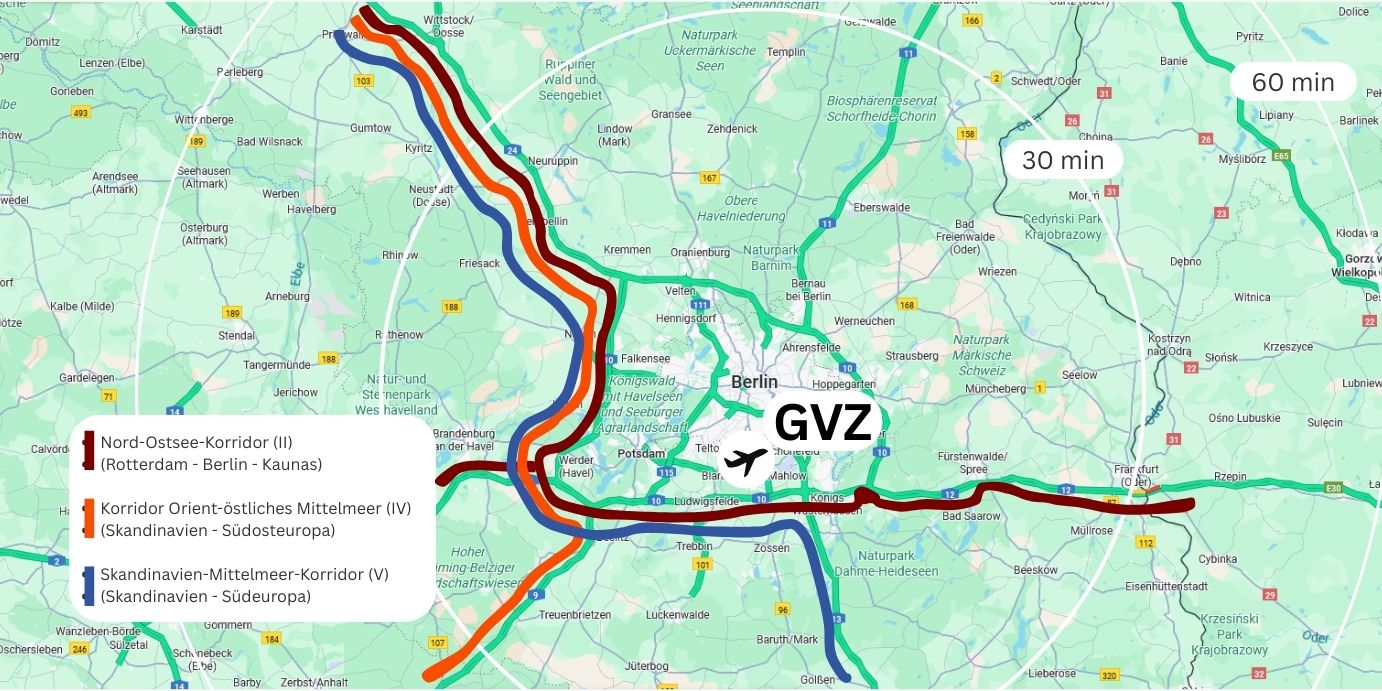
The true strength of a freight village lies in its ability to intelligently link different modes of transport. The GVZ Berlin is in an exemplary position in this respect.
The connection to the road network is excellent for all locations and essential for the "last mile".
Rail is the key to sustainability and efficiency in long-distance freight transport. Three of the four locations are designed as bimodal or trimodal centers and have high-performance transhipment terminals for combined transport (CT).
Berlin Brandenburg Airport (BER) can be reached quickly from all locations (approx. 20-45 minutes driving time). As a modern capital city airport, it offers a constantly growing air cargo center. Although the tonnage handled is even lower compared to pure cargo airports such as Frankfurt or Leipzig, the proximity to BER is an invaluable advantage for time-critical shipments and global spare parts logistics.
In recent years, the Berlin-Brandenburg region has developed into one of the top 5 logistics regions in Germany. But what are the reasons for this impressive economic development?
These factors lead to a high take-up of space and dynamic economic development, which is reflected in the steadily growing number of employees in the freight villages.
For companies, the costs at the location are a decisive criterion. How does the GVZ Berlin compare here?
The logistics boom has caused prices in the capital region to rise noticeably. Nevertheless, they are still at an attractive level in a national comparison.
Trade tax is a significant financial burden for companies. The assessment rates differ from municipality to municipality and can tip the scales in the location decision.
| Location | Municipality | State | Trade tax rate 2023/2024 | Property tax B assessment rate 2023/2024 |
| GVZ City Westhafen | Berlin | Berlin | 410 % | 810 % |
| GVZ Süd Großbeeren | Großbeeren | Brandenburg | 320 % | 430 % |
| GVZ Ost Freienbrink | Grünheide (Mark) | Brandenburg | 380 % | 430 % |
| GVZ West Wustermark | Wustermark | Brandenburg | 380 % | 400 % |
(Sources: Statistical Offices Berlin-Brandenburg, respective municipal budgets. Assessment rates are subject to change, an examination by the responsible municipality is recommended.)
Analysis: The table clearly shows the competitive advantage of the Brandenburg locations, especially the GVZ Süd Großbeeren, compared to the Berlin location. The difference in the trade tax rate of up to 90 percentage points is a significant argument for settling in the Brandenburg area.
Berlin's freight villages are home to an impressive variety of companies from logistics, trade and production. The presence of well-known global players underlines the importance of the locations.
To provide a quick overview, here is a direct comparison of the most important key figures of the locations:
| Ratio | GVZ Süd Großbeeren | GVZ Ost Freienbrink | GVZ West Wustermark | GVZ City Westhafen |
| Total | approx. 320 ha | approx. 335 ha | approx. 270 ha | approx. 43 ha |
| Employees | > 12,000 | approx. 4,000 | approx. 4,500 | approx. 2,000 |
| Companies located here | > 130 | approx. 60 | approx. 70 | approx. 50 |
| Modality | Bimodal (rail/road) | Bimodal (rail/road) | Bimodal (rail/road) | Trimodal (water/rail/road) |
| CT terminal | Yes (Powerful) | Railway sidings | Yes (Powerful) | Yes (container terminal) |
| Feature | Largest location, all-rounder | E-commerce/automotive focus | KV Hub West | City location, harbour |
(Sources: Official data from the GVZ operators and the Investment Bank of the State of Brandenburg (ILB), as of approx. 2023.
Graphic proposal: A map of Berlin and the surrounding area, on which the four GVZ locations are marked and connected to the most important motorways (A10, A2, A9, A12 etc.) and waterways. Source: Own representation based on data from [name of source, e.g. WFBB].
One of the most pressing questions for any expanding company is: Can we find enough qualified personnel locally? The situation in the capital region is divided into two parts.
The Berlin freight center is much more than just a collection of warehouses. It is a highly integrated, intelligent and growing network that is a key driver of the economic dynamism of the German capital region. The four locations complement each other ideally and offer a tailor-made solution for almost every logistical requirement profile – from trimodal city hubs to large-scale e-commerce centers with direct connections to the Eastern European markets.
The challenges of the future lie in the ongoing shortage of space, the increasing shortage of skilled workers and the need to make logistics even more sustainable. The operators of the GVZ and politicians are called upon to set the course for further growth through intelligent densification, the expansion of the rail infrastructure and investments in education and automation.
For companies looking for a strategic location in the heart of Europe, the GVZ Berlin remains one of the top addresses. The combination of excellent infrastructure, a huge sales market and a diversified mix of industries provides a foundation on which the logistics of the future can be successfully shaped.
Commercial property, logistics property and contract logistics in Hesse at a glance - LAGERflaeche.de!
Object no.: 10073
Warehousing (warehouse with management)
Germany
34582 Borken
Price on request

Object no.: 10060
Rental
Germany
34385 Bad Karlshafen (Helmarshausen)
Price on request
Object no.: 10051
Warehousing (warehouse with management)
Germany
65462 Ginsheim-Gustavsburg
Price on request
Object no.: 10016
Warehousing (warehouse with management)
Germany
63263 Neu-Isenburg
Price on request