



Hall simulations in logistics
Table of contents
- Hall Simulation in Logistics: Lexicon, Guide & Practice
- What is meant by a hall simulation? (Definition)
- Why are simulations indispensable for logistics real estate?
- The game changer in contract logistics
- From the classic model to the "digital twin"
- Numbers, Data & Hard Facts: The ROI of a Simulation
- Frequently asked questions (FAQ) about warehouse and hall simulation
- Conclusion: The logistics machine of the future has been virtually tested
Hall Simulation in Logistics: Lexicon, Guide & Practice
The logistics industry is under enormous pressure: rising land prices, the rapid e-commerce boom and the acute shortage of skilled workers demand maximum efficiency on every square meter. Anyone planning a new hall or setting up complex intralogistics processes today can simply no longer afford to make wrong decisions. This is exactly where indoor simulation comes into play. But what exactly is behind it and why is it increasingly becoming a survival factor for real estate developers and contract logistics companies?
What is meant by a hall simulation? (Definition)
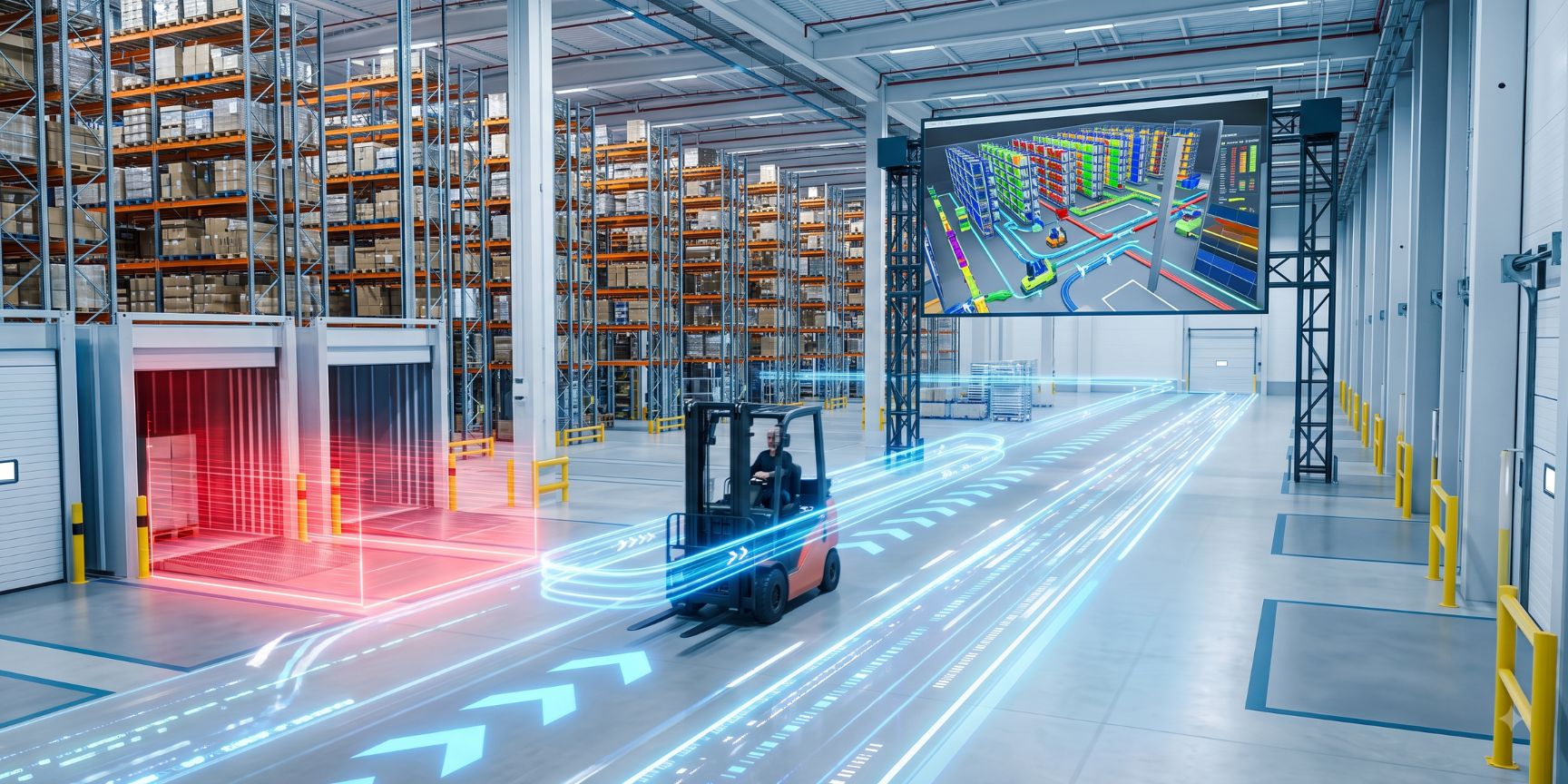
A hall simulation is the dynamic, computer-aided replica of a logistics hall and all its intralogistics processes. In contrast to classic, static 2D hall layouts (such as the I-Shape or U-Shape shape), simulation takes into account the crucial fourth dimension: time.
It calculates complex material flows, dynamic bottlenecks, the walking routes of employees, the utilization of loading gates and the operating times of industrial trucks and autonomous mobile robots (AMR/AGV) under highly realistic operating conditions. In short, it digitally brings a rigid blueprint to life.
Why are simulations indispensable for logistics real estate?
The development and construction of a modern logistics property is extremely capital-intensive (high CAPEX costs). Physical planning errors – such as aisles that are too narrow for certain reach trucks, incorrectly dimensioned pre-zones for cross-docking or blocked routes – can only be corrected retrospectively in concrete and steel at enormous financial expense.
A 3D hall simulation makes the property transparent. Project developers and future tenants can already test in the design phase how different column grids, ceiling heights (UKB) or the positioning of fire protection walls affect later performance. The property is built exactly around the perfect process (build-to-suit) instead of forcing the process into an unsuitable hall.
The game changer in contract logistics
In the highly competitive contract logistics, service providers no longer win their tenders only on the basis of the lowest pallet space price, but on the basis of proven operational excellence.
If a logistics company offers a complex outsourcing concept to a potential customer (e.g. from the automotive or pharmaceutical industry), the hall simulation provides the decisive proof of concept. The service provider can virtually demonstrate to the customer how it can confidently cope with extreme seasonal peaks (such as on Black Friday), how value-added services (VAS) can be smoothly integrated and how throughput times are guaranteed. This creates massive trust and significantly minimizes operational risk for both parties.
From the classic model to the "digital twin"
The latest and most powerful evolutionary step in indoor simulation is the so-called Digital Twin. While classic simulations are often only used once in the planning phase (greenfield planning), the digital twin lives on parallel to real warehouse operations.
It is fed in real time via interfaces (APIs) with data from the warehouse management system (WMS) and the hall's sensors. This allows supply chain managers to run through "what-if scenarios" at any time:
- What happens in outgoing goods if the order volume doubles tomorrow?
- How does the failure of an automated small parts warehouse affect the pick rate? The AI-powered software immediately calculates the impact and suggests fallback strategies before the real problem even occurs.
Numbers, Data & Hard Facts: The ROI of a Simulation
Is it worth the time and financial effort for a highly complex simulation level? The practice of warehouse logistics clearly shows: Yes.
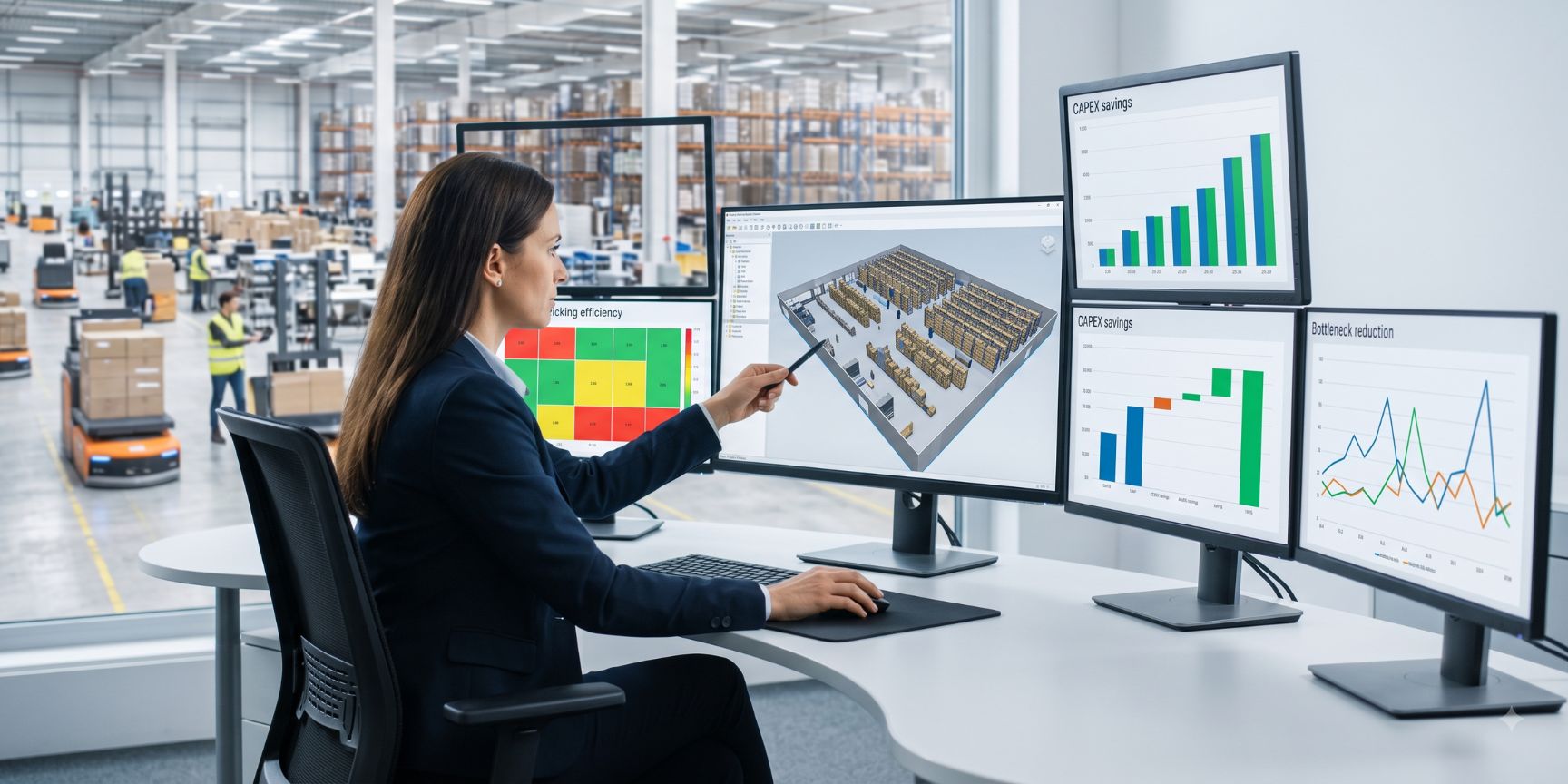
- Drastic error prevention: Studies from facility management and plant planning show that planning errors that are only noticed during ongoing operation are up to 10 times more expensive to correct than changes made at the click of a mouse in the virtual planning phase.
- Massive increase in efficiency: Optimized material flows, equalized routes and improved route planning can usually reduce throughput times by 15 to 25%.
- Capital Savings (CAPEX): Very often, simulation reveals that instead of the planned 12 forklifts, only 9 are needed if the routing and shift schedules are intelligently adjusted. This not only saves acquisition costs, but also personnel and maintenance costs (OPEX) in the long term.
Frequently asked questions (FAQ) about warehouse and hall simulation
Question: From what size of hall is a simulation worthwhile? Answer: Even though complex 3D simulations used to be the preserve of gigantic logistics companies, modern cloud software means that they are now already profitable for medium-sized warehouses (from approx. 5,000 m²). This is especially true when automation technology, driverless transport systems or very small-scale order picking are integrated.
Question: What data is absolutely necessary for a realistic warehouse simulation? Answer: The virtual model is only as good as its data foundation. Detailed historical order data (order profiles of the last few months), precise article master data (dimensions, weights), the CAD layout plans of the logistics property, performance parameters of the intralogistics technology (e.g. lifting speeds) and the planned shift models of the staff are absolutely necessary.
Question: Can a hall simulation also help with ESG optimization? Answer: Absolutely. Modern simulation tools have long since ceased to calculate not only time and throughput, but also the exact energy consumption of intralogistics systems and industrial trucks. In this way, load peaks can be capped, CO2 emissions minimized and green building certifications (such as DGNB or LEED) for the hall can be substantiated with data.
Conclusion: The logistics machine of the future has been virtually tested
In logistics, hall simulation has long since ceased to be an expensive "nice-to-have" or a technical gimmick, but a strategic necessity for survival. Anyone who wants to remain profitable as a contract logistics provider or operate a future-proof logistics property as a user must no longer plan according to the principle of "gut feeling". The enclosed space must be used in a highly intelligent way, material flows must be unbundled without errors, and degrees of automation must be precisely calculated. The result of a clean simulation is a high-performance supply chain that delivers maximum return with absolutely minimal operational risk.
💡 Are you currently planning to move into a new logistics property or are you looking for a contract logistics company that maps your processes state-of-the-art? On LAGERflaeche.de you will find future-oriented hall space and the right experts for your next logistics project!
Your Ideal Logistics Warehouse
Browse listings for warehouse space, logistics real estate, industrial land, and contract logistics solutions.
Browse Exposés
Maximize Exposure for Your Warehouse Space
Showcase your logistics properties and attract qualified inquiries.
Discover Products