Rottenburg, Tübingen, Stuttgart | Warehousing | Palettenstellplätze | Freie Kapazitäten
Object no.: 10190
Warehousing (warehouse with management)
Germany
72108 Rottenburg (Neckar)
Price on request
Here you get a direct overview of useful Dangerous Goods Logistics companies with their storage offers. Additional information about the services of the contract logistics provider, such as transports etc., can be obtained by linking the exposé to their company exchange entry.

Dangerous Goods Logistics can be found in different cities and regions by using a map search or a search mask. Find a preselection of Dangerous Goods Logistics companies, here at LAGERflaeche.de!
Object no.: 10190
Warehousing (warehouse with management)
Germany
72108 Rottenburg (Neckar)
Price on request
Object no.: 10173
Warehousing (warehouse with management)
Germany
68159 Mannheim
Price on request
Object no.: 10172
Warehousing (warehouse with management)
Germany
97440 Werneck
Price on request
Object no.: 10169
Warehousing (warehouse with management)
Germany
97440 Werneck
Price on request
Object no.: 10166
Warehousing (warehouse with management)
Germany
90471 Nürnberg
Price on request
Object no.: 10111
Warehousing (warehouse with management)
Austria
4020 Linz
Price on request
Object no.: 10104
Warehousing (warehouse with management)
Germany
64646 Heppenheim
Price on request
Object no.: 10021
Warehousing (warehouse with management)
Germany
97080 Würzburg
Price on request
Object no.: 9929
Warehousing (warehouse with management)
Germany
09481 Elterlein
Price on request
Object no.: 9921
Warehousing (warehouse with management)
Germany
40589 Düsseldorf
Price on request
Object no.: 9899
Warehousing (warehouse with management)
Germany
15378 Herzfelde
Price on request
Object no.: 9890
Warehousing (warehouse with management)
Germany
42855 Remscheid
Price on request
Dangerous/hazardous goods in logistics always pose an increased risk, which requires compliant and always well thought-out storage. For your dangerous goods warehouse, it is therefore important to have a clear structure in order to do justice to the properties of your substances. But what distinguishes dangerous goods such as gases, radioactive substances or flammable elements and what is relevant with regard to storage? In this article, we show you in more detail what effective storage systems for dangerous goods look like.
Many products require the use of dangerous substances. This is the case for the production of paint, for example, but also for many cleaning products and similar substances. In order to ensure safe and, above all, holistic forwarding to the production site, you are on the safe side with standardised storage. In addition to the material characteristics of the warehouse, the personal characteristics of the warehouse staff must also be taken into account at this point. For most hazardous substances, specific training is required and must be completed beforehand.
According to the Ordinance on Hazardous Substances (GefStoffV), hazardous substances are all substances that are classified as dangerous due to special properties. Several hazard classes are defined, distinguishing between physical hazards, health hazards, environmental hazards and other hazards.
Separate labelling of such substances is urgently required. In order to have access to a practical solution for hazardous goods in warehouse and contract logistics, a suitable dangerous goods warehouse is highly recommended. Depending on the nature of the hazardous substances, a classic hazardous goods cabinet is not always sufficient. In some cases, new rooms or even individual storage buildings are required to store goods, for example radioactive substances.
Depending on the substance, there are structural, organisational and legal requirements that are important for storage. The respective dangerous goods classes play an important role when it comes to the classification and storage of hazardous substances. Class 1 stands for explosion hazard, class 2 for easy flammability, class 3 for oxidising substances, class 4 for gases under pressure. Dangerous goods class 5 stands for corrosive substances, class 6 for toxic hazardous substances. Class 7 stands for irritant substances, class 8 for substances harmful to health. Class 9 stands for environmentally hazardous substances. We would be happy to help you here with LAGERflaeche.de in your search for a suitable service provider for your storage.

→ Disposal logistics
→ Chemical logistics
→ Building materials logistics
The exact requirements for a dangerous materials storage facility are derived from the regulations of the federal states. For example, storage is generally not permitted in corridors or traffic routes or in stairwells. In many dangerous materials warehouses, adequate ventilation must also be ensured. The same applies to a clear lighting concept to ensure that labels on containers are clearly visible.
For a hazardous materials warehouse that is ready for acceptance, you also need a sufficiently safe escape route concept. Storage outside the hazardous materials warehouse is also precisely defined in the requirements. A maximum of 20 kg of flammable solids and flammable liquids may be stored outside the warehouse. As soon as this limit is exceeded, the storage is mandatory. At this point, make sure to purchase suitable industrial tanks that fit the respective requirement.
LAGERflaeche.de and its logistics partners support you in your search for the ideal hazardous goods storage facility! Find out at LAGERflaeche.de what also needs to be considered in your industry with regard to dangerous goods storage logistics. With the help of targeted and modern dangerous goods storage solutions, you will be ahead of the game!
Gefahrgutlogistik lagert und bewegt Güter, die auf dem Transport als gefährlich gelten. Die Klasse steht auf dem Versandstück, die UN-Nummer nennt den Stoff. Der Kreis ist weiter als die Chemie: auch Batterien, Spraydosen, Lacke und Reiniger gehören dazu. Was eine Halle annehmen darf, steht im Exposé, nicht im Wort Gefahrgut auf der Karte.
Nein. Gefahrgut ist das Recht der Beförderung, auf der Straße über das ADR und die GGVSEB. Gefahrstoff ist das Recht am Arbeitsplatz, die Gefahrstoffverordnung und die TRGS 510. Dieselbe Flüssigkeit kann im ADR Klasse 3 sein und im Lager einer anderen Lagerklasse folgen. Eine brennbare Flüssigkeit ohne Gefahrgut-Eigenschaft kann trotzdem eine Auffangwanne brauchen.
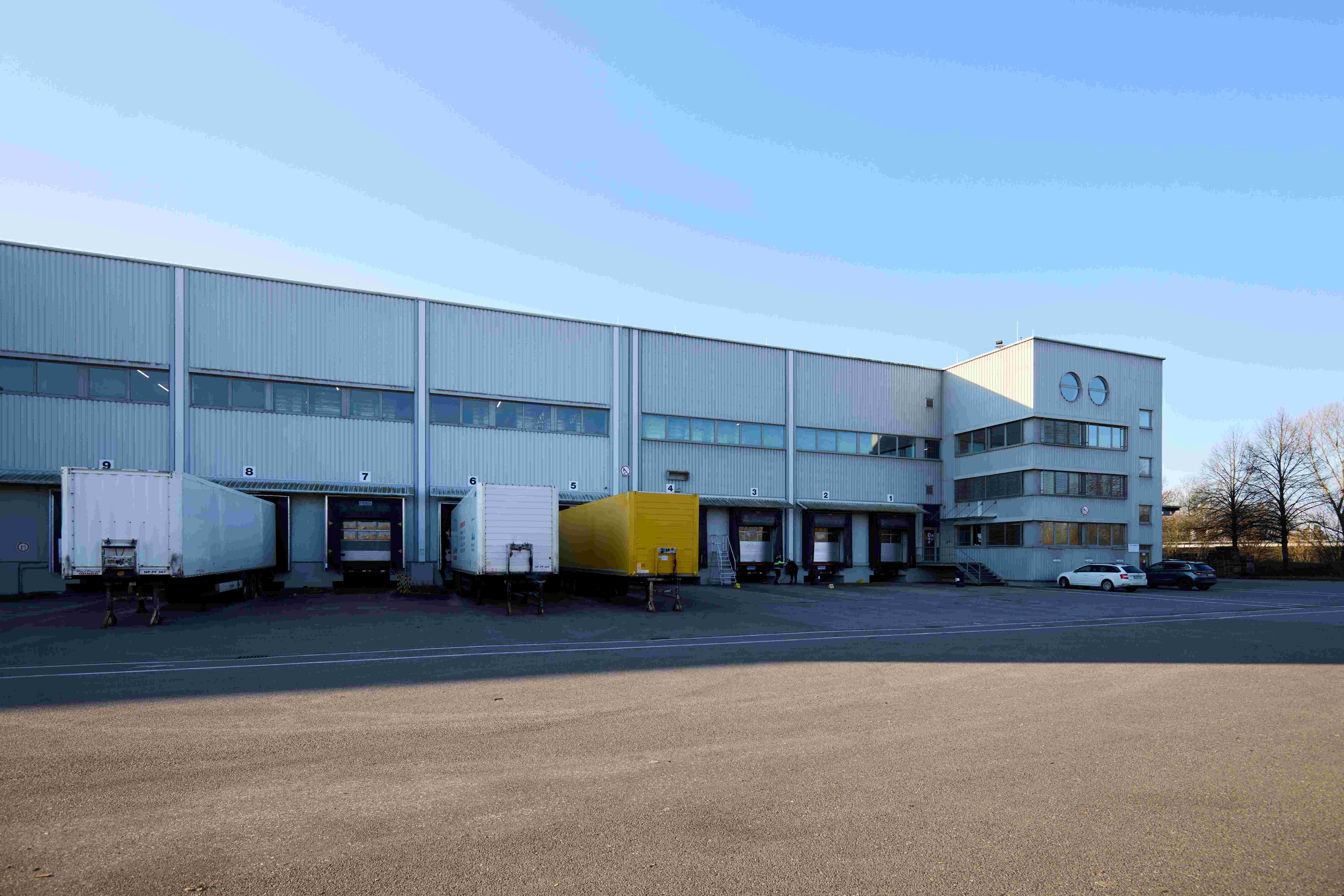
Klasse 4 umfasst entzündbare feste Stoffe, selbstentzündliche Stoffe und Stoffe, die mit Wasser entzündbare Gase entwickeln. Die Raute allein trennt diese drei nicht. Dafür steht die UN-Nummer auf dem Kennzeichen. Auf dem Bild dieser Seite ist diese Zeile angeschnitten. Im Exposé sollte sie ausgeschrieben sein.
Er sortiert die Liste. Er ersetzt nicht Klasse, Gebinde und Rückhaltung. Palettenstellplätze sagen dazu nichts. Öffnen Sie das Exposé über Zum Angebot. Fehlt die Klasse auch dort, ist der Eintrag noch keine Entscheidung. Ein Gesuch hilft, wenn Sie UN-Nummer oder Klasse, Gebinde und Region nennen.
Eine eigene Preisliste dafür gibt es hier nicht. Die Miete einer üblichen Halle liegt nach dem Beitrag Lagerraumpreise Deutschland 2025 in den Top-Regionen bei 5,50 bis 7,50 € je Quadratmeter und Monat, in schwächeren Lagen bei 4,00 bis 5,50 €. Rückhaltung, Lüftung und die Freigabe der Klasse stehen in dieser Spanne nicht.
West
Rent a production hall in Frankfurt
Warehouse in Cologne
Industrial warehouse in Saarbrücken
South
Find Logistics Space in Munich
Storage Space in Nuremberg
Logistics Hall in Stuttgart
Rent Warehouse in Freiburg
Rent Warehouse Space in Italy
Logistics Hall in Austria
Storage Space in the Netherlands
Warehouses in France
Search Storage Space in Poland
Renting halls in Switzerland
Find logistics premises in Belgium
Storage in Bulgaria
Renting warehouses in the UK
Search for warehouse properties in Croatia
Logistics warehouses in Romania
Logistics centres in Russia
Search for warehouse locations in Slovenia
Rent warehouse space in Slovakia
Logistics property in Spain
Find storage space in Hungary
Rent a warehouse in the Czech Republic
Storage facility in Denmark