

Logix Publishes New Position Paper on the Relationship between Logistics Properties and Data Centres
Market & Investment
Press release
Weiterstadt, 9 November 2026
- Study shows selective locational competition and synergies
- Publication provides strategic implications for market participants and municipalities
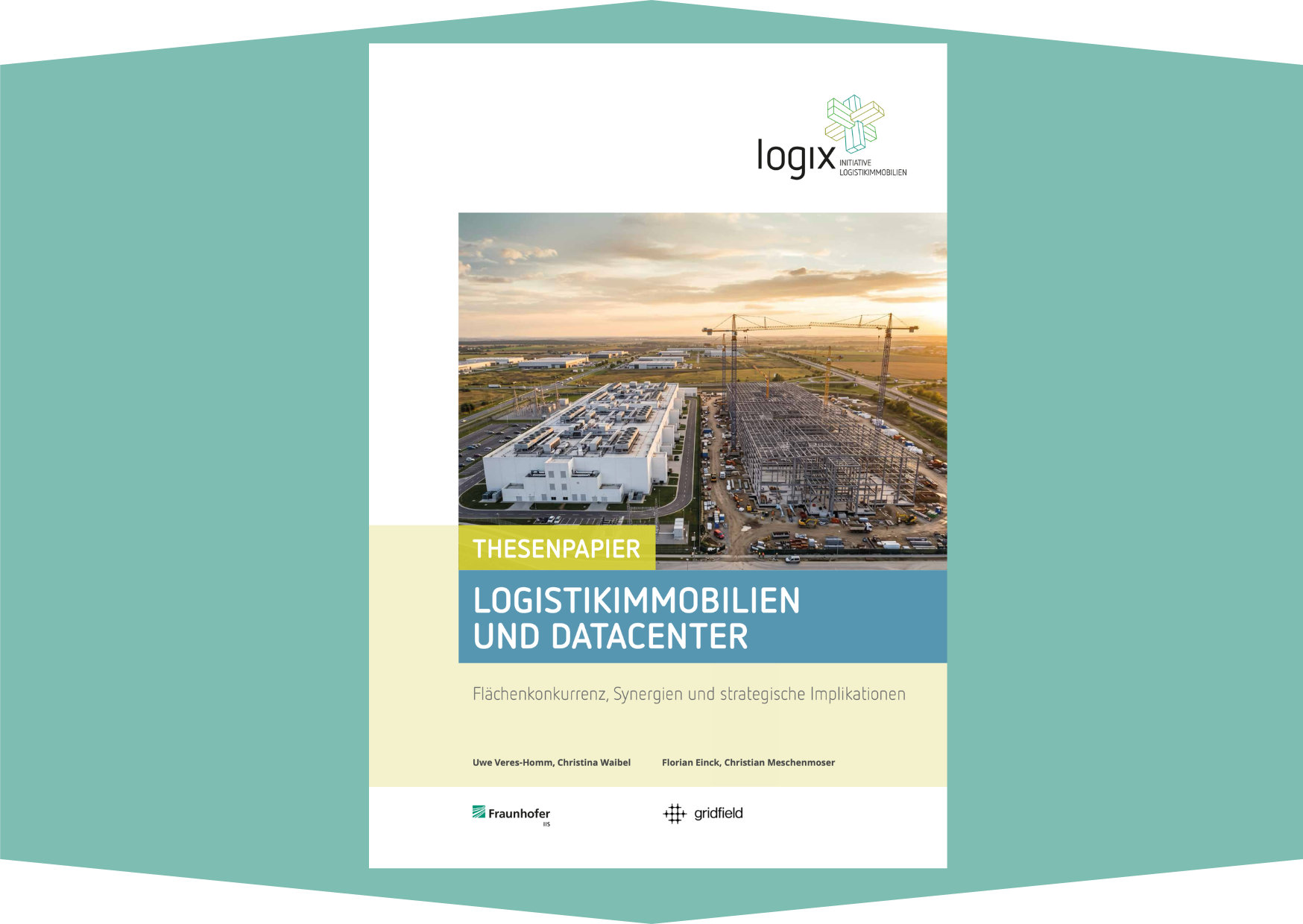
The new position paper examines site competition, synergies and strategic implications of both asset classes. Copyright: Logix.
The German federal government wants to at least double data-centre capacity in Germany by 2030. With its National Data Centre Strategy, it is driving the expansion of digital infrastructure. This is also bringing the requirements for suitable sites, power connections and grid infrastructure more strongly into focus. But how do new data centres relate to logistics properties, which likewise depend on suitable commercial sites and high-performing infrastructure? A new position paper by the Logistics Real Estate Initiative (Logix) examines the locational competition between the two types of use and derives strategic implications for the real-estate industry and municipalities from it.
Selective locational competition, synergies are limited
The central finding of the study: Competition between logistics properties and data centres does not affect the entire German market, but is concentrated on locations that come into consideration for both uses.
“While logistics properties benefit above all from proximity to sales markets, industry and transport infrastructure, data centres depend in particular on high-performing power connections and fibre-optic links. Where these requirements coincide at a location, data centres can displace logistics uses. One reason for this is, among other things, their higher willingness to pay for suitable plots,” says Uwe Veres-Homm, Head of Risk and Location Analysis at the Fraunhofer Institute for Integrated Circuits IIS and one of the authors of the position paper.
At the same time, the study points to possible synergies. The joint development of larger sites and the conversion of industrially characterised land can open up opportunities. The expansion of energy infrastructure for data centres can also benefit neighbouring logistics locations. Such effects are not, however, automatic. If grid connection capacities are reserved at an early stage for individual projects, they may initially be unavailable to other schemes. The use of waste heat, too, often presupposes additional offtakers and corresponding infrastructure.
Strategic implications for market participants and municipalities
For project developers and investors, the growing expansion of data centres means assessing location requirements and competitive situations more closely. Where the requirements of both uses overlap, data centres can influence land prices and the availability of suitable sites for logistics properties.
For municipalities, the question arises of how they develop and allocate land in the face of competing claims on its use. In addition to the willingness to pay of potential users, the existing energy and transport infrastructure, employment effects and the long-term development opportunities of a location should be taken into account.
The position paper was prepared by Uwe Veres-Homm and Christina Waibel (Fraunhofer IIS) together with Florian Einck and Christian Meschenmoser (gridfield) and is the 13th publication of the Logistics Real Estate Initiative (Logix). The 22 theses examine in more detail the competition for land, the requirements placed on energy and grid infrastructure, the municipal perspective, ecological and energy-related synergies, and the real-estate implications for investors.
“Logistics properties and data centres depend on high-performing infrastructure and are at the same time important building blocks of a functioning economy. Rising electricity demand is leading to competition for suitable plots, in which logistics properties tend to come off worse. Accordingly, it is important to plan their development with foresight, to identify conflicts of use at an early stage and to find solutions that benefit companies as well as municipalities and society,” adds Dr Malte-Maria Münchow, Spokesman and Member of the Board of the Logistics Real Estate Initiative (Logix).
The position paper is available for free download at www.logix-award.de/forschung and will be presented by Uwe Veres-Homm at BUILDINX at 3 p.m. on 18 November 2026.
About Logix
The Logistics Real Estate Initiative (Logix) is the central platform of the logistics and industrial real estate sector in Germany. Logix bundles the interests of its stakeholders, takes up relevant topics at an early stage and promotes research, communication and dialogue among all market participants – from municipal representatives and economic-development agencies, via developers and construction companies through to users and investors.
With the expertise of its members as well as of external specialists, Logix carries out research and publication projects relating to logistics and industrial real estate. Through its work, Logix helps to ensure that logistics, industry, retail and commerce are provided with the space urgently needed in Germany for the storage and processing of goods and merchandise. In this way it makes an essential contribution to the functioning of a modern economy and to the prosperity of society.
With the Logix Award, the initiative has since 2013 been honouring outstanding project developments and innovations that are recognised by an independent jury on a two-year cycle.
The Logix Initiative includes: abrdn Investments Deutschland AG, ALCARO, Aurelis Real Estate, BayernLB, BF.infrafinance, Bockermann Fritze plan4buildING, Bremer, Camelback Mountain Capital, CBRE, Colliers, CTP, Cushman & Wakefield, Dachser, Deka Immobilien, Delta Development, Deutsche Pfandbriefbank, Deutsche Post DHL, Dietz AG, DLH Real Estate Germany, dörpinghaus divisek und partner, Drees & Sommer, Duisburger Hafen, EGLS, Ellisinvest, Energy Partners, EQVANCE Real Estate, Evolutiq, Expo Real (Messe München), Fiege, Four Parx, FOX Industrial Real Estate, Frasers Property, Garbe, GCA projektmanagement + consulting, GDD, Goldbeck International, Goodman, greenfield development, Greenflash, GSE, GSK Stockmann, Hagedorn, HagerEnergy, Harden Industriebau, Hines, Immogate, Jones Lang LaSalle, Lang & Cie. Industrial, Lidl, LIST Bau, Logicor, Logivest, LOGREM, M3 Geotechnik, Madaster, Marq Logistics, Mercurius, metawerk, Mileway, MLP Group, Nuveen Real Estate, Panattoni, ParkProperty Europe, pfenning logistics, Phase 5 International, pkb consulting, Prologis, Property Team, Rail4Real, Real I.S., Realogis, Robert C. Spies, Segro, Sicore Real Assets, Singu, Sunrock, Trammell Crow Company, Union Investment, Verdion, VGP, WDP and Wisag.
The cooperation partners include the BVL Logistics Real Estate topic group with Power of Logistics, the Deutsche GVZ-Gesellschaft (DGG), the German Association of Towns and Municipalities (DStGB), the initiative Die Wirtschaftsmacher and the ZIA (Zentraler Immobilien Ausschuss). Exclusive media partners are Immobilien Zeitung, Deutsche Verkehrs Zeitung and Logistik heute.
Contact:
Logix GmbH Initiative Logistikimmobilien | www.logix-award.de
Dr Malte-Maria Münchow | +49 171 494 1000 | kontakt@logix-award.de
Schneppenhäuser Straße 51 | 64331 Weiterstadt
teamtosse Agentur für Kommunikation | www.teamtosse.de
Jens Tosse | +49(0)89 414175290 | jens.tosse@teamtosse.de
Kistlerhofstraße 70 | Gebäude 88 | 81379 München

Latest Warehouse News
Logix Publishes New Position Paper on the Relationship between Logistics Properties and Data Centres
A new position paper by the Logistics Real Estate Initiative (Logix) examines the locational competition between logistics properties and data centres....

Geis and Quehenberger Continue to Grow Together
As of 1 January 2027, Geis is introducing a new matrix organisational structure for the entire group – including Quehenberger Logistics....

Prologis Completes New Development in Herne and Hands It Over to JF Global Supply Chain
JF Global Supply Chain takes over 20,445 square metres to expand its German logistics network....

GRUBER Logistics Considers Transparency Essential for Sustainable Action
GRUBER Logistics publishes its fourth sustainability report for 2025 voluntarily under CSRD/ESRS – with CO2 savings, twelve electric trucks and 49 per cent green power....