The Warehouse Magazine
The magazine is published once a quarter to provide information on trends in the logistics industry and the logistics and industrial property sector. With our new magazine, we want to reach our target groups even better. Interesting topics are provided by renowned professors, customers or representatives from the industry.
If you would also like to publish an article or place an advert, please contact us.
The robot thinks, the human steers
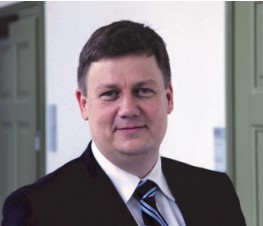
by Prof Dr Markus Krabbes
For around three decades, robots have been triumphant in all areas of industrial value creation. From the very beginning, these mechanical colleagues have been accused of destroying jobs - and yet during this time, those industrial sectors in Germany that have consistently applied and further developed robotics have grown in particular. The main motivation for the introduction of robots is often forgotten: the avoidance of work that is monotonous, physically difficult or even harmful to human health. This necessarily requires advances in productivity that justify the high investments in robotic systems. In addition, there is an immense increase in reproducibility and process stability, enabling technologies that can hardly be controlled manually. All these advantages have led to robotic applications becoming established in many areas despite the very high initial investment.
In recent years, robots have been advancing into ever new fields of application. Increasing complexity of the application scenario is always overcome: smaller batch sizes of the same products, more sensors required for motion control, fluctuating workpiece properties, difficult handling situations. Thanks to powerful sensors, increasing computing power, sophisticated software and a drop in the price of standard robots, new areas of application are becoming technically and economically feasible every year.
Until now, all robot types have been based on a clear distinction between industrial and service robots. Industrial robots can be integrated extremely flexibly into a wide variety of applications. They are customised using tools mounted as so-called end effectors and with appropriate control programming. During production, industrial robots are hardly reactive and are therefore dependent on precisely predefined conditions. High possible contact forces of these heavyweights force them to be installed within an enclosure of the work area.
On the other hand, service robots, such as milking robots or mobile platforms, now have significantly higher sales figures - especially in the form of autonomous home hoovers or self-propelled lawnmowers. They are characterised by the predetermined and irreversible tailoring of the design and software to the intended application, with all conceivable reactions and adaptations for the varying operating environment already implemented in the control system. For safety reasons, the indispensable mobility in a workspace that cannot be separated from humans (and other robots) limits the contact forces permitted for service robots.
The two basic types outlined above are so different in their architecture that the common root of the words industrial and service robots is almost surprising. From the point of view of the application, however, both classes embody an artificial worker derived literally from robota (Slavic) and convey an undeniable human likeness in a complex environment with a sovereignty of movement that is always impressive in its own way.
Until now, new robot applications have always been based on a more direct assignment of the context of use to one of these basic types. An interesting convergence is currently taking place between them. Human-robot cooperation scenarios, such as hand-guided machining processes, manual teaching or simply assistance as a "third hand", are so diverse and demanding that they can only be developed economically with an unspecific robot concept based on the industrial robot model. The most common representatives of these are so-called articulated arm robots with six swivel joints that always replicate a human shoulder-hand configuration. However, as the workspace is now shared with humans and objects may even be moved together, any contact forces that occur must be reliably limited within permissible limits by limiting the axis torques or avoiding collisions at an early stage. This is achieved through a complex strategy consisting of consistent lightweight construction, monitoring of the torques in the axes and (early) detection of contact on the surfaces of the robot. Current commercial examples of this type of robot are the BAXTER from Rethink Robotics, the LBR from KUKA Laboratories and the ROBERTA from gomtec.
The discrepancy described at the beginning regarding the economic viability of such applications is becoming increasingly apparent in co-operative approaches. So far, these highly innovative systems are still very expensive. In contrast, productivity gains can obviously only be realised beyond the substitution of manual work steps, which cooperative robotics should literally "lend a hand". Nevertheless, the future belongs to these applications because, in addition to dispensing with mandatory enclosures with monitoring, loading, etc., this scenario utilises all the senses and sensorimotor skills that humans naturally bring to this cooperation. As a result, the exaggerations of today's "over-engineering" for human-free digital factories with sophisticated visual object tracking, intelligent gripping strategies or fully automated object flows will be pushed back a little. For high-quality customised capital goods, humans themselves often prove to be sufficiently productive as long as they are effectively supported by machines and the process quality is sufficiently stabilised.
A similar "co-operative" scenario is now increasingly developing from a different approach. Even the consideration of whether and how a robot can be used to automate human actions first requires a formalised description of the processes. What is common practice in large-scale production leads to massive productivity gains in many new areas of application even before robots are actually used. Examples include surgery as well as route control for vehicles or order picking in mail dispatch. Ultimately, a given process description can be used to control all kinds of support processes without the need to use a robot at all.
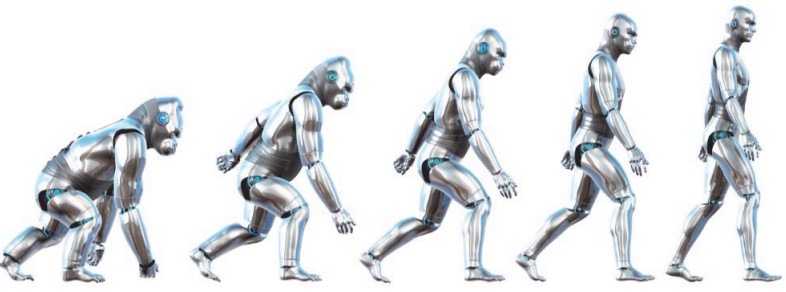
The combination of human sensorimotor skills, which will remain unrivalled for the foreseeable future, with assistance systems that prevent fatigue and errors has already led to a rethink of robot applications. For example, in multi-variant automotive production, intralogistics using tugger trains with hand-guided towing vehicles (possibly only on partial routes) may be more efficient than large farms of automated guided vehicles (AGVs). It also helps the surgeon more to have all the necessary information, tools, diagnostic equipment and preparations for a frequent operation at the right time and in a strictly predefined location, and to receive timely warnings from the navigation system about incorrectly positioned instruments, than to have to stand idly by and watch a robot perform the operation.
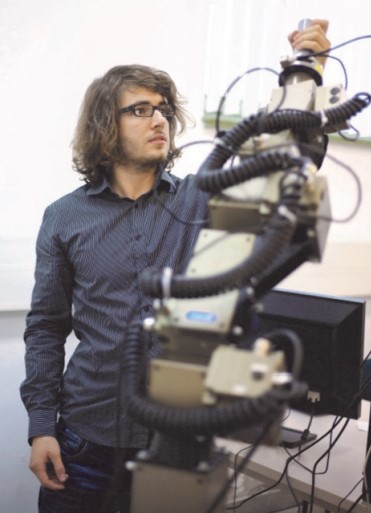
Would you like an example where you can experience this scenario yourself every day? Well, imagine your car equipped with all the assistance systems imaginable today! Ultimately, you now receive every instruction from the cockpit via the navigation system, number plate recognition, etc., otherwise you are monitored and warned of all recognisable errors such as tailgating, lane departure, incorrect overtaking and even drowsiness. The question of who is actually the programme-controlled robot here seems justified. However, if we agree that a robot is always the automated system that supports humans in all sensorimotor-based activities by independently planning, executing and monitoring actions, we finally come to the conclusion: "The robot thinks, the human steers."
Contact and author:
Prof. Dr.-Ing. Markus Krabbes
Leipzig University of Applied Sciences
Karl-Liebknecht-Str. 132
D-04277 Leipzig
Tel. +49 341 3076 0
markus.krabbes@htwkleipzig.de
www.htwk-leipzig.de
Author |
|
| Prof. Dr.-Ing. Markus Krabbes |