The Warehouse Magazine
The magazine is published once a quarter to provide information on trends in the logistics industry and the logistics and industrial property sector. With our new magazine, we want to reach our target groups even better. Interesting topics are provided by renowned professors, customers or representatives from the industry.
If you would also like to publish an article or place an advert, please contact us.
Logistics property in Germany
Space requirements and solutions
There is currently high customer demand for new logistics properties in various sectors. The biggest growth drivers in Germany include logistics service providers, retail and the automotive industry. In addition, national and international investors have increasingly identified logistics property as an asset class. At the same time, it is becoming increasingly difficult to find attractive space for new developments in prime German locations. Developers and investors are being called upon to supplement their existing offering with new solutions in order to promote further growth.
Logistics service providers as growth drivers
Many companies are currently facing the challenge of improving their logistics structures so that they can implement their business strategy more efficiently and secure competitive advantages in their respective sectors. Logistics service providers, for example, have to present their customers with a convincing overall concept and respond ever more flexibly to the requirements of their clients. According to calculations by BNP Paribas, they therefore accounted for the largest take-up of space in Germany last year with a share of 38 per cent. New property solutions that are implemented to high quality standards at locations with multimodal connections offer them this flexibility. One example is Goodman's current new development for the medium-sized logistics service provider Hammer, which will move into the first construction phase of a 103,000 m2 property in Bedburg at the end of 2014. Connected to a dense motorway network, the airports in Cologne and Düsseldorf and the Rhine ports in Neuss and Cologne-Diehl, the location opens up optimal opportunities for Germany-wide and international logistics. For example, the property itself will be equipped with LED lighting throughout and has 145 loading and unloading gates. Both measures clearly exceed the industry standard and indicate the advantages that can be achieved with a customised new development.
Growth driver retail
Last year, the retail sector contributed around 32 per cent to take-up in the logistics property sector. Many consumers are experiencing for themselves how their own shopping behaviour is changing. These changes are also reflected in the property market. Basically, all retail groups are faced with the question of how to organise their sales channels for the future and how to reach consumers most effectively. Goodman is therefore focussing on the entire diversity of retail. In Regiopark Mönchengladbach, the company is currently expanding a logistics centre for the online retailer Zalando to 134,000 m2, creating the largest "wardrobe" in Europe. At the same time, the property group has built a new 11,000 m2 head warehouse for fruit and vegetables for the REWE Group in Leipzig. The retail company is thus moving even closer to its consumers in the regional markets and optimising its fresh produce concept for this sensitive product group. The Leipzig site enables the REWE Group to ideally cover the conurbations of Berlin, Dresden and Leipzig-Halle. It also exemplifies an approach that developers and investors can pursue in order to respond proactively to the increasing shortage of space in prime locations and expand their range of solutions. This refers to so-called "land banking", the early acquisition of properties without an explicit client mandate. Goodman has acquired a 120,000 m2 site in Leipzig's GVZ Süd III and marketed 53,000 m2 of new logistics space to four companies from three sectors in around eight months. The result is an entire logistics park that is used by retail companies as well as logistics service providers and Leipzig's strong automotive industry.
Growth driver automotive industry
The automotive industry is also an important driver of new developments beyond the Leipzig location. Overall, industrial companies accounted for around 26 per cent of take-up in 2013. A large proportion of this is attributable to projects for the automotive industry. German premium manufacturers such as Porsche, BMW, Daimler and Volkswagen are expanding their logistics capacities in the best locations in order to strengthen their national and international business and thus secure their good market position in the long term. The focus of interest is usually on locations close to factories and harbour locations. In order to offer optimal solutions for these and similar requirements, Goodman has been pursuing the revitalisation of brownfield sites with great technical expertise for several years. Instead of using up green areas that are hardly available in prime locations, old areas are being revitalised and put to new, sustainable use by logistics. Two examples of successful land conversions in harbour locations are solutions for Daimler in Bremen and Volkswagen in Duisburg. In Bremen's Hansalinie, the Daimler Group needed a new logistics centre with around 33,000 m2 of space and a special property design in order to supply its own production with body shell components. Proximity to the plant was the most important criterion. The property also had to have trimodal road, water and rail connections and be completed within a tight timeframe of ten months. The property acquired by Goodman in Hemelingen harbour was originally a clay pit and was used for various other purposes up until 1970. All forms of utilisation had left their traces, which had to be removed. Thanks to the property group's high level of technical expertise and many years of experience with conversion projects, the new development was handed over to the client on time despite all the challenges. In the port of Duisburg, Goodman built a 24,000 m2 logistics centre for Volkswagen, which the client uses as an export hub. The necessary components and modules are supplied to Volkswagen Group production facilities worldwide from Duisburg.
New developments at top locations: the example of Hamburg harbour
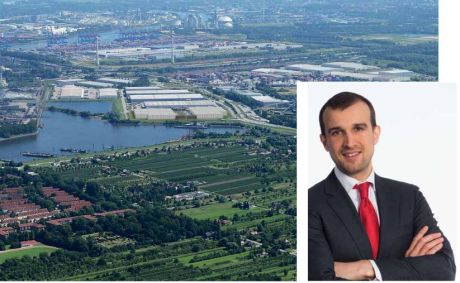
Provided that good utilisation concepts and an active network are in place, new developments can also be launched at absolute premium locations. In the Port of Hamburg, for example, Goodman, in cooperation with the Hamburg Port Authority (HPA), has succeeded in securing a 6.5-hectare site on which up to 40,000 m2 of customised logistics space can be developed. The first unit of Goodman Interlink Hamburg with 10,000 m2 has now been completed. Flexible lettings totalling between 5,000 and 40,000 m2 are possible. A number of concrete discussions with various interested parties are currently close to being finalised. The nickname Interlink refers to the excellent location in the Port of Hamburg and expresses the corresponding multimodal connections at this location.
About Goodman:
Goodman is an integrated property group. The company owns, develops and manages logistics and commercial property in continental Europe, the UK, the Asia-Pacific region, North America and Brazil. The Group invests in industrial estates, warehouses and distribution centres. Goodman also manages a number of listed and unlisted property funds, including the Goodman European Logistics Fund (GELF) as the European flagship. In this way, the Group offers access to specialised services and investment products. Goodman works continuously to create value through commercial property and fund management. This includes innovative new developments as well as further business and investment opportunities. With current assets under management of €17 billion and more than 400 industrial properties under management, Goodman is the largest industrial property group on the Australian Stock Exchange and one of the largest listed industrial property groups in the world. Through its market understanding and regional teams, Goodman creates sound investment opportunities and develops properties to meet individual client requirements. With over 1,000 employees and 32 offices in 16 countries, Goodman is able to meet the needs of its customers worldwide as they expand or develop their businesses. In Europe, Goodman has offices in Germany, the Netherlands, Belgium, Luxembourg, France, Spain, Italy, Poland, the Czech Republic, Hungary, Slovakia, Sweden and the UK.
Author |
|
| Jordan Corynen |