


Revolution on the Ramp: Why New Retail Realities Are Forcing a Radical Rethink in the Light Industrial Segment
Table of Contents
- The End of Monoculture: The Birth of Hybrid Usage Concepts
- Location Quality 2.0: Energy and Data Distance
- Urban Value Creation: The Factory Returns to the City
- International Comparison: Who is Building the Future of Light Industrial?
- The building as a Power Plant: Energy, Digitalization and ESG
- Practical Example: The "Urban Hub Berlin" (fictitious but realistic example)
- The Role of Automation: When the Building Thinks for Itself
- Conclusion: Strategic Recommendations for Action for Stakeholders
The world of commerce has changed faster in the last five years than in the previous five decades. Where there used to be clear dividing lines between "here is produced", "there is storage" and "there is sale", the boundaries are now becoming increasingly blurred. This fundamental change is hitting one asset class particularly hard and at the same time offers enormous opportunities: light industrial.
But what does this change mean in concrete terms? Why is the classic commercial hall on the outskirts of the city no longer sufficient? In this deep dive, we analyze how energy availability is becoming the new hard currency, why buildings need to "breathe" today, and how Germany compares internationally in the transformation of urban value creation.
The core questions of this analysis:
- Why is the quality of the location no longer primarily defined by the postal code?
- What do hybrid usage concepts look like that combine production and e-commerce?
- What technological requirements do automation and energy resilience place on the building envelope?
- What can Germany learn from pioneers such as Great Britain or the Netherlands?
The End of Monoculture: The Birth of Hybrid Usage Concepts
For a long time, light industrial was the "stepchild" of the real estate industry – functional, grey, often neglected. Today, it is at the heart of the omnichannel economy. The separation of B2B production and B2C distribution is dissolving.
Today, modern light industrial areas have to function as hybrid ecosystems. A tenant may use the space in the morning for the final assembly of e-bikes (production), in the afternoon as a pick-up station for customers (retail) and at night as a micro-fulfillment center for delivery (logistics).
Facts & Figures: According to a study by CBRE, the demand for mixed-use space (urban mix) in European metropolitan regions has increased by around 12% annually since 2021. Pure storage areas in the vicinity of cities are losing their attractiveness compared to areas that allow production that is relevant to trade tax.
Location Quality 2.0: Energy and Data Distance
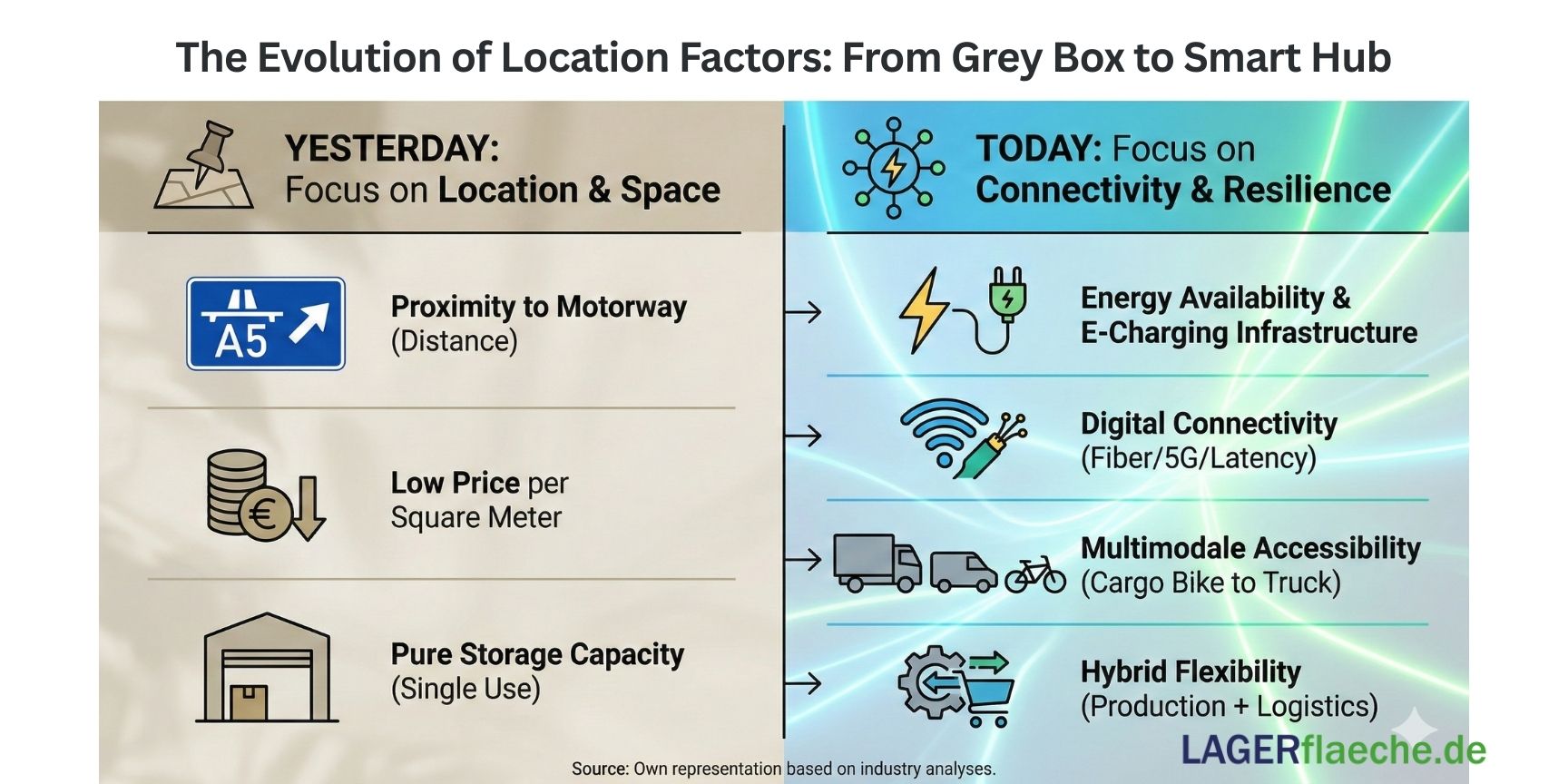
In the past, it was said: "Location, location, location". Today, the motto is: "Power, Port, Plug". A location in a prime inner-city location is worthless if the power grid cannot charge the fleet of 50 electric vans at the same time or if the latency times of the fiber-optic connection are too high for the cloud-controlled sorting robots.
The new parameters of site selection:
- Energy resilience: The availability of high-voltage connections and the capacity for PV self-consumption of electricity determine tenant favorability.
- Digital connectivity: 5G campus networks within buildings are essential for autonomous industrial trucks (AGVs).
- Multimodality: Accessibility not only by truck, but also by cargo bike or even via rail micro-hubs.
"The price per square meter has become secondary if energy costs eat up the tenant's operating margin due to a lack of efficiency or a lack of charging infrastructure."
Urban Value Creation: The Factory Returns to the City
Industry 4.0 and 3D printing are making production processes quieter, cleaner and more compact. This enables the re-urbanization of industry. Light industrial buildings act as an interface here.
This trend is particularly noticeable in fresh food logistics. Urban farming concepts or "ghost kitchens" require areas that are hygienically perfect, highly air-conditioned and logistically perfectly connected. Here, buildings have to "perform" technologically:
- Redundant cooling systems.
- High floor loads for vertical storage systems.
- Sustainable water cycles.
International Comparison: Who is Building the Future of Light Industrial?
Germany is often considered the logistics world champion, but other nations are more agile when it comes to adapting new light industrial typologies.
| Country | Focus | Why is it different from Germany? |
| United Kingdom (UK) | Multi-Story & Industrial Hotels | An extremely high shortage of space in London led to multi-storey concepts (e.g. SEGRO V-Park) early on. E-commerce rate is >25%. |
| Netherlands | High-Tech & Sustainability | Focus on circular construction and maximum automation due to high labor costs. |
| Singapore/China | Vertical Industrial | "Stacking" of production over 10 floors is standard. In Germany, this often fails due to fire protection and building law. |
| USA | Last-Mile Mega-Hubs | Integration von Retail-Showrooms direkt in Logistikhallen (Amazon/Prologis). |
Germany in comparison: In Germany, rigid development plans (separation of residential and commercial) often slow down development. While "industrial hotels" are being built in London, where people live upstairs and produce downstairs, German municipalities often still struggle with the noise protection ordinance of 1990. Nevertheless, Germany is catching up massively in brownfield developments (revitalization of old industrial sites).
The building as a Power Plant: Energy, Digitalization and ESG
Today, a modern light industrial property is no longer a passive asset, but an active part of the energy transition.
Facts, figures, data:
- PV potential: According to Fraunhofer ISE, industrial roofs could cover up to 25% of the German photovoltaic target.
- ESG impact: Certifications such as DGNB or BREEAM are no longer an option, but an obligation for financing. Properties without an ESG strategy are threatened with "stranded asset" status.
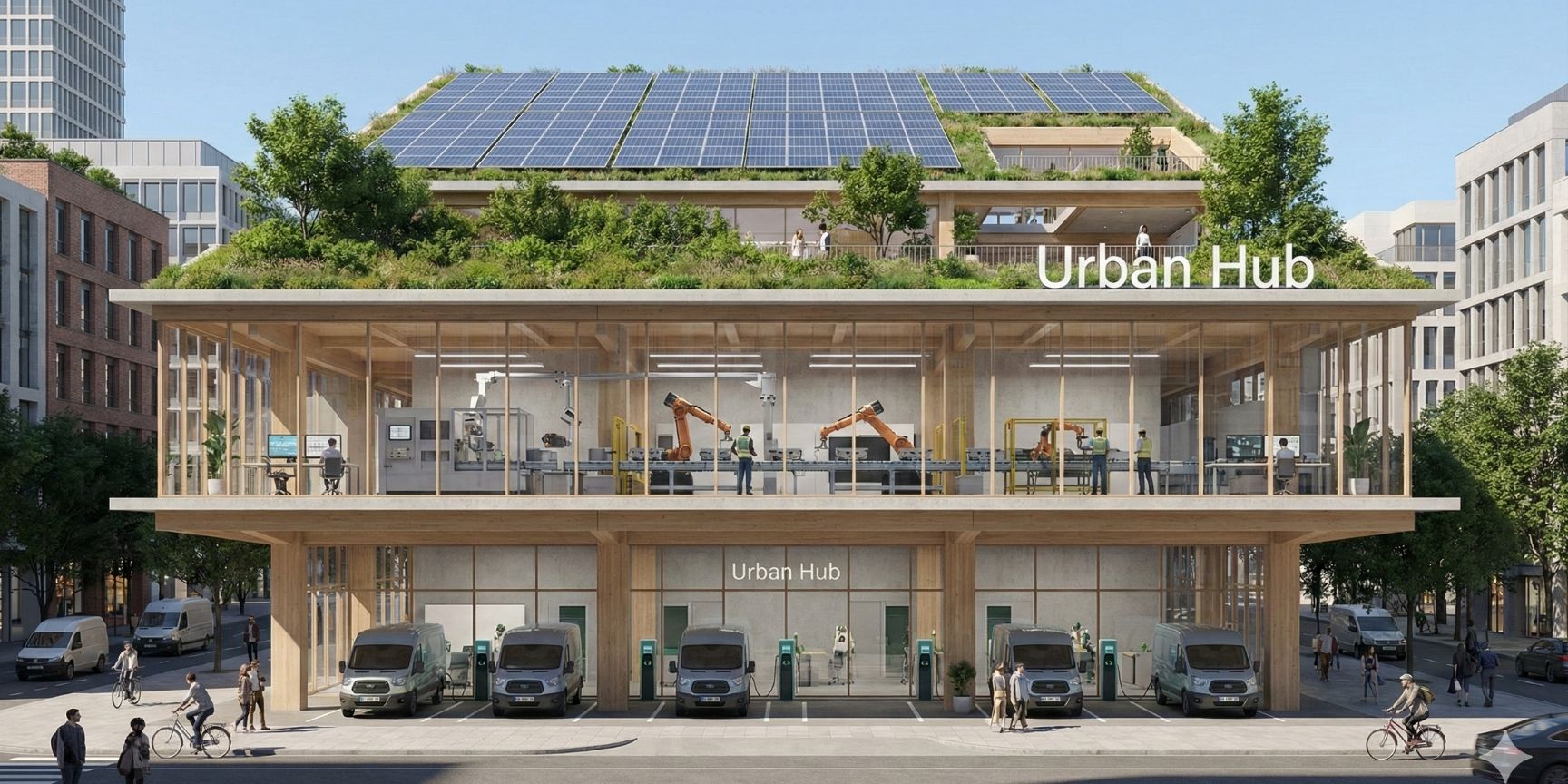
Practical Example: The "Urban Hub Berlin" (fictitious but realistic example)
An investor is revitalizing an old printing plant in Berlin-Lichtenberg.
- Use: Ground floor for e-food delivery (cold rooms), 1st floor for a medical technology start-up (cleanroom production), 2nd floor for co-working and showrooms.
- Technology: The building has intelligent load management for the delivery service's e-fleet.
- The result: Mixed use increased the rent per m² by 40% compared to pure warehousing, while at the same time reducing the CO2 levy for tenants.
The Role of Automation: When the Building Thinks for Itself
In the new trading reality, speed is everything. The light industrial segment must offer buildings that are "robot-ready". This means:
- Floor conditions: Extreme flatness (VDMA guidelines) for narrow-aisle warehouses and AGVs.
- Sensor technology: IoT infrastructure for monitoring the flow of goods and the condition of buildings (predictive maintenance).
- Flexibility: Modular walls that allow a workshop to be turned into a warehouse overnight.
Conclusion: Strategic Recommendations for Action for Stakeholders
The light industrial segment has come of age. It is no longer the appendage of logistics, but the enabler class for our modern way of life.
For investors and project developers, this means:
- Flexibility before fixation: Plan buildings as modularly as possible.
- Energy as a product: As a landlord, think like an energy supplier.
- Dialogue with municipalities: Promote hybrid area categories ("urban areas") to bring production back to the city.
The decisive question for the future is not: How cheaply can I build the hall? Rather: How much added value per square meter can my tenant generate here through technology and location?
References (exemplary for the blog):
- CBRE Research: European Logistics Hubs Report 2024.
- Fraunhofer Institute for Solar Energy Systems (ISE): Photovoltaics Potential Study.
- JLL: Light Industrial – The asset class in the focus of transformation.
- Statista: E-Commerce Penetration Rates by Country 2023.
Latest Blog Posts
Stay up to date with the newest trends, insights, and tips in warehouse and logistics. Our latest articles help you navigate the industry with confidence.
Data Centres vs. Logistics Facilities: The Race for Power and Land
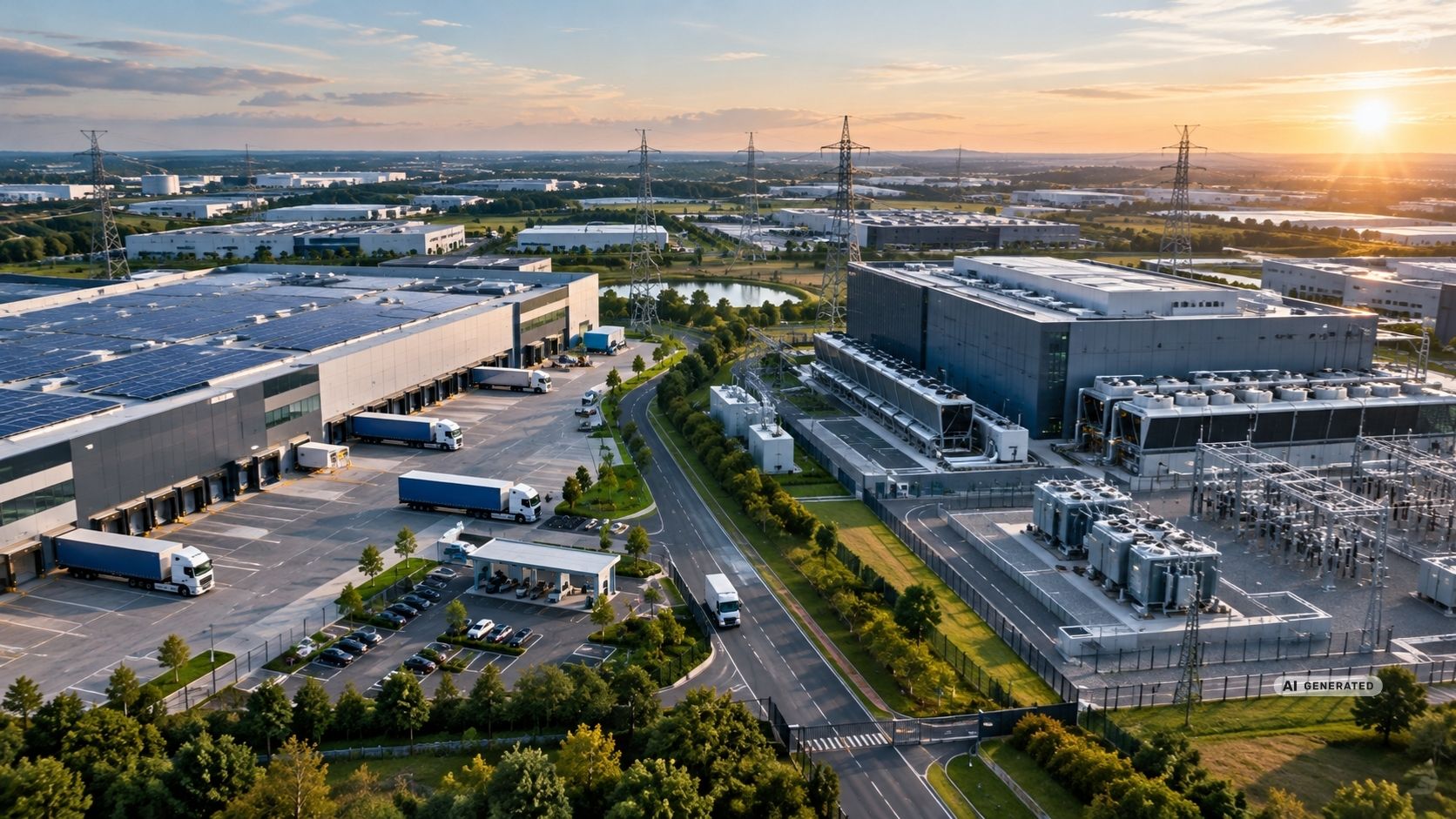
Across Europe, logistics operators are competing for more than land and transport access. They increasingly need something much harder to secure: grid capacity. Data centres are intensifying that competition — and changing how logistics locations are evaluated....

Chinese companies discover Europe's logistics real estate
Chinese companies are becoming an increasingly visible user group in Europe's logistics real estate market. What does this mean for warehouse space, 3PL structures and the requirements for European logistics locations?...
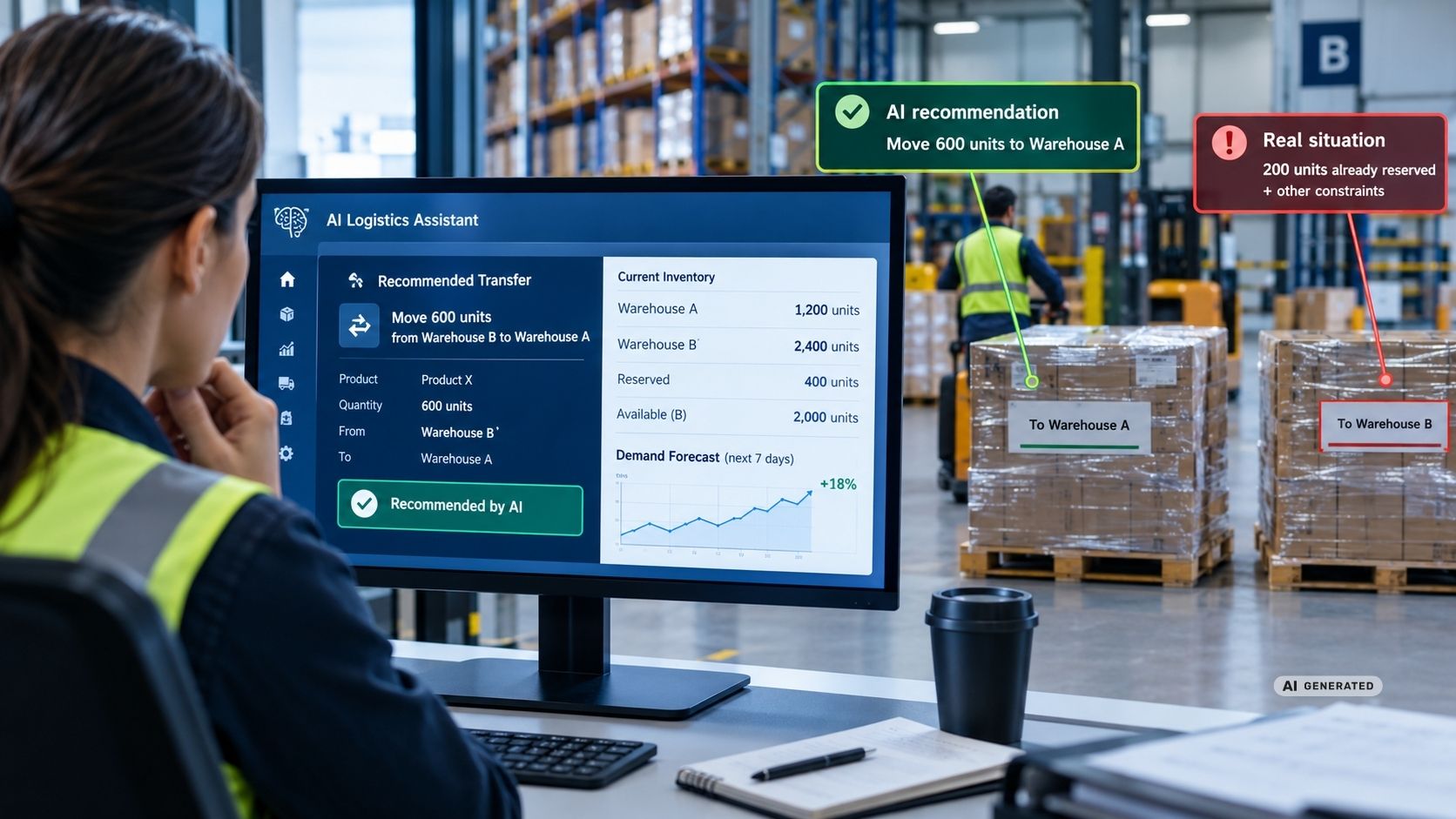
AI Hallucinations in Logistics: When AI Plans the Wrong Delivery
AI can analyze enormous amounts of logistics data — but it can also produce a convincing answer that is simply wrong. The critical question is not whether AI makes mistakes, but what happens when a wrong recommendation becomes an operational decision....
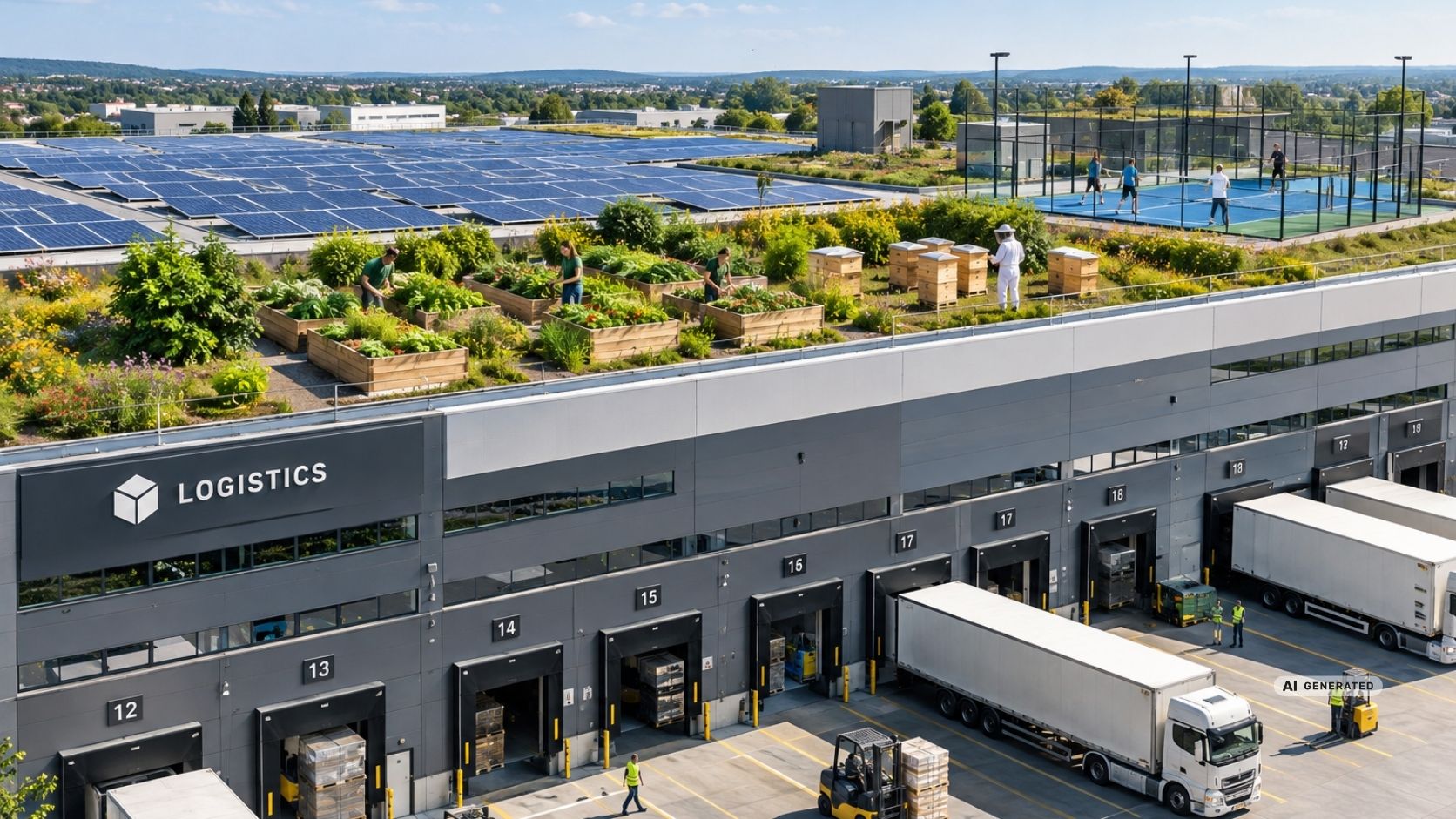
The Green Revolution on the Hall Roof: From Concrete Block to Ecological Power Plant?
Logistics roofs can do more than PV: greening, bees, urban farming and even sports areas turn unused roof space into multifunctional rooms....