




Cargo bike in logistics
Table of contents
- Definition: What is a cargo bike in a logistical context?
- The role of cargo bikes in warehouse and contract logistics
- Cargo bikes in logistics real estate: halls and intralogistics
- Facts, figures and figures: Overview of performance profiles
- Practical Utility: Economy Meets Ecology
- Challenges and operational limits
- Frequently Asked Questions (FAQ)
- Conclusion: An indispensable piece of the puzzle of the logistics of the future
Definition: What is a cargo bike in a logistical context?
A cargo bike (also known as a cargo bike or cargo bike) is a specially designed bicycle that is designed to transport heavy or bulky goods. In professional logistics, these are almost exclusively e-cargo bikes (pedelecs with electric pedal assistance up to 25 km/h). Logistics cargo bikes differ massively from private models: they have reinforced frames, heavy-duty brake systems and standardised transport boxes, which are often precisely matched to the dimensions of Euro pallets or standardised KLTs (small load carriers).
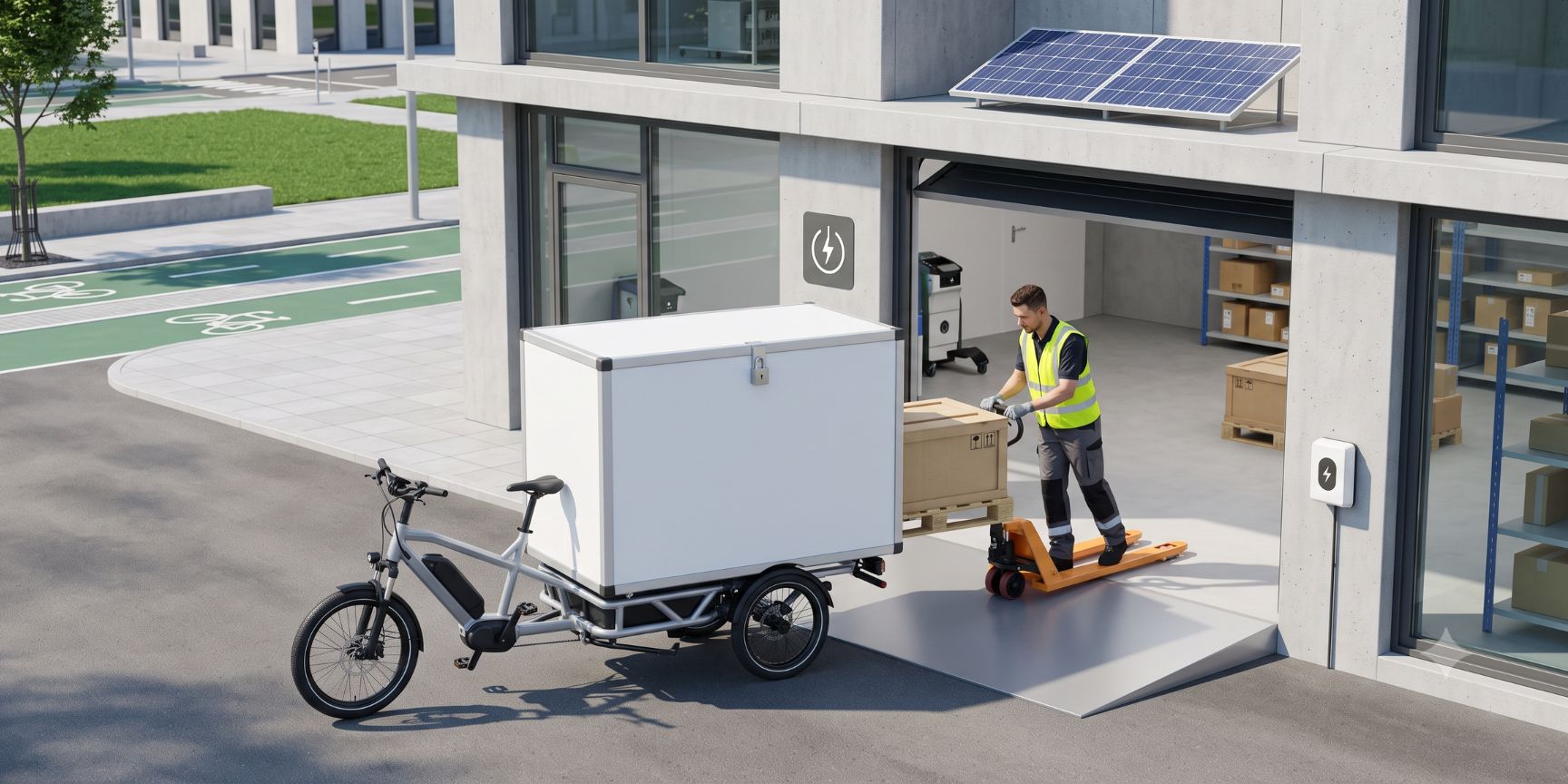
The role of cargo bikes in warehouse and contract logistics
In contract logistics, service providers take on complex, long-term logistics tasks for industry and trade. Here, the cargo bike acts as a strategic building block for optimizing the supply chain, especially on the so-called "last mile". Instead of sending large trucks to congested city centres, goods are picked in upstream warehouses and loaded onto cargo bikes via cross-docking in standardised swap bodies. For contract logistics companies, this offers a decisive competitive advantage when tendering urban distribution contracts, as emission specifications (zero emission zones) and noise protection guidelines are easily complied with.
Cargo bikes in logistics real estate: halls and intralogistics
The architecture and use of logistics real estate is changing noticeably due to the use of cargo bikes. Cargo bikes are not only used for delivery, but increasingly also within or in the immediate vicinity of large hall complexes (factory logistics):
- Micro-hubs: Logistics properties on the outskirts of the city serve as transshipment points. The hall requires not only classic truck ramps, but also ground-level gates so that cargo bikes can enter the picking zone directly.
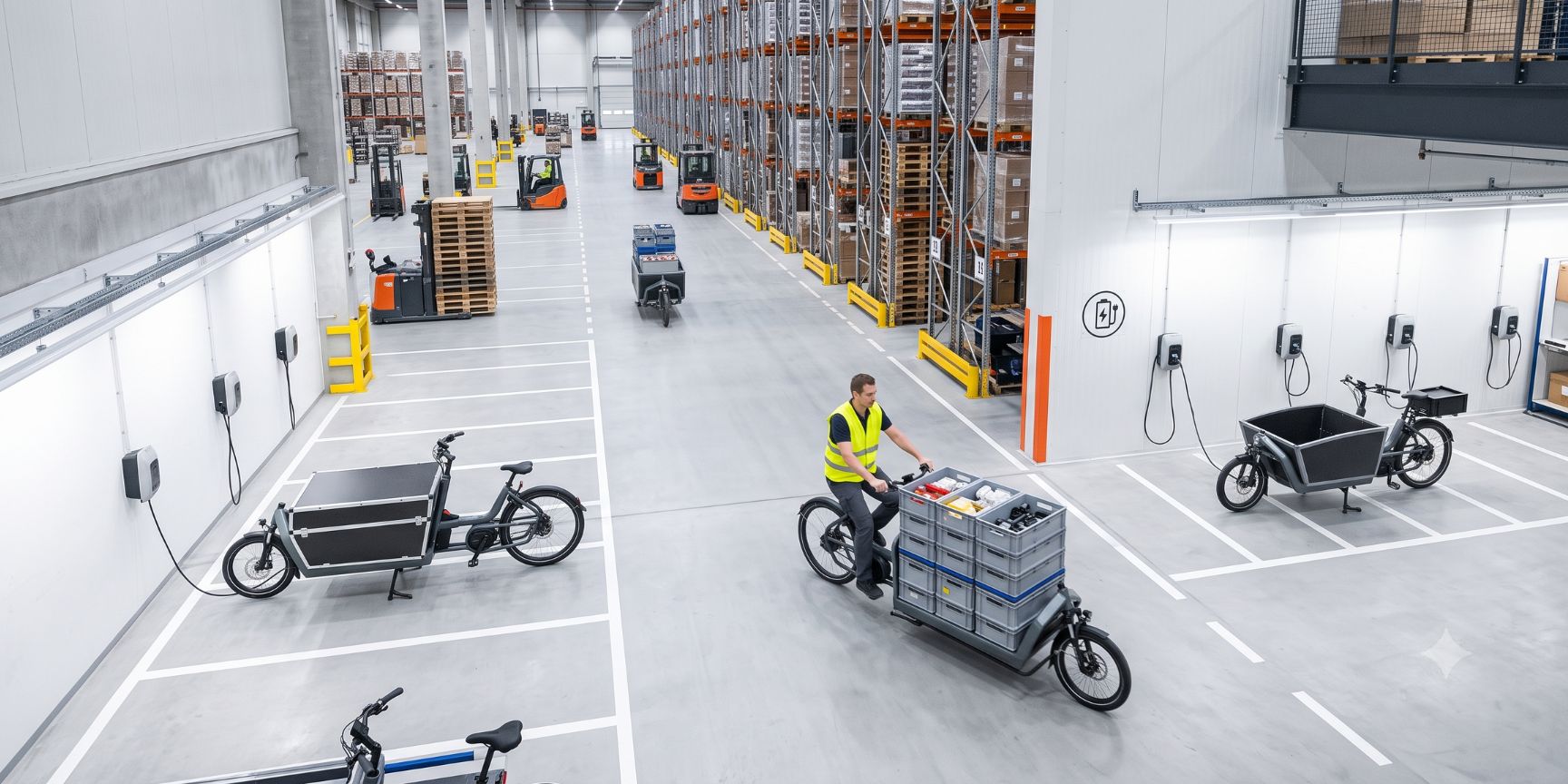
- Intralogistics & factory transport: On extensive campus areas or in mega-halls, cargo bikes sometimes replace forklifts or electric carts for the quick transport of tools, spare parts or documents between different fire compartments, as they are manoeuvrable and do not require special industrial truck certificates.
- Charging infrastructure: Modern logistics properties must provide special fire protection zones for e-cargo bikes for charging and storing lithium-ion batteries.
Facts, figures and figures: Overview of performance profiles
To make the practical utility tangible, concrete performance indicators of modern heavy-duty cargo bikes help:
| Metric / Feature | Average value in the professional segment | Logistical benefits |
| Payload | 150 kg up to 300 kg | Transportation of up to 15-20 standard packages per tour |
| Loading volume | 1.5 m³ to 3.0 m³ | Space for half a pallet to a full Euro pallet |
| Range (battery) | 40 km to 80 km (unlimited with removable batteries) | Sufficient for a complete 8-hour shift in urban areas |
| Average speed | 15 - 20 km/h (in city traffic) | Often faster than vans, as traffic jams are avoided |
| Space requirements (parking) | approx. 2 to 3 square meters | 1 car parking space holds up to 5 cargo bikes |
Practical Utility: Economy Meets Ecology
The use of cargo bikes in warehouse logistics offers tangible economic advantages:
- Reduction of TCO (Total Cost of Ownership): The acquisition, maintenance and energy costs of an e-cargo bike are only a fraction of those of an electric 3.5-ton truck.
- Recruitment: Drivers do not need a car or truck driver's license. This enormously expands the pool of potential employees for logistics service providers.
- Route efficiency: Cargo bikes are allowed to use cycle paths, drive on one-way streets in the opposite direction and park directly in front of the end customer's front door. The search time for parking spaces, which consumes up to 20% of the working time for vans, is completely eliminated.
- ESG compliance: The use enhances the sustainability balance (Scope 3 emissions) of logistics companies and real estate operators.
Challenges and operational limits
Despite the enormous advantages, the cargo bike is not a panacea. The limits lie in the dependence on the weather (which makes occupational safety for drivers in the cold season challenging) and in the maximum capacity. For heavy pallet goods or nationwide distribution in rural areas, the classic truck or van remains indispensable. In addition, the integration of cargo bikes into existing warehouse management systems (WMS) requires new routing and picking algorithms.
Frequently Asked Questions (FAQ)
Question: How is a cargo bike integrated into an existing warehouse structure?
Answer: Integration is usually done via a "hub-and-spoke" structure. The main goods are delivered by truck to the logistics hall (hub). There, tours are pre-picked on roll containers. The cargo bike enters the hall at ground level, picks up the pre-picked container (swap body) and starts delivery.
Question: What requirements does a cargo bike place on the logistics property?
Answer: In addition to ground-level gates and wide driveways in the pre-zone, safe, fire-protected charging stations for the batteries are absolutely essential. In addition, social rooms and changing rooms are needed for the drivers, as they are exposed to the weather.
Question: Are cargo bikes suitable for classic B2B contract logistics?
Answer: Yes, increasingly. Even though they are classically associated with B2C parcel deliveries, cargo bikes in B2B logistics take over just-in-time deliveries of spare parts, office supplies or pharmacy deliveries within metropolitan areas.
Question: Are the acquisition costs for commercial cargo bikes eligible?
Answer: In Germany, Austria and Switzerland, there are far-reaching subsidy programmes from the federal, state and local governments that subsidise between 25% and 40% of the acquisition costs (sometimes up to 2,500 euros per bike) for commercially used e-cargo bikes.
Conclusion: An indispensable piece of the puzzle of the logistics of the future
The cargo bike has long since outgrown its niche. For specialists in warehouse and contract logistics as well as for developers of logistics properties, the Cargobike is now a serious, highly efficient addition to the vehicle fleet. It solves the space problem in cities, reduces logistics costs on the expensive last mile and forces an intelligent architectural development from classic warehouses to urban, sustainable micro-hubs. Anyone planning future-proof logistics networks can no longer avoid the strategic integration of cargo bikes.
Your Ideal Logistics Warehouse
Browse listings for warehouse space, logistics real estate, industrial land, and contract logistics solutions.
Browse Exposés
Maximize Exposure for Your Warehouse Space
Showcase your logistics properties and attract qualified inquiries.
Discover Products