
The Warehouse Magazine
The magazine is published once a quarter to provide information on trends in the logistics industry and the logistics and industrial property sector. With our new magazine, we want to reach our target groups even better. Interesting topics are provided by renowned professors, customers or representatives from the industry.
If you would also like to publish an article or place an advert, please contact us.
Supply chain risk management in practice - old wine in new bottles?
by Prof Dr Dirk Hartel and Dr Ulrich Lison
Risks in the supply chain are seen as a real threat in the logistics industry. In the Allianz Risk Barometer 2014, for example, "business and supply chain disruptions" were categorised as the most important business risk as recently as mid-January (see Allianz (ed.) 2014, p. 1). But is this more than just a catchy buzzword? Doesn't the example of the Indonesian volcano Tambora in 1815 show that natural disasters already had a global impact on the (European) economy almost 200 years ago and led, for example, to famine in the former Kingdom of Württemberg due to short-term climate changes ("the year without a summer")?
Survey of the Cooperative State University and AEB
Against this backdrop, the Baden-Württemberg Cooperative State University Stuttgart and the software company AEB conducted a survey of 110 experts in foreign trade and supply chain management in autumn 2013, the majority of whom came from small and medium-sized companies (see Lison/Hartel 2013). Some of the key findings regarding relevance, methods and risk management strategies are presented below: Supply chain risks are not theoretical constructs that are dealt with exclusively in science and research, but they are real issues that have arrived directly in the consciousness of companies. This is also shown by the results of the survey: Only eight per cent of participants would fully agree with the statement "Supply chain risks only play a minor role in my company".
Consequences of Fukushima?
Initially, the results seem surprising when it comes to the question of the significance of Fukushima for supply chain processes, as the Japanese earthquake has occasionally been described as the "greatest crisis of mankind". Toyota, for example, lost its title as the world's largest car manufacturer in 2011 and was unable to deliver for a good two months. From the perspective of the study participants, who primarily come from medium-sized mechanical and plant engineering companies, the effects were obviously less serious, which may have been due to the fact that the Japanese mechanical and plant engineering industry recovered very quickly from the disaster
and also does not have its geographical focus in western Japan. This explains why more than half of the respondents (55%) stated that they had neither reviewed nor adjusted their supply chains after Fukushima.
In order to avoid such supply bottlenecks, some companies - including those in the automotive industry - have started to rethink some just-in-time connections and build up targeted safety stocks at critical points. However, it seems understandable that such risk management strategies - which are more impact-based - cannot provide a sustainable solution to the problem. It is therefore not surprising that 52.7% reject a strategy of deliberate stockpiling in principle.
No systematic approach to supply chain risks (yet?)
Recognising the importance of supply chain risks is the first step towards a systematic approach. However, the survey results show that many companies are still a long way from having an institutionalised risk management system. A variety of different methods and tools are available for implementing effective supply chain risk management. They were rarely originally developed for risk issues, but originate either from general strategic management (early warning systems, SWOT analyses, scenario technology, etc.) or quality management, e.g. FMEA and risk portfolios (see Fig. 1). In both cases, these are methods that were conceptually developed before the end of the last century or earlier. It is precisely against this background that the methodological competence deficits appear conspicuous.
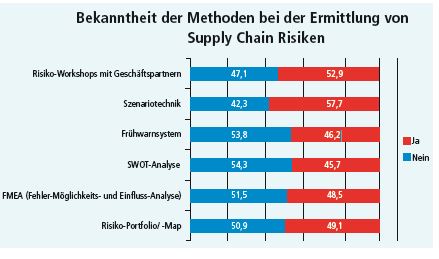
Across all methods, only between 42.3 % (for scenario techniques) and 53.8 % (for SWOT analyses) of respondents were aware of them. The deficits in methodological tools mean that almost half of the participants, and in some cases more than half, do not recognise individual methods. On the one hand, this response behaviour is surprising; on the other hand, the lack of a systematic approach to risk management has already been noted elsewhere. Apparently, supply chain risks are considered to be very important, but problems tend to be dealt with or solved "hands on".
Significant differences between company sizes
At first glance, the results are surprising and the question arises as to whether the level of awareness of the methods correlates with the company size of the participants, measured by the number of employees. With the help of a cross-tabulation, a large dispersion in the level of awareness of the
methods could be demonstrated. In the SWOT analysis, this ranged from 33.3 % (small companies with up to 100 employees) to 55.3 % (medium-sized companies with between 101 and 500 employees) and 69.2 % (large companies with more than 500 employees). It can be deduced from this that the need for methodological action primarily affects smaller companies. For all other SCRM methods (with the exception of the scenario technique), the level of awareness of a method also increases with the size of the company.
Coordination of supply chain risks with third parties
Supply chain management requires co-operation in cross-company networks. Against this backdrop, 63% of participants say that they coordinate their SCRM strategies and measures with third parties. The most important partners in this coordination are A-customers and A-suppliers. Over 80% of respondents stated that they systematically involve them or at least coordinate with them more frequently. This is followed by logistics service providers, who have evolved from traditional freight forwarders to equal partners in the supply chain.
Conclusion
Companies have become aware of supply chain risks. Only a fraction of those surveyed therefore assign them a subordinate role. However, the survey results show that the methodological expertise for effective risk management can be improved, especially in small and medium-sized companies. In many cases, there is still a need for action here, as recognising supply chain risks is a first step, but does not yet solve them.
Sources:Allianz (ed.) (2014): Allianz Risk Barometer - Business Risks 2014, Munich
Lison, U./Hartel, D. (2013): Global Trade Management Agenda 2014 - Future challenges, risks and solutions in global supply chain management, Stuttgart
Author |
|
| Prof. Dr Dirk H. Hartel |
| Prof Dr Dirk H. Hartel |