



The Warehouse Magazine
The magazine is published once a quarter to provide information on trends in the logistics industry and the logistics and industrial property sector. With our new magazine, we want to reach our target groups even better. Interesting topics are provided by renowned professors, customers or representatives from the industry.
If you would also like to publish an article or place an advert, please contact us.
Methodical search for the optimal warehouse location
A previously neglected aspect of methodical logistics planning concerns the search for the optimum location of a logistics site for storage and/or distribution. Many companies, but also many logistics consultants, still work here in the conventional way without methodical support. This is where SDZ GmbH comes in and offers IT-supported planning and optimisation methods that enable a location analysis within a few minutes.
The ever-increasing spread of internet-based ICT options is leading to extremely short reaction times, particularly in the logistics sector, and requires companies to design increasingly flexible logistics structures. Along with these developments, the permanent expansion of domestic markets is increasing the competitive situation and thus the competitive pressure for logistics and transport companies. These companies are therefore forced to constantly optimise and further develop their business processes in order to be able to hold their own in this market.
One aspect of this concerns transport companies that operate in the contract logistics sector, among others. This involves not only the provision of pure transport services, but also supplementary logistics services such as warehousing, order picking or value added services (VAS). A key cost driver here is the question of the optimum number and location of the site(s) where goods are stored and picked for one (or more) customers and from where they are distributed to delivery points. The more favourable (in terms of the resulting total transport performance) this location is selected, the more competitively a company can bid for such business. This is where SDZ GmbH comes in and has developed innovative, web-based methods to methodically support companies in planning these aspects.
The idea of developing web-based applications for logistics planning began a few years ago. The idea behind this was to develop knowledge-based applications that are specifically focussed on individual logistics planning issues. One of these aspects is the search for the optimum location of one (or more) logistics sites. Using modern ICT systems and on the basis of innovative IT development technologies, an easy-to-use application was to be developed that would provide a result of superior quality to conventional methods in the shortest possible time. In extensive research and development projects (e.g. EffizienzCluster LogistikRuhr), these methods were standardised so that they are now offered as web services on the Internet.
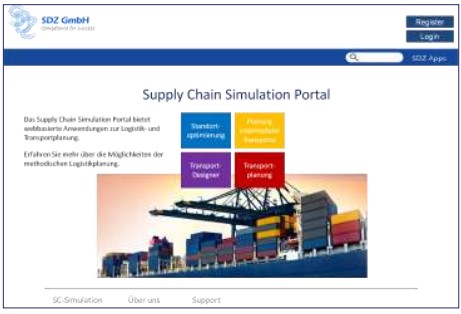
These applications are based on transports to customers or delivery points. The basis for planning can be transport quantities, transport volumes or simply the number of transports. The user can parameterise this specification and also import the relevant data from his
To determine the optimum logistics structure, the user can specify the number of logistics locations required or to be evaluated. The user can also specify the evaluation of the results, for example by specifying the evaluation factor for the transport distance or cost data. The evaluation of the resulting emissions can also be specified by the user using a CO2 factor.
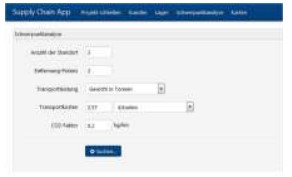
The optimisation calculation is used to determine the location of the optimum site, for which either the transport distances or the transport costs can be used. Analysing the resulting emissions (kg CO2) offers a further possibility for comparison.
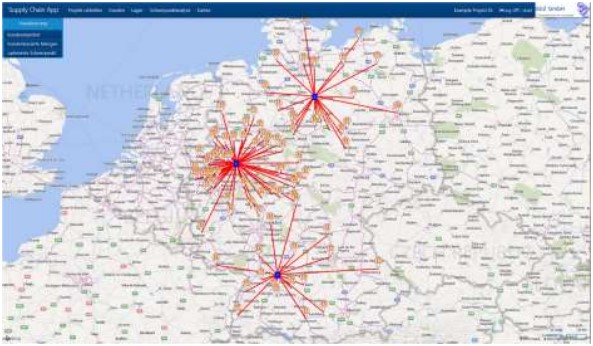
More and more companies are using new methods of digital planning, such as simulation, to find an optimal location or to evaluate the location of their own site. This applies to both shippers and logistics service providers. In this way, it is possible to compare cost and service aspects in the search for the optimum location. One use case in this regard is the search for a service-optimised logistics location. The delivery points are distributed throughout Germany.
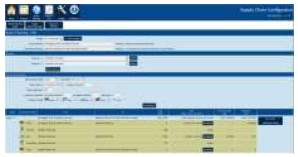
As a result, the user receives a detailed analysis for each scenario analysed. Firstly, the result for the optimum location of the site(s) is displayed. This overview shows the results of the resulting transport kilometres, transport costs and emissions for each location. The result determined for the optimum location of the sites is displayed to the user visually on a digital map.
However, knowledge of the optimum location of sites is not enough to meet the requirements of short-term responsiveness, resulting flexibility and low logistics and transport costs. As a result, increasingly interconnected supply chain networks will have to be implemented and operationally managed. Any disruption to a process chain element can affect the success of the entire supply chain. This will lead to transport structures that have to be managed very flexibly and at ever shorter notice (because they are situational). Given the large number of factors influencing these transport structures, the task of managing these structures can no longer be ensured in the conventional way. This is increasingly taking place against the background that many companies organise their supply chain strategically, but do not have the necessary methods to manage it operationally with regard to the current challenges. What is needed are methods that enable a completely new type of cooperation between shipper and carrier in order to guarantee the service and profitability of the supply chain for all parties involved in every operational situation. This co-operation requires mutual trust and transparency, which can be achieved through new IT applications.
Other web-based applications already exist, e.g. for the planning of intermodal transport chains for international freight transport, for the short-term scheduling of means of transport and for the scheduling of freight transport.
Contact and author:
SDZ GmbH
Dipl.-Ing. Mathias Bös
Hauert 20
44227 Dortmund
Tel.: +49 231/97505 0 0
Fax: +49 231/975050 50
mathias.boes@sdz.de
www.sdz.de