The Warehouse Magazine
The magazine is published once a quarter to provide information on trends in the logistics industry and the logistics and industrial property sector. With our new magazine, we want to reach our target groups even better. Interesting topics are provided by renowned professors, customers or representatives from the industry.
If you would also like to publish an article or place an advert, please contact us.
Opportunities in a new logistical guise
by Wolfgang Lehmacher
Logistics can no longer be separated from responsibility for prosperity, well-being and the future. This means for logistics companies: Only those who think innovatively beyond their original logistics activities and processes will be able to utilise opportunities and be successful in the long term.
Digital and mobile revolution, increasing environmental and security risks, growing complexity of global value chains: Modern logistics and its clients are facing challenges that require collective action and a new self-image on the one hand and open up many new opportunities for everyone involved on the other. Take the scarcity of resources, for example: rare earth metals are rare, and their extraction harms the environment and the people who work with them. However, these metals are currently indispensable for our daily lives in many areas, as they are found in countless products in our daily lives, such as fluorescent lamps, plasma televisions, car catalytic converters and medical devices
as well as in mobile phones and smartphones.
Where are the opportunities for logistics? If it thinks in terms of the new logistics paradigm (see diagram) beyond traditional logistics and along the entire value chain, many new potentials can be tapped into together with customers and other partners.
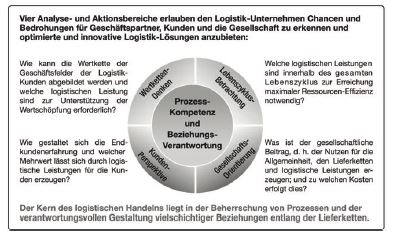
Logistics can shape value cycles
In addition to rare earth metals, a mobile phone contains many other important raw materials such as copper, silver, gold and plastics. Raw materials that can and should be recycled. At the same time, a special kind of warehouse has developed: Only 5 per cent of Germans give their discarded mobile phones for recycling, although between 65 and 80 per cent of mobile phones are recyclable. The rest - and experts estimate this to be 120 million mobile phones with a value of 4 billion euros - are stored in household drawers.
This is a value-added opportunity for logistics! It can organise the return of these valuable materials. Either through cost-effective transport, for example by means of an exchange service, by setting up recycling bins or through collection point co-operations with local retailers - thus closing important material cycles. Materials also need to be separated and recycled. There is a need to catch up here. Logistics companies can also see this as an opportunity for themselves and utilise it - for example, by developing their own recycling expertise and offering corresponding services.
The return and recycling of metals into the value cycle not only simplifies the procurement of raw materials - the environment benefits in several ways: fewer raw materials have to be mined and transported over thousands of kilometres. This leads to less traffic and lower CO2 emissions. Roads, railways and sea routes are relieved. Incidentally, this also applies to the procurement and disposal of plastics and other mobile phone components.
Opportunities beyond the classic service
A smartphone is often discarded because a small part is defective. Clever spare parts management, which can be organised by logistics companies, can significantly extend the service life of smartphones. In addition, 3D printers will play an increasingly important role in the production of spare parts. This opens up another opportunity for logistics! UPS, for example, has equipped branches in the USA with 3D printers and can produce spare parts directly on site and deliver them quickly by the shortest route.
3D printers are no longer unknown in Germany either: The DIY chain Knauber, for example, offers a 3D printing service at its flagship store in Bonn-Endenich. A customised iPhone case is available for as little as ten euros. Spare parts are charged at 24 cents per gram plus a set-up fee.
For consumers, this means Spare parts that are not necessarily offered by the manufacturer can now be produced and purchased at low cost. Thanks to 3D printing, dishwashers, microwaves and other household gadgets and appliances that would have to be taken out of service due to a missing spare part can now be repaired and continue to be used. In addition, manufacturers no longer have to stock spare parts nationwide. Or keep them in stock for several years in order to be able to offer repairs if the worst comes to the worst. This relieves the burden on warehouses and reduces space requirements. It also reduces capital commitment costs.
The various examples show: By taking an end-to-end view of the value chain - from raw material procurement to recycling - and incorporating innovative technologies, the logistics industry can open up new areas of business, make its contribution to solving social and environmental challenges and at the same time create added value for customers, partners and the logistics companies themselves.
Author |
|
| Wolfgang Lehmacher |