
The Warehouse Magazine
The magazine is published once a quarter to provide information on trends in the logistics industry and the logistics and industrial property sector. With our new magazine, we want to reach our target groups even better. Interesting topics are provided by renowned professors, customers or representatives from the industry.
If you would also like to publish an article or place an advert, please contact us.
Logistics property - market and locations 2013
by Dr Alexander Nehm
The 3rd edition of the study "Logistics Real Estate - Market and Locations" by Fraunhofer SCS analyses and compares the most important locations in Germany, Austria, Switzerland and, more recently, Belgium and the Netherlands
Germany is still undisputedly the most important logistics market and location in Europe. Although, according to analyses by Fraunhofer SCS, the volume of new logistics space in Germany in 2013 was rather moderate at 2.7 million m2 compared to the peak values of the last 10 years (in 2012 it was around 2.6 million m2), investment in logistics properties continues to be strong. Accordingly, the market for logistics properties has long since become attractive for investors beyond its niche existence.
The most exciting question, which interests both users and investors alike, is still which location is and will remain attractive in the long term and sustainably. However, the answer can be very different for users and investors.
Generally speaking, locations where logistics business is generated are attractive. These are primarily logistical sources and sinks, i.e. regions with strong production and sales, infrastructure-dependent gateways such as seaports or airports or important transport hubs in the hinterland.
Looking at the map of Europe, it quickly becomes clear that such regions are not to be found exclusively in Germany. Numerous investors, especially international investors, are therefore interested in attractive locations in Europe and, accordingly, beyond Germany's borders.
In its latest edition, the Fraunhofer SCS study analyses logistics regions in five countries (Germany, Austria, Switzerland, Belgium and the Netherlands) and identifies a total of 35 outstanding logistics hotspots. 20 of these are in Germany, 5 in Austria, 4 in Belgium and 3 each in the Netherlands and Switzerland.
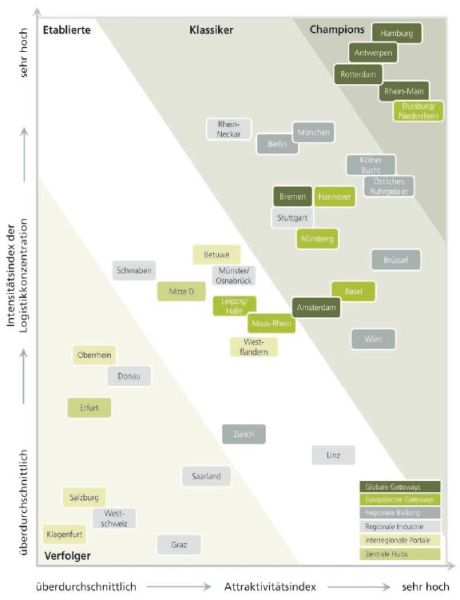
The number of these regions within a country is not the decisive factor here. Furthermore, not every location is equally suitable for every logistics task. What is often overlooked is that numerous logistics locations are not in competition with each other due to their different logistics tasks and can therefore be of interest to very different customers. The study therefore shows how the individual regions can be categorised in terms of their logistical suitability. The authors initially classify the locations into 5 different categories:
1. Global gateways
Hamburg, Antwerp, Rotterdam and Bremen are international gateways for the container business due to their seaport connections. Rhine-Main and Amsterdam can also be categorised in this category due to their international airports. Both the attractiveness and the intensity index are still very high for these locations, although Bremen is somewhat behind in a direct comparison.
2. European gateways
The classic gateways for European goods flows are primarily the Duisburg/Lower Rhine and Meuse-Rhine regions, but Hanover, Nuremberg, Basel and Leipzig/Halle also fulfil this function. The logistics centres within the regions comparatively often take on supra-regional and international tasks in a European context. While the focus of most locations in this category is primarily on the trimodality of road, rail and waterways, the international freight airport is a decisive location criterion in Leipzig/Halle.
3. Regional supply and disposal companies
Locations within this class are primarily due to the attractive conurbations ("regional agglomeration") and the strong regional industrial markets ("regional industry"). "Regional agglomeration" is particularly attractive for logistics service providers and trading companies. The most important sales markets for end consumers are located here. Consequently, the densely populated regions of Cologne, the eastern Ruhr area, Munich and Zurich as well as the capital cities of Berlin, Brussels and Vienna are categorised here. "Regional industry" is a magnet for logistics service providers in the contract logistics sector, as long-term orders can be generated in these regions. Stuttgart, Rhine-Neckar, Swabia, Münster/Osnabrück, Danube, Saarland, western Switzerland, Linz and Graz are such industrial locations. Most of the regional industries have sector-specific focal points, such as the automotive or chemical industries. These are primarily logistics properties for the supply and disposal of production and comparatively fewer supra-regional than regional or local distribution centres.
4. Interregional portals
Interregional portals such as the Upper Rhine region, Salzburg, Klagenfurt, the Betuwe region and West Flanders are united by their border location and a special logistics portal function to neighbouring European countries. Numerous companies have settled in the Upper Rhine region due to its proximity to France and Switzerland. Salzburg is in close contact with its German neighbours and Klagenfurt offers good opportunities to Italy and south-eastern Europe. Other representatives of this category are West Flanders and Betuwe, which have focussed on France and Germany respectively due to their border location.
5. Central hubs
Numerous settlers in the "Centre D" and Erfurt regions take advantage of the central location in Germany and the late cut-off times. This means that goods can be accepted very late in these locations, with the guarantee that the goods will also arrive on time the next day to recipients throughout Germany. Companies from the e-commerce sector, for example, can be found at such locations. In addition to the differentiated location analysis, the study also looks at the availability of space and labour and brownfield development, as well as the future development of logistics-related economic sectors in the respective regions. As it has developed into one of the strongest demanders of logistics space in recent years, the study also analyses the retail sector in more detail. It compares differences in the location decisions of bricks-and-mortar and online retailers and contrasts alternative logistics strategies. In addition, the TOP logistics regions in Europe are again presented in clear profiles, their respective strengths and weaknesses are highlighted and current developments in the local submarkets are analysed in detail.
The study thus serves all market players in making well-founded investment decisions and evaluating locations and properties - from users to project developers, brokers, consultants, investors and municipal space providers.
The study can be obtained from Fraunhofer Verlag under ISBN 978-3-8396-0613-1.
Author |
|
| Dr Alexander Nehm |