



The silent giant awakens: Why wood is the future for logistics and industrial real estate
Table of Contents
- The new star in the sky of project developers: What's behind the wood hype?
- Advantage 1: The unbeatable climate champion – bind CO₂ instead of emitting it
- Advantage 2: Speed is money – How wood is revolutionizing construction time
- Advantage 3: Room for efficiency – The magic of large spans
- Advantage 4: The human factor – a better working atmosphere in the truest sense of the word
- The myth of fire protection: Doesn't a wooden hall burn like tinder?
- Focus on Europe: A Differentiated View of Timber Construction and Logistics Hotspots
- Conclusion: An investment that pays off – economically and ecologically
The skyline of our industrial parks is traditionally dominated by steel and concrete. But a change is in the air – a change that smells of the forest. Project developers of warehouses, logistics and industrial properties are increasingly rediscovering a centuries-old building material for themselves: wood. What may seem like a step backwards at first glance is in fact a huge leap forward. But why is this change happening now? What tangible advantages convince hard-nosed investors, and who in Europe sets the tone for this trend? This article dives deep into the subject matter and sheds light on why the asset class of logistics real estate is on the verge of a wooden revolution.
The new star in the sky of project developers: What's behind the wood hype?
For a long time, wood was considered a niche product in large-scale commercial construction. But times are changing. The pressure to operate more sustainably is increasing – not only due to legal requirements such as the EU taxonomy, but also due to demand from tenants and investors. ESG criteria (Environmental, Social, Governance) are no longer mere buzzwords, but hard currency in the competition for capital and renowned users. A logistics property made of wood is an unmistakable statement here. It contributes directly to the sustainability goals and improves the CO₂ balance of an entire portfolio. Project developers such as Garbe Industrial Real Estate GmbH, which is building one of the largest logistics halls in Europe in pure timber construction in the port of Straubing, show that the trend has arrived in reality and is setting new standards.
Advantage 1: The unbeatable climate champion – bind CO₂ instead of emitting it
This is perhaps the most convincing advantage in this day and age. While the production of cement for one ton of concrete releases around 600 kg of CO₂, wood has exactly the opposite effect. One cubic metre of wood permanently stores around one tonne of CO₂.
"According to initial calculations, for example, we expect a CO₂ reduction of up to 66 percent compared to a development in conventional reinforced concrete construction." - Garbe Industrial Real Estate (referring to their project in Straubing)
A logistics hall with a wooden structure of 4,000 cubic meters, for example, thus becomes an active carbon sink that removes 4,000 tons of CO₂ from the atmosphere. This effect, combined with the savings in emissions that would have been incurred during concrete and steel production (substitution effect), makes wood the number one climate protection material. For project developers, this means not only a clear conscience, but also a measurable contribution to achieving climate goals that can be marketed better and better.
Advantage 2: Speed is money – How wood is revolutionizing construction time
Time is one of the most critical factors in project development. Every day that a property is completed earlier means an earlier rental and therefore a faster return on investment. This is where timber construction fully shows its strengths. Due to the high degree of prefabrication of wooden elements such as glulam trusses or entire wall and roof elements, the actual assembly time on the construction site is drastically shortened. The components are manufactured precisely in the factory and only assembled on site. This results in:
- Shorter construction times: Weeks, sometimes months, can be saved.
- Less construction site noise and traffic: A blessing for surrounding residents and the environment.
- Higher precision and quality: Production under controlled factory conditions minimizes sources of error.
This efficiency also makes timber construction more and more attractive in terms of costs, although the pure material costs for wood can be higher than for concrete.
Advantage 3: Room for efficiency – The magic of large spans
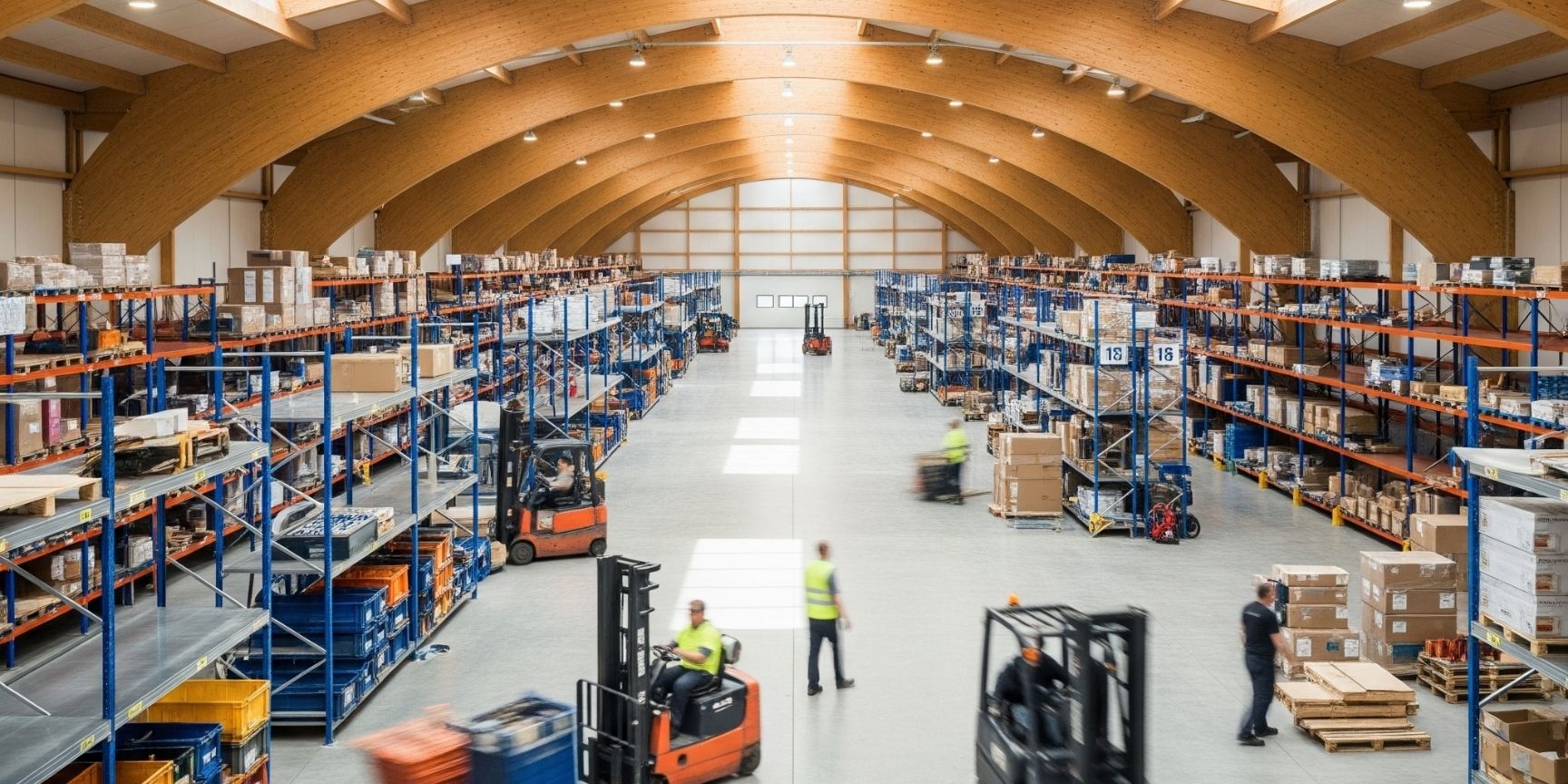
When you think of a warehouse, you think of huge, open spaces for maximum flexibility in storage and picking. Annoying supports are an efficiency killer here. Glulam is the ideal building material here. It combines a relatively low dead weight with an enormous load capacity. This allows column-free spans of over 50 metres to be realised economically. For tenants, this means unrestricted usability of the space, which significantly increases the attractiveness of the property. The elegant, often visible wooden structures also give the hall an unexpected aesthetic.
Advantage 4: The human factor – a better working atmosphere in the truest sense of the word
In times of a shortage of skilled workers, the quality of the workplace is becoming a decisive competitive advantage. A wooden hall has been proven to offer a more pleasant atmosphere than a sterile concrete building. Wood naturally regulates humidity and provides a better indoor climate. The warm appearance and natural feel of the material have a positive effect on the well-being and motivation of employees. An argument that is becoming increasingly important in the recruitment and retention of staff.
The myth of fire protection: Doesn't a wooden hall burn like tinder?
A persistent prejudice against timber construction is the supposedly high risk of fire. But the opposite is the case. Modern timber construction methods offer excellent and, above all, predictable fire protection. Solid wooden components such as glulam beams do not burn out abruptly in the event of a fire. They form a protective charcoal layer on the surface, which greatly slows down the burning process and reduces the oxygen supply to the inside of the carrier. This charring layer acts as a natural insulation. The load-bearing behaviour of the structure is thus maintained over a long, precisely calculable period of time, which gives the fire brigade valuable time for evacuation and extinguishing work – often longer than with steel structures, which can unpredictably lose their load-bearing capacity in the heat. Modern fire protection concepts and sprinkler systems therefore make wooden halls just as safe as conventional buildings.
Focus on Europe: A Differentiated View of Timber Construction and Logistics Hotspots
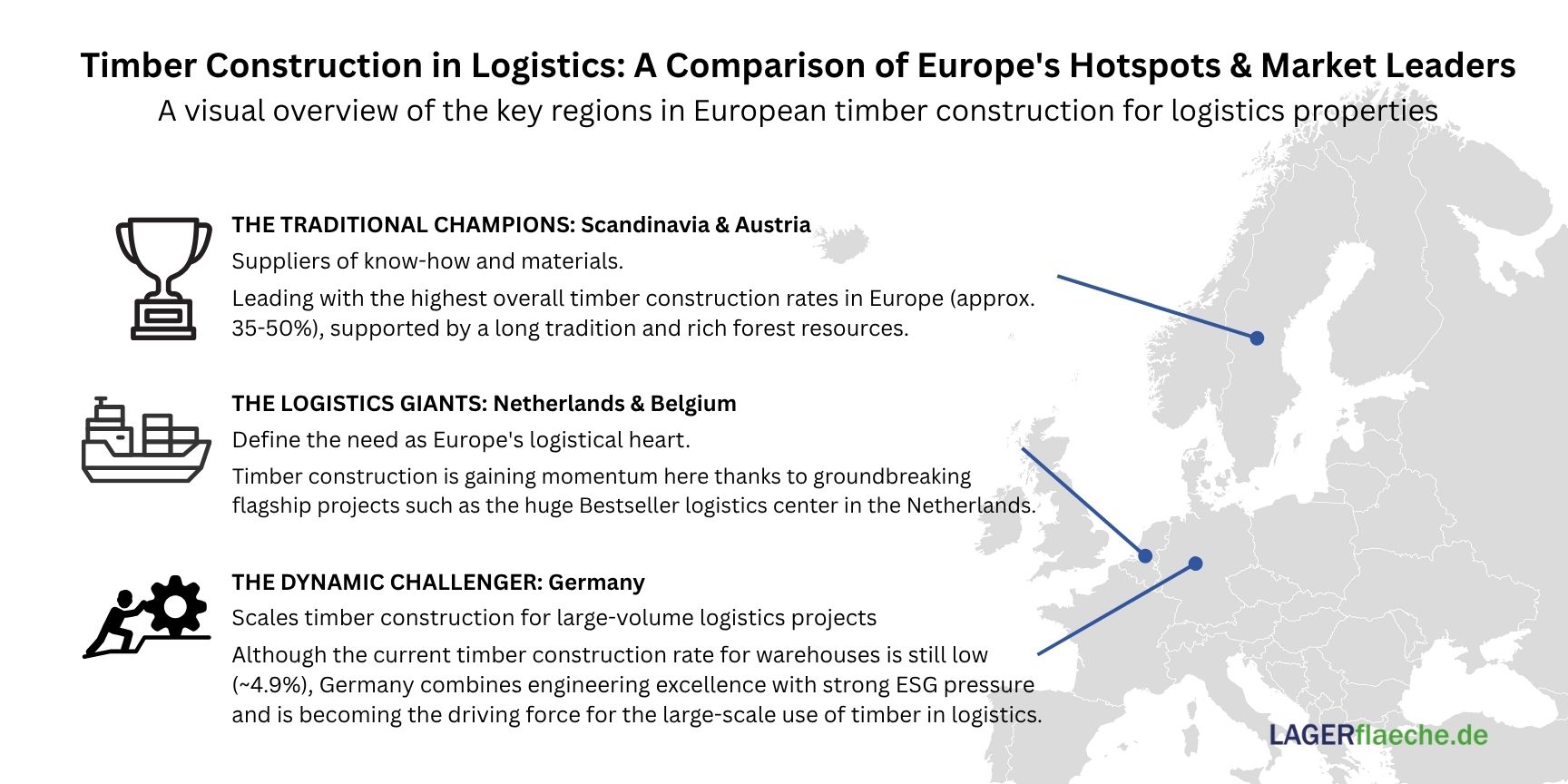
The question of the European pioneer in timber construction for logistics real estate cannot be answered with a single name. The picture is differentiated and depends heavily on the perspective: Do we look at the general timber construction tradition or the specific application in the large logistics hubs?
The traditional timber construction champions: Scandinavia & Austria
If you look at the general timber construction rates, the Scandinavian countries (esp. Sweden and Finland) and Austria are the undisputed frontrunners. With timber construction quotas that sometimes reach 30-50% of the total new construction, these countries have a deep-rooted timber culture, huge sustainably managed forest resources and a politically strongly promoted timber industry. Their expertise is undisputed, but historically focused heavily on housing and public construction.
The logistics giants: Netherlands & Belgium in transition
As the logistics heart of Europe with the mega-ports in Rotterdam and Antwerp, the Netherlands and Belgium are the undisputed champions in goods handling. Their logistics real estate markets are highly developed and trimmed for maximum efficiency. Surprisingly, however, this leading position is not (yet) reflected in a leading role in timber construction for logistics properties. For a long time, the focus here was on traditional construction methods and other sustainability aspects such as BREEAM certifications and large-scale solar systems.
But here, too, a rethink is taking place, driven by ambitious climate targets and lighthouse projects. A spectacular example is the logistics centre of the fashion group Bestseller in Lelystad, the Netherlands, which is currently under construction. After its completion in 2026, it will be Europe's largest logistics centre in timber construction – a clear signal that timber construction is also arriving in the established logistics hotspots.
Germany: The bridge between timber know-how and logistics power
Germany plays a fascinating key role. With a timber construction rate for warehouse buildings of only approx. 4.9% in 2022 (source: bulwiengesa), there is still a lot of room for improvement. But Germany is the market in which large-volume logistics development and highly industrialized timber construction are currently growing together most dynamically. German project developers like Garbe, who are boldly investing in large-scale timber projects, are combining domestic engineering with the growing pressure for ESG-compliant assets. Germany thus acts as a crucial bridge and proves that timber construction is not only possible for the most demanding logistics applications on a large scale, but also economically and ecologically sensible.
In summary, it can be said that while Scandinavia provides the tradition and the material and the Benelux countries define the logistical necessity, it is currently Germany in particular that is driving the scaling of timber construction in the logistics asset class and thus paving the way for the whole of Europe.
Conclusion: An investment that pays off – economically and ecologically
The use of wood in project development for warehouse, logistics and industrial properties is much more than a short-term trend. It is the logical consequence of the requirements of the market: sustainability, efficiency and user orientation. The advantages – from the positive CO₂ balance to the fast construction time to flexible, people-friendly spaces – are tangible and convincing. Even though the pure construction costs can currently still be slightly higher than those of conventional construction methods, this is more than compensated for by faster completion, high demand and potentially higher value stability in the life cycle of the property. For project developers who want to act responsibly and in a future-proof manner, there is no way around wood as a building material. The quiet revolution has begun, and it is made of wood.
Latest Blog Posts
Stay up to date with the newest trends, insights, and tips in warehouse and logistics. Our latest articles help you navigate the industry with confidence.
Data Centres vs. Logistics Facilities: The Race for Power and Land
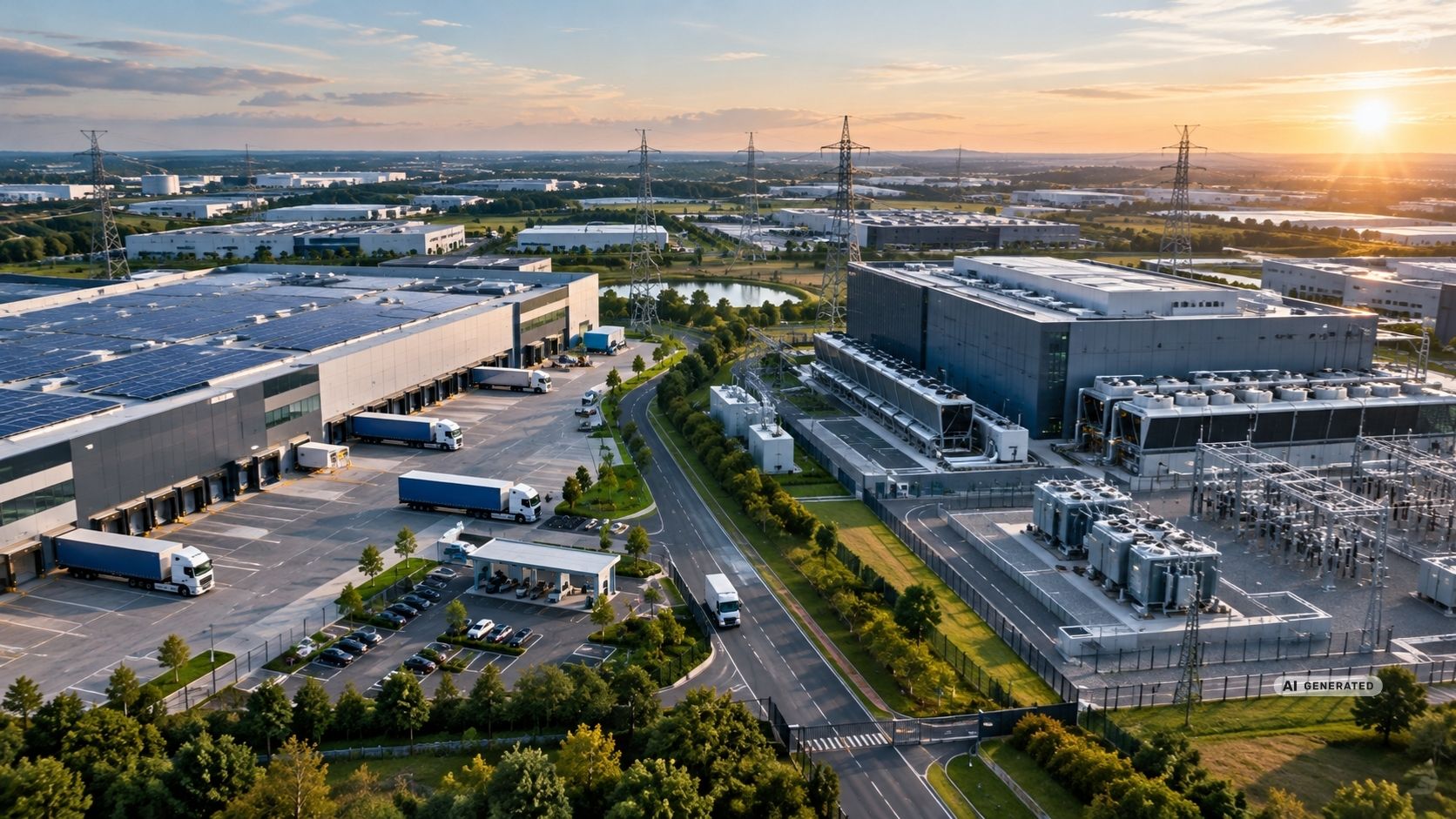
Across Europe, logistics operators are competing for more than land and transport access. They increasingly need something much harder to secure: grid capacity. Data centres are intensifying that competition — and changing how logistics locations are evaluated....

Chinese companies discover Europe's logistics real estate
Chinese companies are becoming an increasingly visible user group in Europe's logistics real estate market. What does this mean for warehouse space, 3PL structures and the requirements for European logistics locations?...
AI Hallucinations in Logistics: When AI Plans the Wrong Delivery
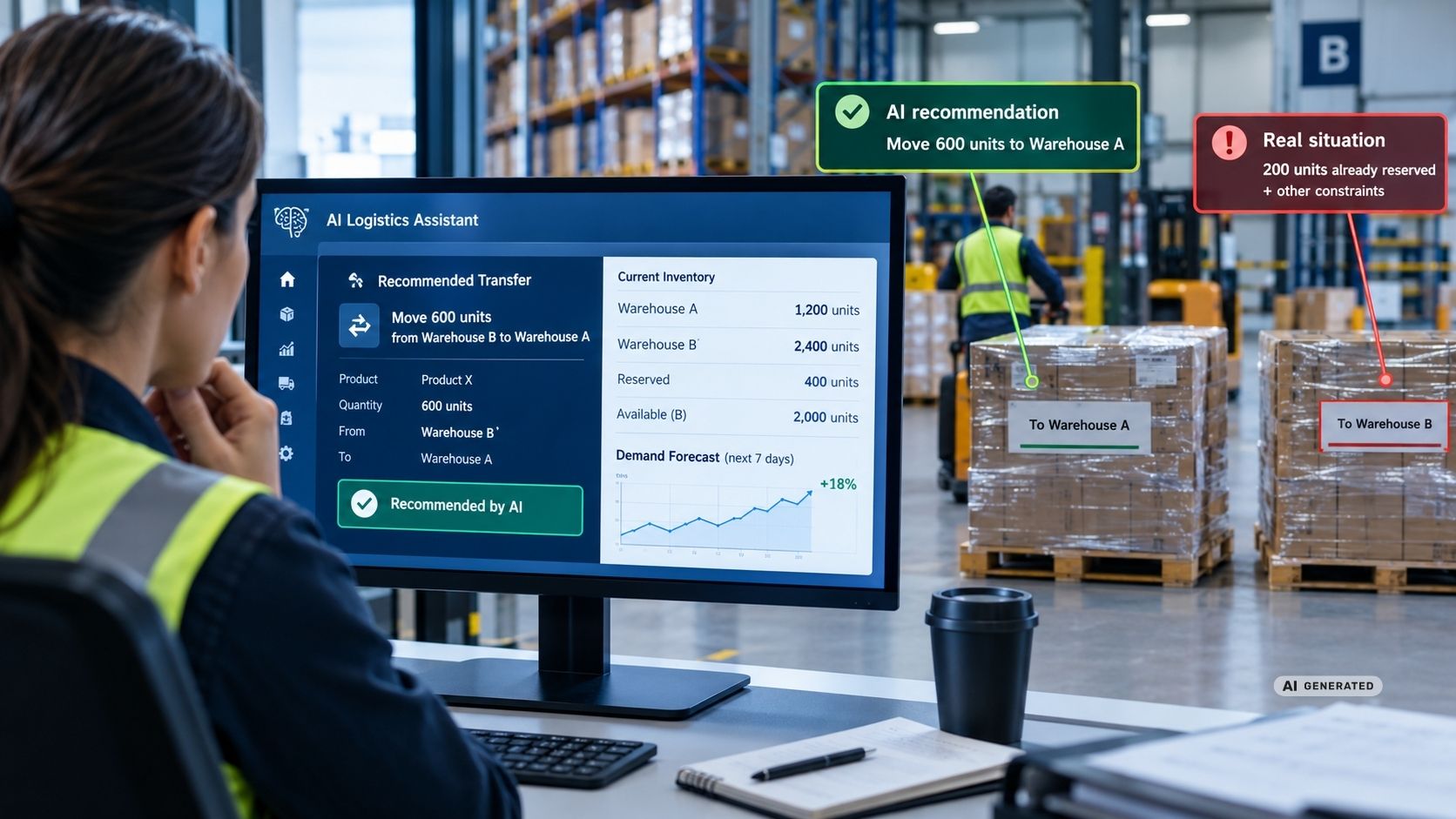
AI can analyze enormous amounts of logistics data — but it can also produce a convincing answer that is simply wrong. The critical question is not whether AI makes mistakes, but what happens when a wrong recommendation becomes an operational decision....
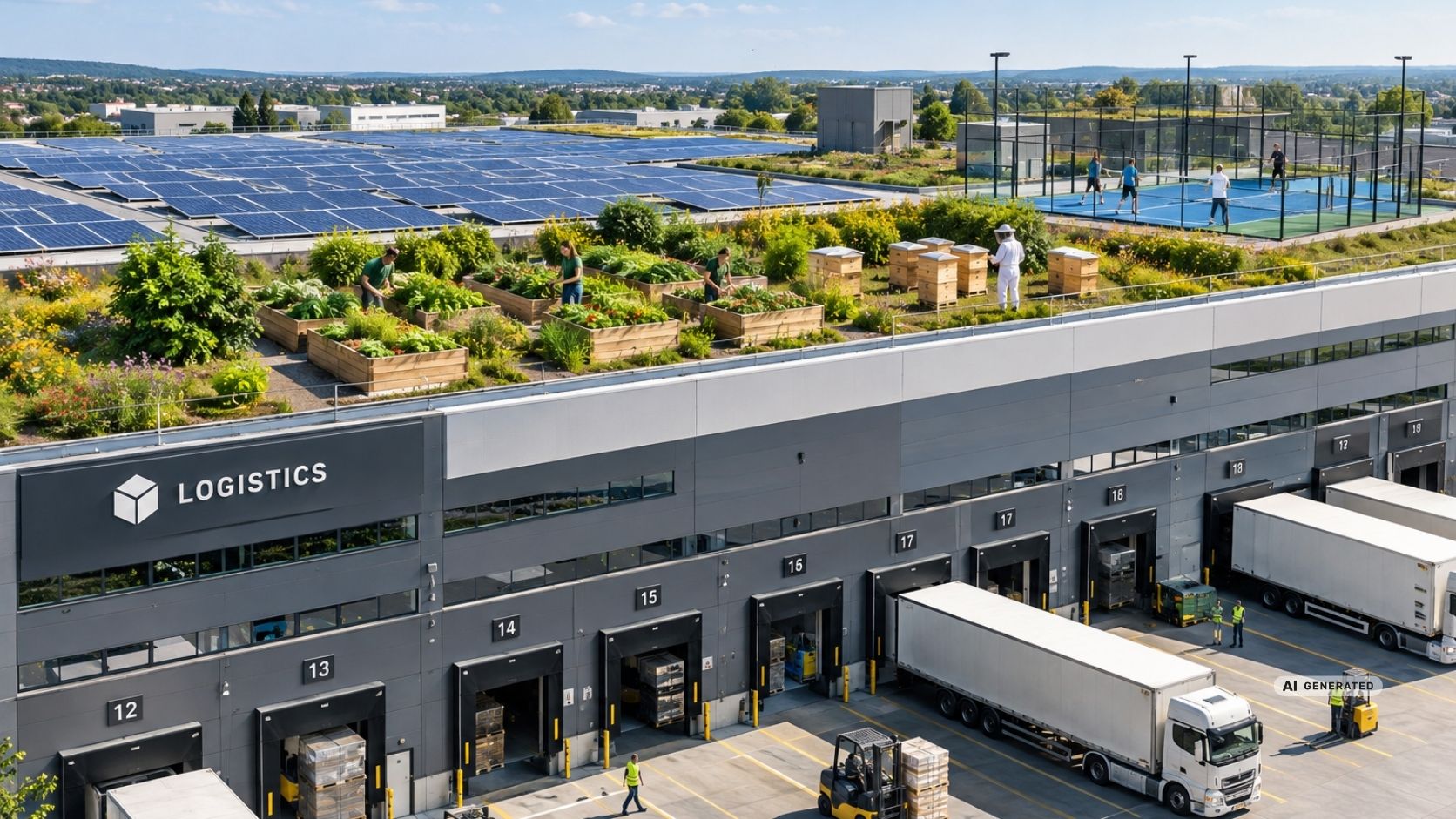
The Green Revolution on the Hall Roof: From Concrete Block to Ecological Power Plant?
Logistics roofs can do more than PV: greening, bees, urban farming and even sports areas turn unused roof space into multifunctional rooms....