


The transparent customer in hybrid retail: How to turn your warehouse into an omni-channel powerhouse
Table of Contents
- Multi-Channel vs. Omni-Channel: More Than Just a Buzzword Bingo
- The key question: Separate zones or total integration?
- The Brain of Surgery: Why Your WMS Is Key
- Practical example: The metamorphosis of "FashionForward GmbH"
- The Global View: Why German Efficiency Doesn't Fit Everywhere
- The Top 5 Hurdles on the Way to the Omni-Channel Warehouse
- The future: AI, robotics and the end of the "camp"
- Conclusion: Not an option, but a necessity
Imagine a customer: He researches online on his smartphone, tries on the jacket in the store, but buys it later in the evening on his tablet – and has it delivered to another store via Click & Collect because he will drive by there tomorrow anyway.
This customer doesn't think in channels. He thinks in terms of "I want the product, now and here." For the logistics behind it, this claim is the "squaring of the circle".
The boom in e-commerce, which according to the German Retail Association (HDE) has stabilized at a high level, is meeting a resilient brick-and-mortar retail sector that is reinventing itself. Companies that serve both worlds are faced with a central question: How should a warehouse be structured to efficiently manage pallets for 100 stores and thousands of individual packages for online customers? And that without breaking the capital commitment caused by double stocks?
The answer lies in the intelligent structuring of warehousing. But the path to get there is complex and very different globally. Welcome to the supreme discipline of logistics: omni-channel warehousing.
Multi-Channel vs. Omni-Channel: More Than Just a Buzzword Bingo
Before we dive into the structures, we need to sharply separate the terms, because they define the strategy:
Multi-channel warehousing
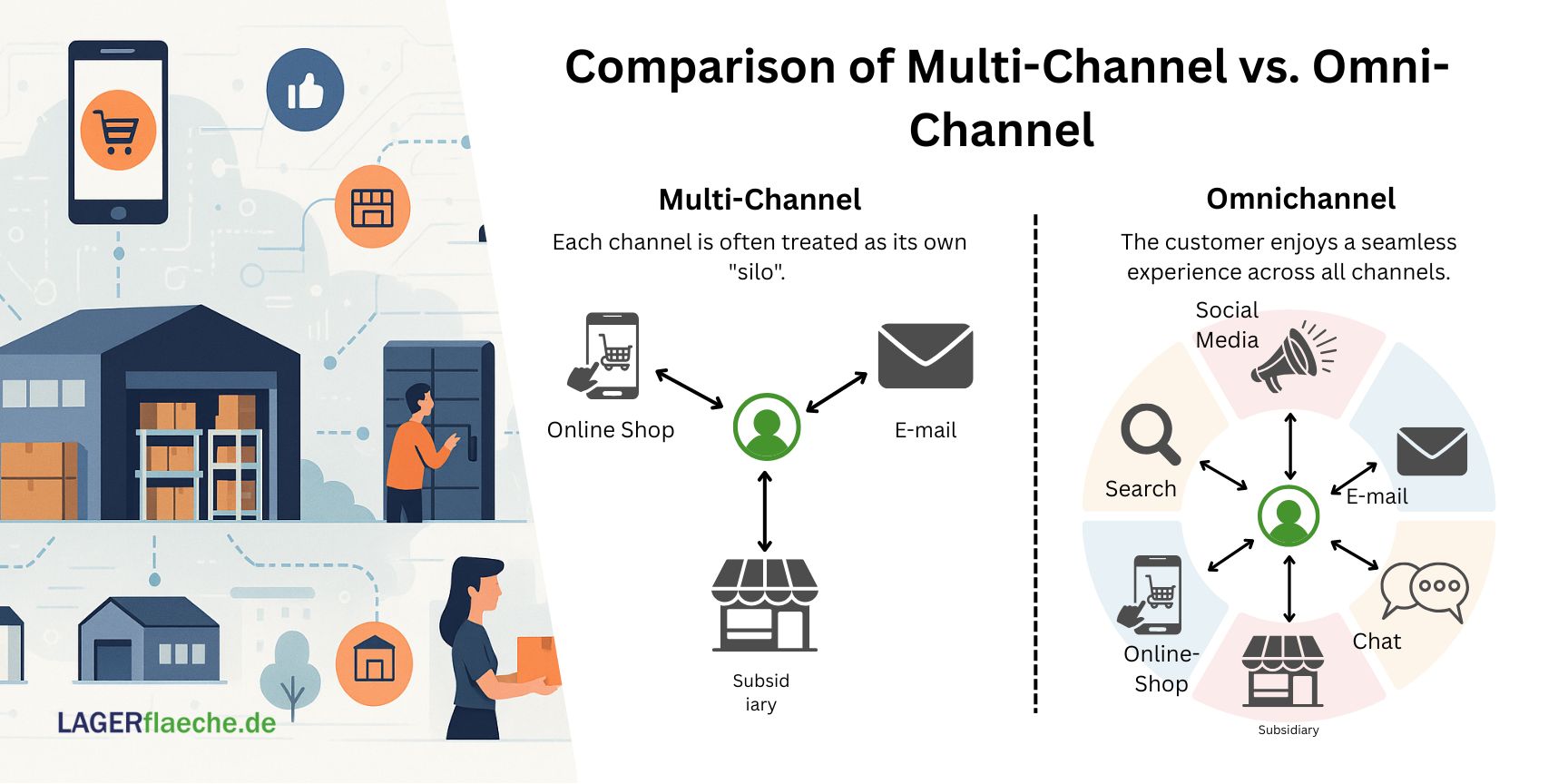
This is the traditional approach. The company operates several channels (e.g. branches, online shop, marketplaces) in parallel. Each channel is often treated as its own "silo". In logistics, this usually means physically separate warehouses: a central warehouse for B2B store deliveries (pallets, large containers) and an e-commerce fulfillment center (B2C) for individual orders.
- Problem: High total costs, duplicate inventory management and the classic annoyance: A product is "sold out" online while it gathers dust in the stores (and vice versa).
Omni-channel warehousing
This is the customer-centric approach. All channels are integrated and access a single, logical overall inventory . The customer experiences a seamless experience. Services such as "Click & Collect", "Ship-from-Store" (store ships online order) or "Endless Aisle" (not available in the store, delivered to the home from the central warehouse) are only possible in this way.
- Requirement: Absolute transparency and a "single source of truth" over all inventories, no matter where they are physically located.
Why is this distinction crucial for your warehouse? Because it influences fundamental design decisions. Multi-channel is easier to start operationally, but strategically a dead end. Omni-channel is complex to implement, but it's the only future-proof solution to reduce inventory costs and meet customer expectations.
The key question: Separate zones or total integration?
What does a warehouse look like that can manage pallets and individual parts at the same time? There is no one solution, but successful models combine elements:
The hybrid warehouse (separate zones under one roof)
The most common and pragmatic solution for the transition. A warehouse location is zoned physically or logically:
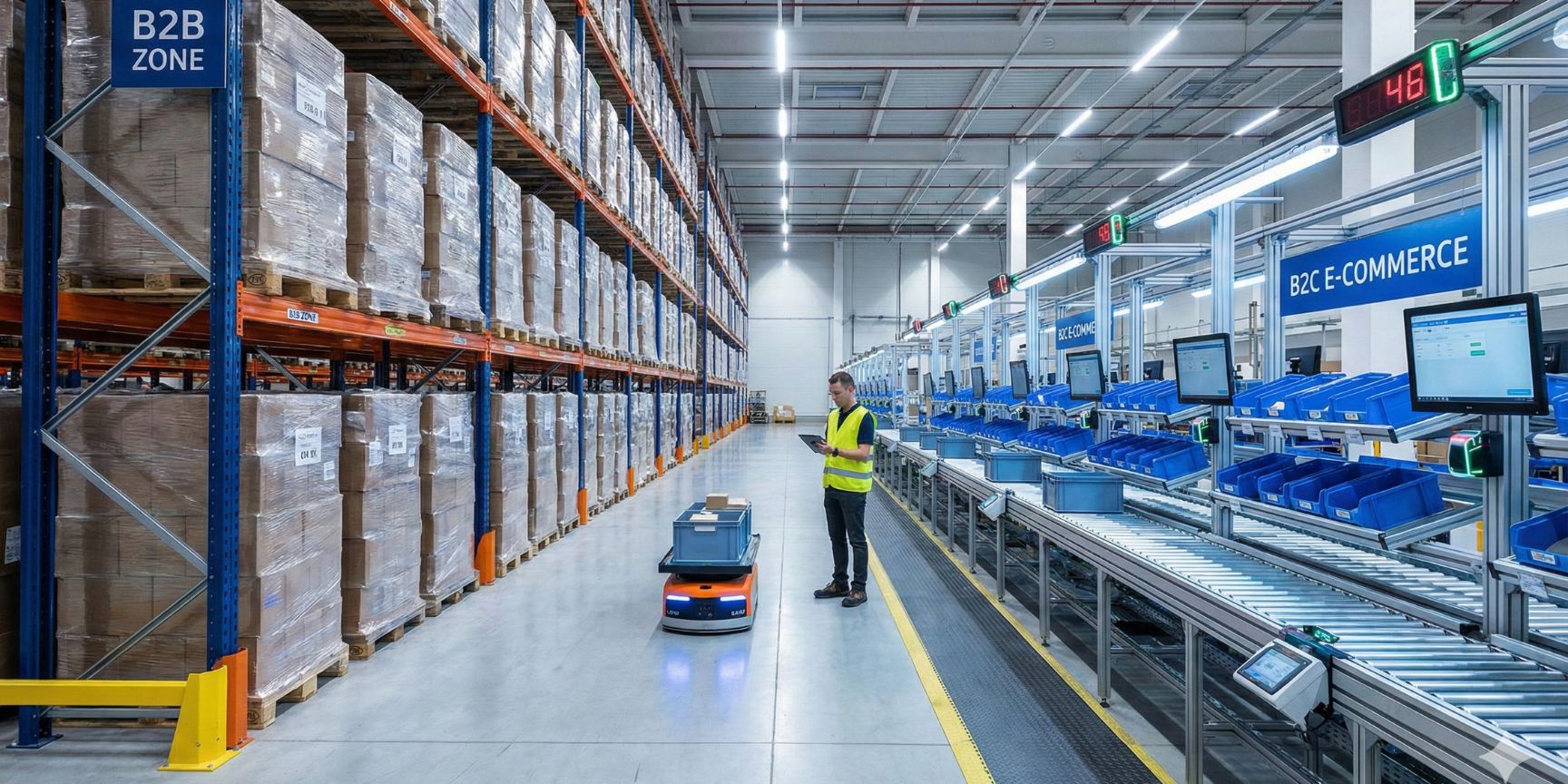
- Bulk Zone (B2B): Classic pallet high-bay warehouse. This is where the supplies for the stores and the "reserves" for the e-commerce zone are stored. Processes are designed for efficiency in pallet picking.
- Pick zone (B2C): A dynamic area, often with shelving racks, flow racks or an automated small parts warehouse (AS/RS). This is where pick-and-pack picking takes place. The processes are trimmed for speed and error minimization (e.g. pick-by-light, pick-by-voice).
The trick lies in the connection: the replenishment from the bulk zone to the pick zone must function system-controlled and smoothly.
Full integration (chaotic warehousing)
Modern systems, such as those used by Amazon, often do without strict zones. Any product can be found (almost) anywhere. The software, the Warehouse Management System (WMS), knows where which item is located and dynamically optimizes the pick routes for B2B and B2C orders.
- Advantage: Maximum use of space and flexibility.
- Disadvantage: Extremely high demands on the WMS and process control. For most medium-sized companies, this is too big a step.
The Brain of Surgery: Why Your WMS Is Key
You can have the best shelves in the world – without a powerful warehouse management system (WMS), omni-channel is impossible. The WMS is the brain that determines success.
An omni-channel-enabled WMS must be able to do more than just "manage storage space":
Bestandstransparenz (Single Source of Truth)
The system needs to know in real time how many units of item X are in the central warehouse, in the B2C picking area, in the returns check and (ideally) in the stores.
Order Routing (Orchestration)
When an online order is received – where is it served from? The WMS automatically decides (based on rules):
- From the B2C warehouse (standard)?
- Via "ship-from-store" from branch Y (because closer to the customer or only stock)?
- Reservation for "Click & Collect" in branch Z?
Process Control
The system must be able to control fundamentally different picking processes (multi-order picking for B2C vs. pallet picking for B2B) in parallel.
Returns Management
E-commerce has high return rates (often over 40% in the fashion sector). The WMS must seamlessly map the returns process (checking, processing, restocking) so that the goods are available again quickly.
Studies such as the WMS Market Report by Fraunhofer IML clearly show that the ability to "multi-/omni-channel picking" is one of the most important differentiating features of modern software.
Practical example: The metamorphosis of "FashionForward GmbH"
Let's take a fictitious but realistic case study: "FashionForward GmbH", a German fashion retailer with 80 stores and a growing online shop.
Initial situation (multi-channel)
A large central warehouse (ZL) supplies the branches. A second, smaller location (external service provider) makes the e-commerce business.
Problems
- High "out-of-stock" rates online, while stores reported full stocks (silo stocks).
- End of the season: Massive discounts online to empty the E-Com warehouse while stores would still have had a need.
- High costs due to duplicate logistics structures.
Die Omni-Channel-Transformation
- Phase 1 (consolidation): The e-commerce warehouse was dissolved and integrated into the existing ZL as a separate B2C pick zone.
- Phase 2 (IT integration): Introduction of a new WMS that centrally manages all inventories (ZL-Bulk, ZL-B2C). The ERP system was connected to create a "single source of truth".
- Phase 3 (Roll-out Services):
- Click & Collect: Online customers can order goods to the stores. The WMS forwards the order either to the ZL (delivery to the store) or (if there is inventory) directly to the store checkout (reservation).
- Ship-from-store: In a pilot with 10 stores, these became mini-warehouses. If an online order is received and the inventory is critical in the ZL but high in branch A, the branch employee packs the package. The WMS routes the order and provides the shipping label.
- Result: Stock availability online increased by 25%. Total capital tied up in the warehouse fell by 15% as buffer stocks were reduced. Customer satisfaction increased due to the flexible delivery options.
The Global View: Why German Efficiency Doesn't Fit Everywhere
The requirements for warehouse logistics are not universal. What is considered efficient in Germany does not work in the USA or China. The drivers are geography, customer behavior, wage and space costs.
Germany: The Efficiency and Automation Master
- Drivers: High labor costs, high space costs (especially in conurbations), high demands on quality and process reliability (DIN standards).
- Warehouse structure: High degree of automation. In Germany, the use of automated small parts warehouses (AS/RS), sorter systems and (increasingly) robotics (AMRs) is widespread in order to reduce personnel costs and maximize area density. The German "Mittelstand" (often B2B-focused) and strong e-commerce players (Zalando, Otto) are driving this technological development. The separation of B2B and B2C processes is often still very pronounced, but integration (omni-channel) is the top topic in the intralogistics industry.
USA: The realm of space and ship-from-store culture
- Drivers: Extreme geographical distances, high customer expectations of delivery speed (the "Amazon Prime effect").
- Warehouse structure: The U.S. relies on a network of huge fulfillment centers (DCs) to cover the country. The most significant difference to Germany is the extremely widespread use of ship-from-store. Giants such as Target or Walmart use their thousands of stores as decentralized warehouses. Target reportedly handles over 80% of its e-commerce orders directly from stores.
- Why? It's often cheaper and faster to ship a package from the store "around the corner" than from a DC that's 800 miles away. The WMS must therefore be able to manage thousands of "mini-warehouses" (the stores).
China: E-commerce on steroids
- Treiber: Extreme Dominanz des E-Commerce (Alibaba, JD.com), Social Commerce, und extreme Lastspitzen (z. B. "Singles' Day").
- Warehouse structure: Logistics in China is optimized for scalability and speed. The use of robotics is massive (e.g. Cainiao, Alibaba's logistics network). There is a high degree of AI-driven demand forecasting to move inventory to regional hubs before ordering. The integration of logistics, retail and payment systems is seamless. The focus is less on integration with the (comparatively weaker) brick-and-mortar retail sector and more on pure e-commerce speed.
France: The "Click & Collect" (Le Drive) Nation
- Driver: Unique customer behavior, especially in the food retail sector (LEH).
- Warehouse structure: While e-commerce in the food retail sector is still a niche phenomenon in Germany, "Le Drive" (Click & Collect by car) is a mass market in France. Large hypermarché chains (Carrefour, E.Leclerc) have hundreds of pick-up stations, often as attached "dark stores" or separate zones in the market. Warehouse logistics is highly optimized for the efficient pre-picking of food orders for car pickup – a process that has little relevance in Germany.
United Kingdom (UK): The mature e-com market
- Drivers: Very high e-commerce penetration (one of the highest in Europe), high population density in cities.
- Warehouse structure: Similar to Germany, high pressure on automation. Due to the density in metropolises such as London, the UK is a pioneer in micro-fulfillment centers (MFCs). These are small, highly automated warehouses (often only 500-1000 square meters) in the middle of the city to enable "quick commerce" (delivery in < 1 hour). The integration of online and offline collections is essential for survival here.
The Top 5 Hurdles on the Way to the Omni-Channel Warehouse
The path is rocky. Almost all companies struggle with the same challenges:
- IT system silos: The biggest problem. The ERP, the WMS and the POS system (POS) do not talk to each other. Solution: A middleware or a modern WMS with open APIs (interfaces) as a central data hub.
- Different processes (B2B vs. B2C): pallet picking requires forklifts; B2C picking requires walking distances and scanning technology. Solution: Clear zoning and use of flexible picking techniques (e.g. multi-order picking, batch picking).
- Inventory accuracy: If the system says "5 pieces are there", there must be 5 pieces. In the event of deviations, the omni-channel promise collapses. Solution: Permanent (cyclical) inventory instead of just cut-off date inventory; Use of scanners, RFID if necessary.
- The Returns Chaos: Where to Put B2C Returns? Back to the B2C camp? Into the B2B camp? Resale in the branch? Solution: A standardized, WMS-controlled returns process (checking, classifying, repackaging, storage).
- The mindset of the employees: A branch employee is traditionally a salesperson, not a logistics specialist. Solution: Change Management. Provide training and incentives on why packing a "ship-from-store" package is just as important as the sales pitch.
The future: AI, robotics and the end of the "camp"
Where is the journey going? The lines continue to blur.
- Artificial intelligence (AI): AI will not only control the warehouse, but also predict stocks (predictive analytics). The system knows that rain is forecast in Hamburg next week and automatically restores more rain jackets to the stores and the nearby E-Com warehouse.
- Autonomous Mobile Robots (AMRs): Flexible robots that work "goods-to-person" are becoming standard. They are more scalable than rigid conveyor technology and can process B2B and B2C orders flexibly.
- Micro-fulfillment centers (MFCs): The warehouse is moving into the city. Dark stores and MFCs are becoming the norm to win the "last mile".
Conclusion: Not an option, but a necessity
The question is no longer whether, but how companies make their logistics omni-channel-capable. A multi-channel approach with separate silos is an expensive luxury that is neither efficient nor customer-friendly.
The transformation to an omni-channel warehouse is not an IT project, it is a strategic corporate decision. It requires investment in a central WMS, a willingness to adapt processes and a rethink in the entire organization – from IT to the store employee.
The German market, characterized by efficiency thinking and automation, must learn from the flexibility of the USA (ship-from-store) and the speed of China in order to remain competitive in global trade. Start with the most important step: create 100% visibility across your entire inventory. Because you can only sell what you see – regardless of the channel.
Latest Blog Posts
Stay up to date with the newest trends, insights, and tips in warehouse and logistics. Our latest articles help you navigate the industry with confidence.
Data Centres vs. Logistics Facilities: The Race for Power and Land
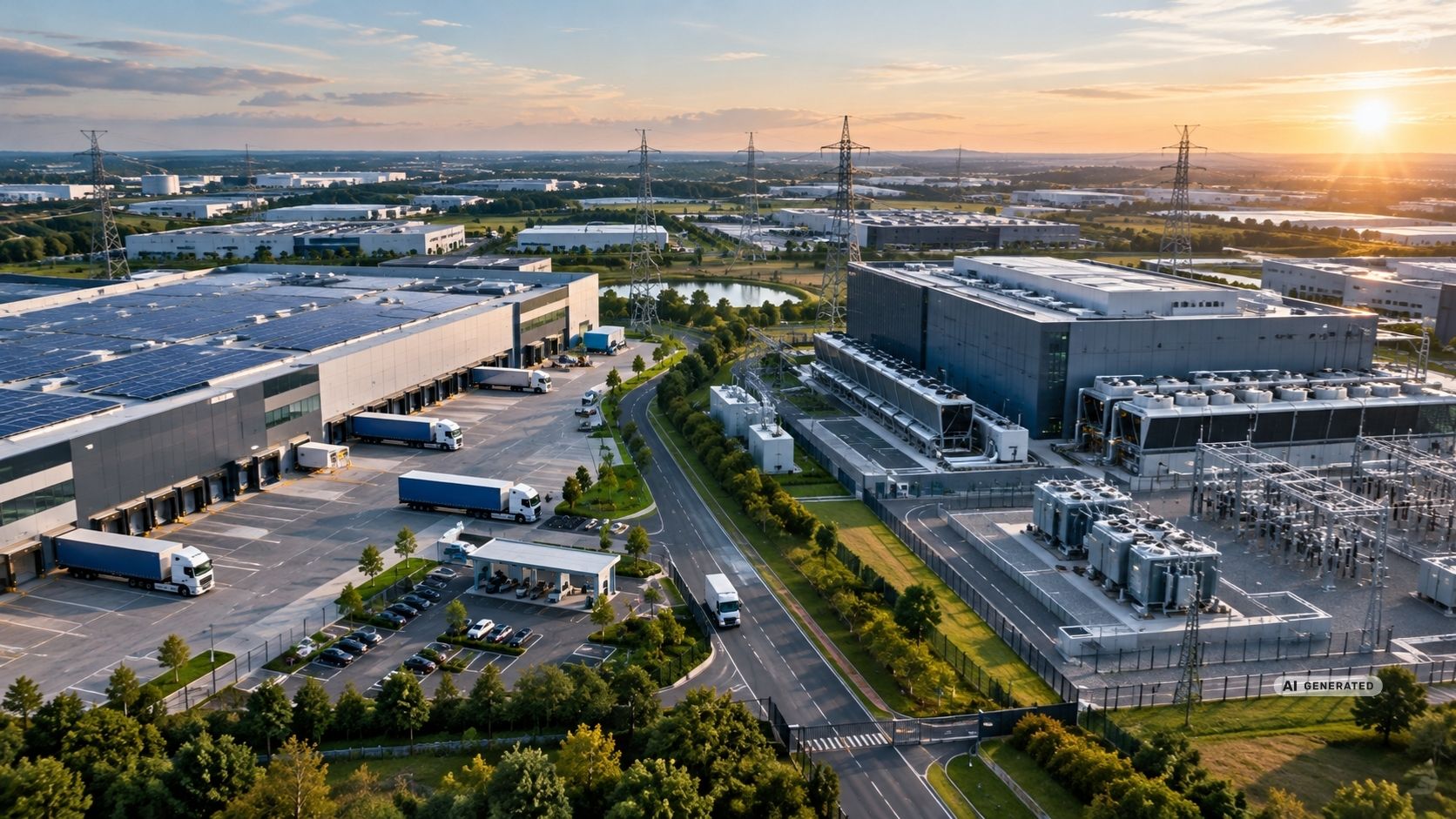
Across Europe, logistics operators are competing for more than land and transport access. They increasingly need something much harder to secure: grid capacity. Data centres are intensifying that competition — and changing how logistics locations are evaluated....
Chinese companies discover Europe's logistics real estate
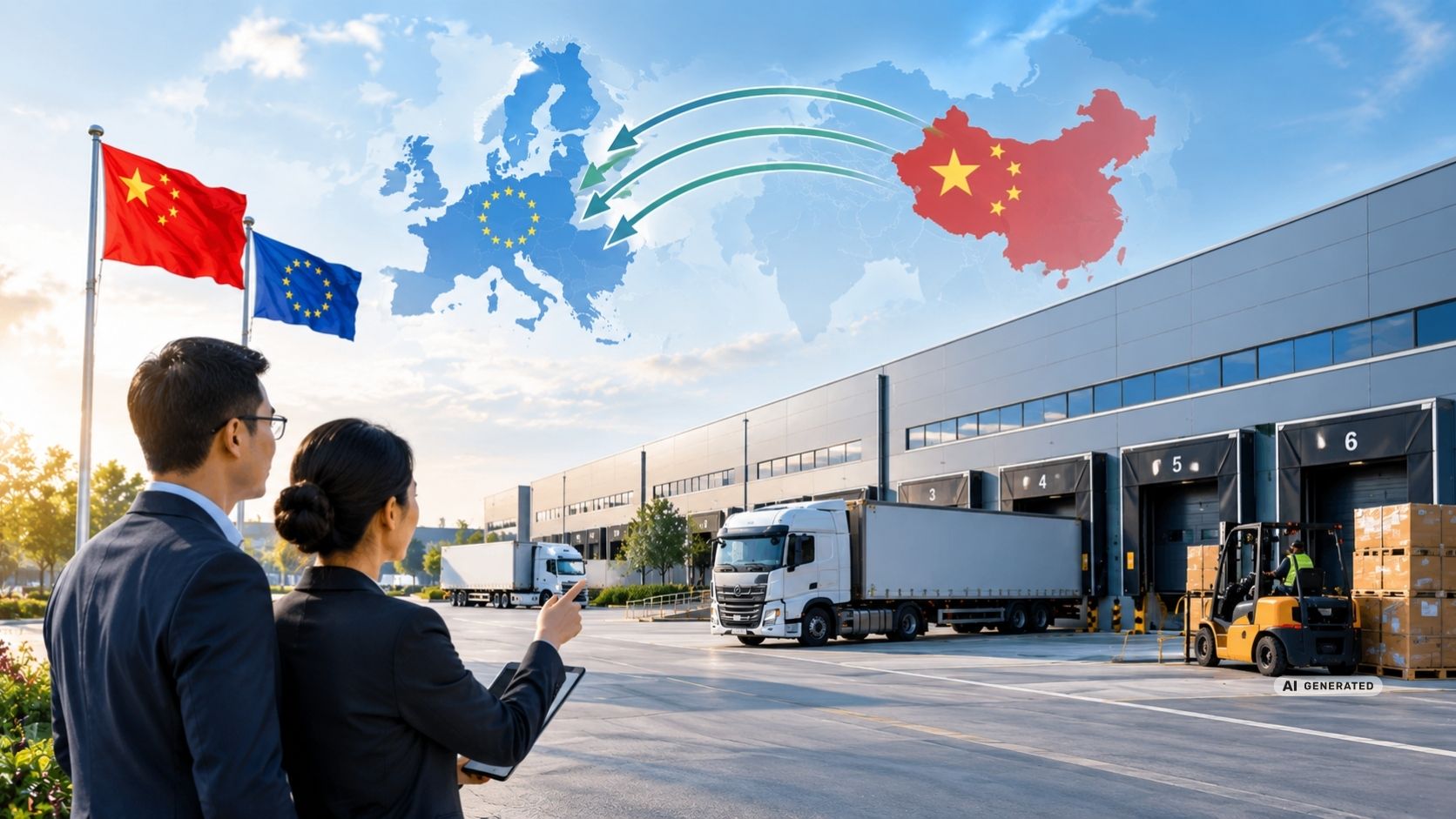
Chinese companies are becoming an increasingly visible user group in Europe's logistics real estate market. What does this mean for warehouse space, 3PL structures and the requirements for European logistics locations?...
AI Hallucinations in Logistics: When AI Plans the Wrong Delivery
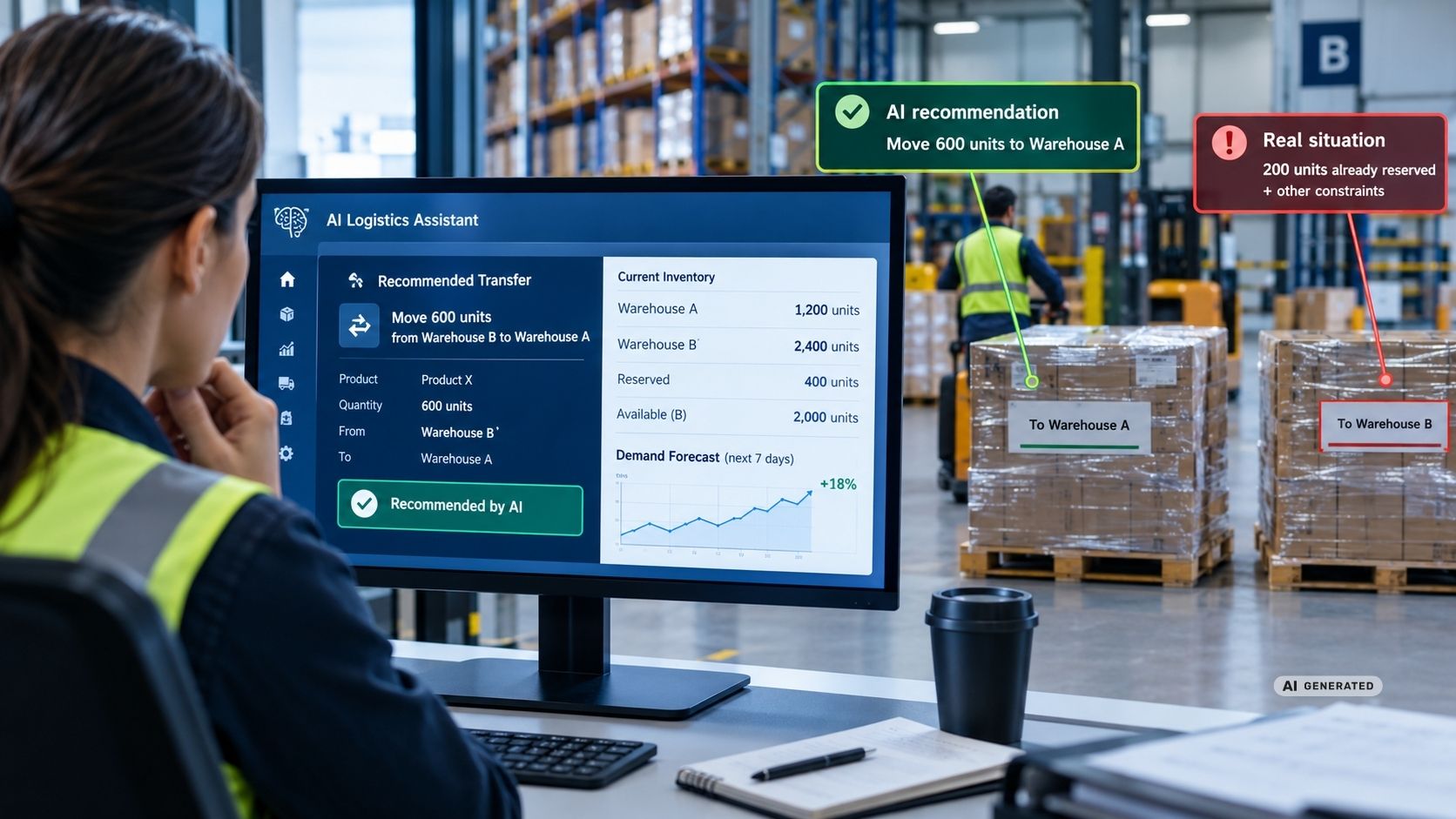
AI can analyze enormous amounts of logistics data — but it can also produce a convincing answer that is simply wrong. The critical question is not whether AI makes mistakes, but what happens when a wrong recommendation becomes an operational decision....
The Green Revolution on the Hall Roof: From Concrete Block to Ecological Power Plant?
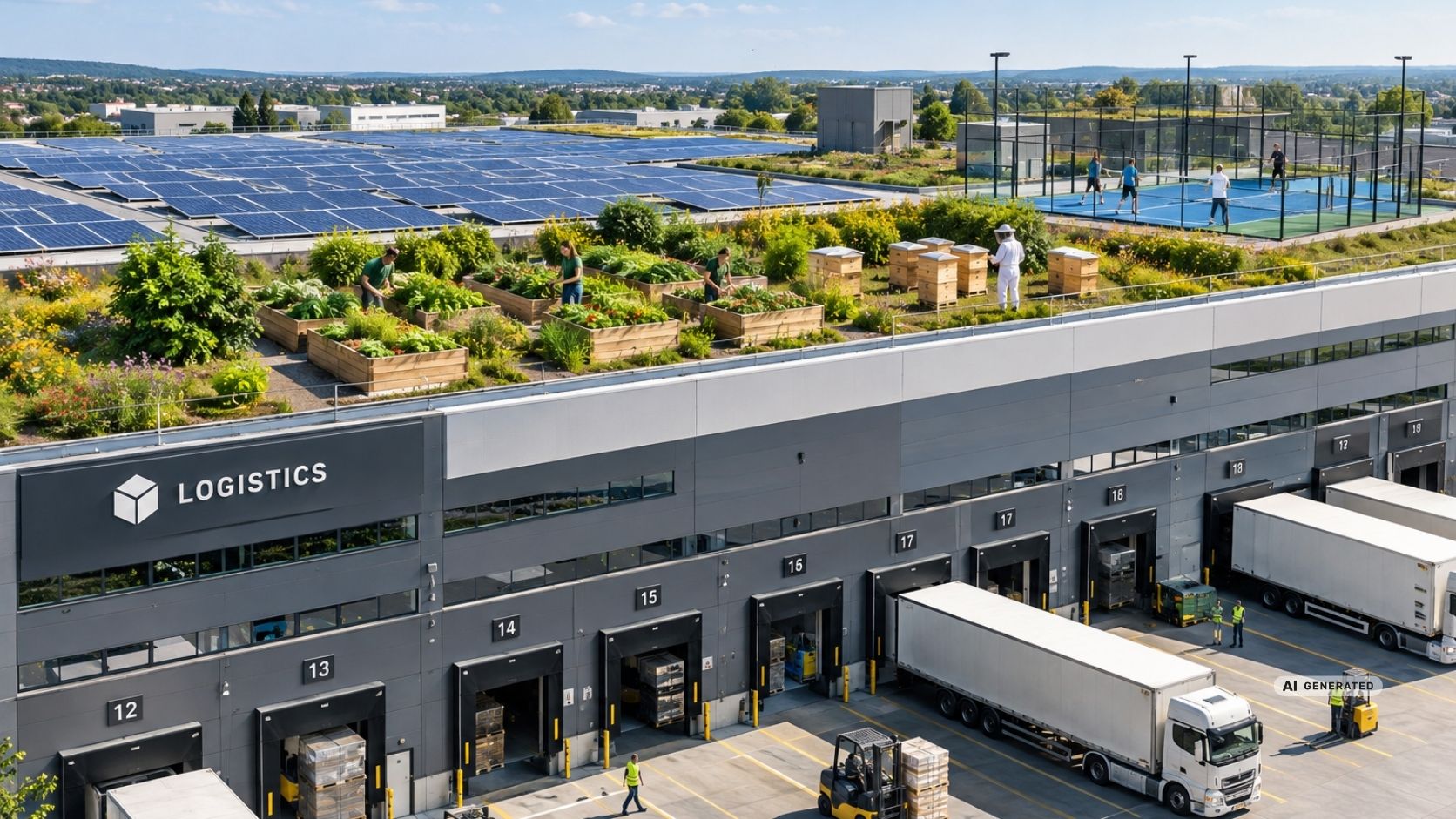
Logistics roofs can do more than PV: greening, bees, urban farming and even sports areas turn unused roof space into multifunctional rooms....