




Rent and let warehouse space like a pro
When renting warehouse and industrial space, location, size, transport connections and parking and loading facilities are crucial. A commercial rental agreement is essential to define all relevant aspects such as rent amount, operating costs and purpose of use. Landlords should select tenants with stable financial circumstances and legally secure the rental agreements. The rent amount can be determined by various models such as fixed, graduated or index-linked rent. All income must be taxed, although costs can also be deducted. Regional differences in taxes and duties must be taken into account. A careful inspection of the property and a transparent list of operating costs are essential for a successful tenancy.
Focus on important aspects for tenants and landlords
- The location, size, transport links and parking and loading facilities are decisive factors when letting warehouse and industrial space.
- Whether your property is suitable for a tenant depends on the specific purpose of use, i.e. what is to be produced or stored there.
- A commercial lease should always be concluded with the tenant.
- All income from commercial leases must be taxed.
- Brokerage commissions are split between the tenant and landlord.
After a successful letting, all rental income is taxable.
Secure income through long-term rental agreements - how it works
An industrial hall or warehouse is a commercial property that is specifically used for business purposes rather than as living space. The choice of location for the industrial hall and the basic furnishing of the property in accordance with the intended use are of great importance. Tenants often have very different ideas for their specific usage requirements and may be planning modifications to the property. As a landlord, it is therefore advisable to select tenants who are prepared to enter into long-term rental agreements - this will ensure a reliable source of income. It is also important to check the financial standing of the future tenant. A look at the commercial register and information from Creditreform can also be useful to assess the previous business track record of your potential tenant.
Important documents before and after signing the contract
- Before letting: Business report, self-disclosure for commercial enterprises, copy of the identity card of the shareholder or managing director, extract from the commercial register, business registration, signed rental agreement including declaration of consent from the shareholders, BWA (business management analysis), balance sheet, annual financial statements
- After letting: proof of VAT liability, tax number/VAT identification number, proof of payment of a deposit, confirmation of public liability insurance with damage to rented property

Fixed rent, index-linked rent or graduated rent? Find the right model
There are different approaches to setting the rent. If you opt for a fixed rent, the rent amount remains constant at the level specified in the contract, regardless of rental price developments in the surrounding area. Models such as index-linked rents are often more attractive for landlords. This means that if the general rent index in the neighborhood rises, the landlord can adjust his rent demands in line with the index. Tenants and landlords can also agree a graduated rent, where the rent increases by a fixed amount each year. Before signing the contract, the landlord should check the expected operating costs. Commercial tenants are obliged to pay a share of the costs for waste collection, water and street cleaning. In addition, other possible ancillary costs should also be determined, such as costs for a security service or property management. Important: The operating and maintenance costs increase with the size of the hall. However, the space required should not be too small. In a warehouse, for example, there must be enough space between the shelves so that two forklift trucks can pass each other without any problems. Sufficient space must also be planned for the storage of parcels ready for dispatch and new deliveries. In addition to the size, the layout of the floor space and the ratio between usable area and access area also play a role: ground-level areas with high ceilings offer maximum flexibility of use.
What should not be missing from your commercial rental agreement
If premises are rented out for business purposes, it is necessary to conclude a commercial rental agreement. The following points should at least be included in the rental agreement:
- List of all parties involved
- Determination of the rental costs and regulation of the type of rent: Graduated, turnover, index-linked or fixed rent
- Breakdown of operating and ancillary costs
- Regulations on repairs and conversion costs
- Duration of the tenancy and notice periods
- Purpose of use of the commercial premises and type of business
- Special features of the rental property, such as size, number of rooms, fixtures and fittings (inventory list), as well as the condition and state of the property when it is handed over
Commercial tenancy law is not an independent area of law, but is based on general tenancy law in accordance with §§ 535 ff. and §§ 580a BGB. Legal information: Landlords of commercial premises are obliged to take care of any necessary maintenance and modernization measures. As a rule, this does not apply to maintenance work within the rented premises, which is specified in the contract. In addition, landlords should ensure that the business premises are suitable for the respective trade and the intended use. In particular, noise and fire protection regulations must be observed.
If you are still looking for a suitable commercial property, you are sure to find the right property for your requirements on the meinestadt.de real estate market!
Letting made easy: All income at a glance for your tax advantage
When renting out commercial properties, all rental income is taxable:
- Rental income for any ancillary rooms, garages, cellars and parking spaces
- levies collected (e.g. for waste collection and energy costs)
- Fees for advertising space
Property repair costs and interest can be deducted from the income.
Landlords have the option of letting subject to VAT (§ 9 I UStG). This is permitted if the tenant uses the rental property exclusively for sales that include a possible input tax deduction. The VAT paid by the tenant less the refunded input tax must be taxed as income.
All rental costs, such as production costs and acquisition costs, can be deducted from tax. If you hire an estate agent for your commercial rental, the costs are negotiated freely between the client and the estate agent. In this case, the client, usually the landlord, determines how the costs are divided between him and the future tenant.
Termination made easy: How to protect yourself in the commercial lease agreement
The provisions on termination are often specifically set out in the commercial lease agreement. Both the tenant and the landlord have the right to terminate the lease within the notice period specified in the contract. Open-ended rental agreements that do not contain a fixed rental period can be terminated properly in accordance with the agreed notice period. If no agreement has been made, the statutory notice period of six months applies. Termination during the term is not possible for fixed-term tenancy agreements, as these are concluded for a fixed period. Without additional provisions, the tenant remains bound by the contract until the end of the rental period. Depending on the federal state, different trade tax rates and municipal levies may apply to industrial buildings. Whether there are restrictions on the use of the hall can be checked in the land register. It may also be important to check whether the adjacent properties are also used as storage areas and whether there is the possibility of extending the building if necessary. In terms of noise protection, it is helpful to know how far away the nearest residential area is.
This will help you find the ideal space for your business and maximize your profits!
Did you already know? These target groups are urgently looking for your storage space
If you intend to rent out warehouses, storage halls or storage space, you are addressing different target groups. For example, there are smaller craft businesses that are looking for suitable storage space. A painter, for example, might need a place to store his paints, ladders and other equipment. At the same time, a larger company could be looking for a new production facility. This makes it clear that your target group does not consist of private individuals, but of companies. These can be both natural persons and legal entities. The latter include, for example, public limited companies or limited liability companies (GmbHs).
This situation offers you the advantage of being able to design the rental agreement according to your wishes and the possibility of making individual agreements. This applies to the notice periods as well as the rental price and the term of the contract. You can also specify the intended use in the contract. This gives you considerable scope for negotiation when concluding your tenancy agreement. The statutory provisions for residential premises, which serve to protect tenants, do not apply to a commercial tenancy agreement. The legislator assumes that the contracting parties are equal and therefore negotiate the contract on an equal footing.
Rental costs under control: How to cleverly transfer operating costs to your tenant
Just as you can negotiate the rent according to your wishes, you also have the option of transferring various costs to your tenant. However, it is important that you list these operating costs clearly in the rental agreement. A general statement that the tenant bears all operating costs is not accepted in this context. Instead, all operating costs must be listed individually. You are free to negotiate the amount of the rent and therefore your income with your tenant. You are therefore free to agree a regular rent. Adjustments to the rent, such as an escalation clause, a turnover-based rent or a graduated rent, are also conceivable. As a landlord, you are obliged to manage the property properly. Therefore, you may only pass on the costs to your tenants within reasonable limits in order to protect them from excessive operating costs. If you specify the rent as a price per square meter in the contract, you should measure the area accurately before signing the contract. Otherwise, incorrect information could invalidate the contract.
Latest Blog Posts
Stay up to date with the newest trends, insights, and tips in warehouse and logistics. Our latest articles help you navigate the industry with confidence.

Data Centres vs. Logistics Facilities: The Race for Power and Land
Across Europe, logistics operators are competing for more than land and transport access. They increasingly need something much harder to secure: grid capacity. Data centres are intensifying that competition — and changing how logistics locations are evaluated....

Chinese companies discover Europe's logistics real estate
Chinese companies are becoming an increasingly visible user group in Europe's logistics real estate market. What does this mean for warehouse space, 3PL structures and the requirements for European logistics locations?...
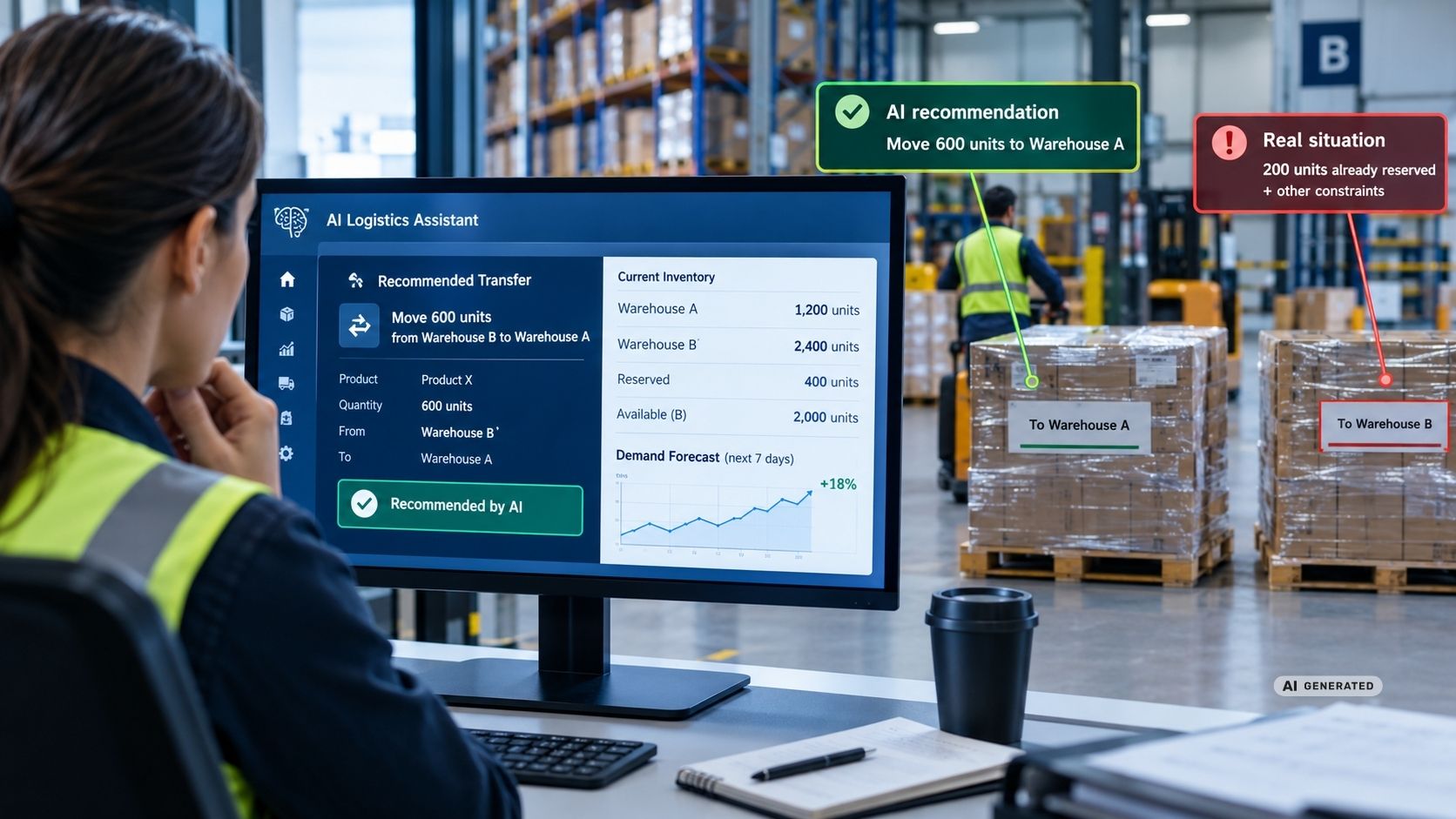
AI Hallucinations in Logistics: When AI Plans the Wrong Delivery
AI can analyze enormous amounts of logistics data — but it can also produce a convincing answer that is simply wrong. The critical question is not whether AI makes mistakes, but what happens when a wrong recommendation becomes an operational decision....

The Green Revolution on the Hall Roof: From Concrete Block to Ecological Power Plant?
Logistics roofs can do more than PV: greening, bees, urban farming and even sports areas turn unused roof space into multifunctional rooms....