



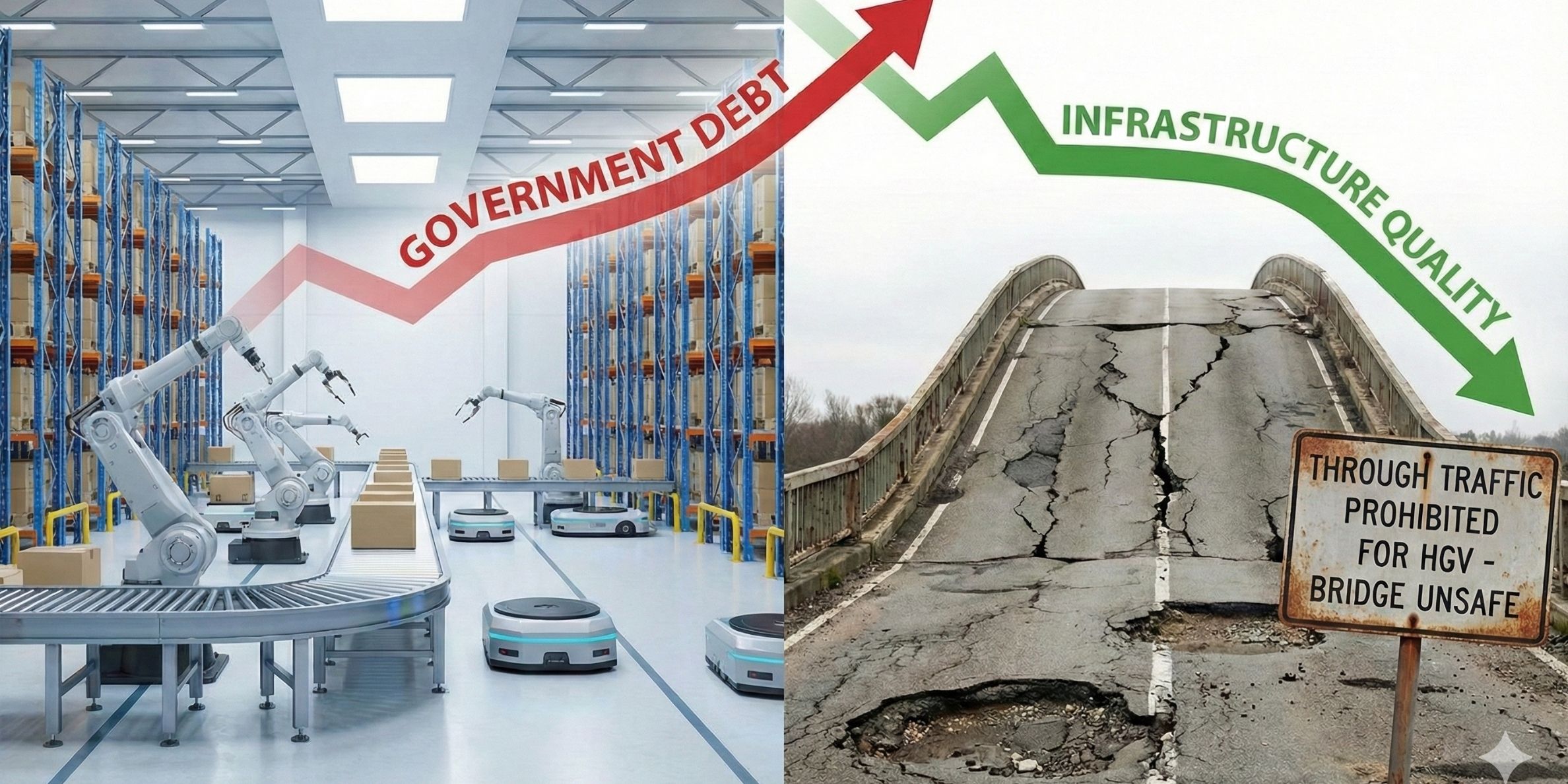
Public Debt and Logistics: How Infrastructure Decay Threatens the Supply Chain
Table of Contents
- The Causal Cycle: From the Debt Brake to the Pothole
- Specific Effects on Contract and Warehouse Logistics
- The Infrastructure Crisis: When "Just-In-Time" becomes "Maybe-In-Time"
- Competitive Disadvantages: Why Germany is Losing its Attractiveness
- Looking over the Fence: Europe in Comparison
- Impact on the Overall Economy: The Bullwhip Effect
- Case Study: The Disaster of the Rahmede Valley Bridge (A45)
- What can the Industry do? Options for Action and Solutions
- Conclusion
Is German logistics still competitive if the state can no longer pay its bills?
Logistics is considered the third largest economic sector in Germany. It is the "bloodstream" of the real economy. But this circulation suffers from hardening of the arteries. The reason is not only of a technological nature, but is hidden deep in the budget books of the federal, state and, above all, local governments. The rising national debt and the resulting lack of investment have a direct, toxic impact on the supply chain, especially on contract and warehouse logistics.
In this article, we analyse why tight municipal budgets are delaying building permits for logistics properties, why the toll is only a symptom and why Germany is losing ground in the international ranking.
The Causal Cycle: From the Debt Brake to the Pothole
To understand the implications for logistics, we need to look at the fiscal chain. The indebtedness of the federal and state governments (despite the debt brake) and especially the chronic underfinancing of many municipalities are leading to a massive investment backlog.
According to the KfW Municipal Panel 2024, the investment backlog of German municipalities is around 186 billion euros. A large part of this is accounted for by transport infrastructure (roads, bridges) and public buildings.
What does this mean for logistics? When municipalities have to save money, they often do so in maintenance ("Substanzehrzehr") or in the staff in the building authorities. A dangerous pair of pincers is emerging for the logistics industry:
- Physical barriers: Dilapidated bridges and roads lead to detours, traffic jams and increased wear and tear.
- Administrative barriers: Staff shortages in offices are massively delaying approval procedures for new logistics centers.
Question: Why does the designation of new industrial parks often take years?
Answer: Because indebted municipalities cannot advance money for development (sewerage, access roads) and there is a lack of staff in the planning offices.
Specific Effects on Contract and Warehouse Logistics
Contract logistics, the long-term assumption of logistics services, reacts particularly sensitively to state financial difficulties. This is not just about transport from A to B, but also about site-specific investments in the millions (warehouses, automation).
The trade tax dilemma
Municipalities in financial distress have few levers to increase their revenues. The most effective is the trade tax rate.
- The problem: Logistics service providers traditionally work with low margins (often 2–4% EBIT). If a municipality drastically increases the assessment rate due to its debt burden, this eats up the profits of the contract logistics companies.
- As a result, contract logistics companies avoid highly indebted cities (often in the Ruhr area or North Rhine-Westphalia) and move to rural "tax havens", which in turn lengthens transport routes.
Shortage of space due to lack of development
Indebted cities often cannot afford to redevelop brownfields. These remain unused while logistics companies are desperately looking for space. This is driving up rents for logistics properties – costs that ultimately have to be passed on to the industry and the end consumer.
The Infrastructure Crisis: When "Just-In-Time" becomes "Maybe-In-Time"
The most obvious effect of the state's financial crisis is the disintegration of transport routes. Logistics depends on reliability.
- Bridge closures: Thousands of bridges in Germany are dilapidated. When motorway bridges (such as on the A45) are closed, trucks have to take huge detours.
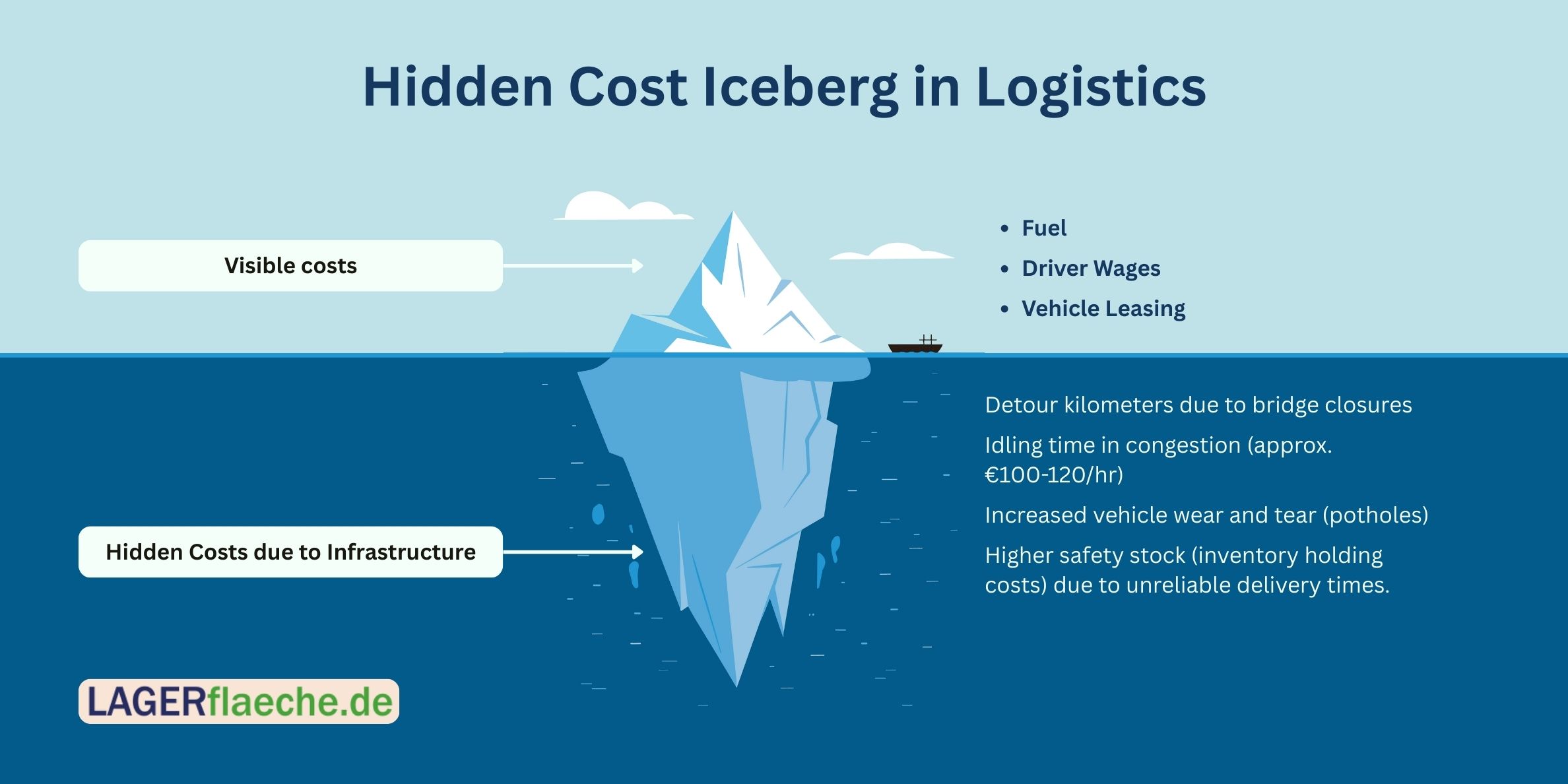
- Facts & Figures: According to the Federal Road Haulage Statistics, vehicle costs are rising significantly due to traffic jams and detours. A truck in a traffic jam costs the freight forwarding company approx. 100 to 120 euros per hour.
For warehouse logistics, this means that inventories must be increased ("safety stocks") to compensate for delivery failures. This ties up capital and storage space – the exact opposite of lean "lean logistics".
Competitive Disadvantages: Why Germany is Losing its Attractiveness
Are there any specific competitive disadvantages? Yes, massively. Germany does not slip into the abyss in international rankings such as the World Bank's Logistics Performance Index (LPI), but it loses its top position in the area of "quality of infrastructure" to countries that invest more aggressively.
The cost screw
The state often tries to cover its debts through user-financed systems. The truck toll increase (including CO2 surcharge) is in fact a hidden tax to restructure the budget (even if it should be officially earmarked, a lot flows into the railway, while the road is falling apart).
Disadvantages for German locations:
- Higher operating costs: tolls, high energy taxes and high municipal taxes.
- Planning uncertainty: Anyone who builds a warehouse today does not know whether the access road will still be suitable for trucks in 5 years.
Looking over the Fence: Europe in Comparison
Why is it running more smoothly elsewhere? A comparison shows structural differences.
Netherlands: The efficiency world champion
The Netherlands (e.g. Venlo, Rotterdam) are the direct competitor for NRW.
- Difference: The Netherlands invests anti-cyclically and massively in infrastructure. The ports are highly automated, and the road network is in top condition.
- Financing: There, logistics is seen as a national strategy, not as a "noise polluter". Debt is accepted if it is opposed to the asset infrastructure.
Poland: The agile challenger
Over the past 15 years, Poland has invested EU funds and state funds extremely efficiently in new motorways and logistics parks.
- Advantage: New infrastructure meets lower bureaucratic hurdles and lower taxes. Many German retailers are relocating their returns logistics or large warehouses to western Poland.
Switzerland: Expensive, but functioning
Switzerland has high costs, but no dilapidated infrastructure.
- Model: The LSVA (performance-related heavy vehicle charge) and the "Railway Infrastructure Fund" decouple financing from the current state budget. The money is earmarked. In Germany, revenues often seep away in the general "debt hole".
Impact on the Overall Economy: The Bullwhip Effect
When logistics coughs, the economy gets pneumonia. The problems of logistics due to national debt do not remain isolated.
- De-industrialization: Manufacturing companies (automotive, chemicals) need reliable supply and outflow. If this is not guaranteed or too expensive, plants will migrate.
- Inflation: The increased logistics costs (due to tolls, detours, warehousing) are added directly to the product prices.
- Security of supply: In times of crisis (pandemic, floods), it becomes clear that an infrastructure sewn to the edge has no resilience.
Case Study: The Disaster of the Rahmede Valley Bridge (A45)
Nothing illustrates the failure due to investment backlog better than the closure of the Rahmedetal bridge near Lüdenscheid.
- Situation: The A45 is the "lifeline" for heavy industry in the Sauerland and Siegerland regions. Due to decades of delaying renovations (pressure to save), it had to be completely closed in 2021.
- Consequences for logistics: Freight forwarders have to take a 50-80 km detour. Daily.
- Consequences for contract logistics: Just-in-time concepts collapsed. Companies had to rent mobile warehouses or reduce production.
- Economic damage: The Chamber of Industry and Commerce estimates the damage to the region at hundreds of millions of euros per year. Companies are migrating because the location is no longer accessible.
- Lesson: This is the direct result when maintenance budgets are cut in favor of a "black zero".
What can the Industry do? Options for Action and Solutions
Whining doesn't help. The logistics industry has to adapt to the conditions of the cash-strapped state coffers.
- Lobbying for earmarking: Associations such as the DSLV or BGL must demand that 100% of revenues from transport (tolls) be reinvested in the road instead of plugging holes in the social budget.
- Privatization of infrastructure (PPP): Public-private partnerships could be a solution to build logistics parks or roads if the municipality lacks the money.
- Digitalization & AI: When the road is slow, planning needs to be faster. AI-powered route optimization and inventory management help mitigate infrastructure inefficiencies.
- Multimodal transport: Switching to rail? Theoretically good, in practice Deutsche Bahn suffers from the same investment backlog. Nevertheless, the diversification of modes of transport is essential for contract logistics companies.
Conclusion
Public debt is not an abstract economic problem for logistics, but a concrete operational brake. It manifests itself in potholes, a lack of commercial space and overburdened building authorities.
Germany runs the risk of losing its locational advantage as the "logistics hub of Europe" if the renovation of the infrastructure is not seen as an investment in the future, but only as a cost factor in debt management. For contract logistics companies, this means that flexibility is the new currency. Those who rely rigidly on state infrastructure lose. Those who build agile networks and diversify locations win.
Sources and further data:
- KfW Municipal Panel 2023/2024: Data on the investment backlog of municipalities.
- World Bank: Logistics Performance Index (LPI) rankings and comparisons.
- Federal Ministry of Digital and Transport (BMDV): Statistics on truck tolls and investment framework plan.
- German Economic Institute (IW Köln): Studies on location competition and infrastructure deficiencies.
- BGL / DSLV: Position papers on cost development in the transport industry.
Latest Blog Posts
Stay up to date with the newest trends, insights, and tips in warehouse and logistics. Our latest articles help you navigate the industry with confidence.
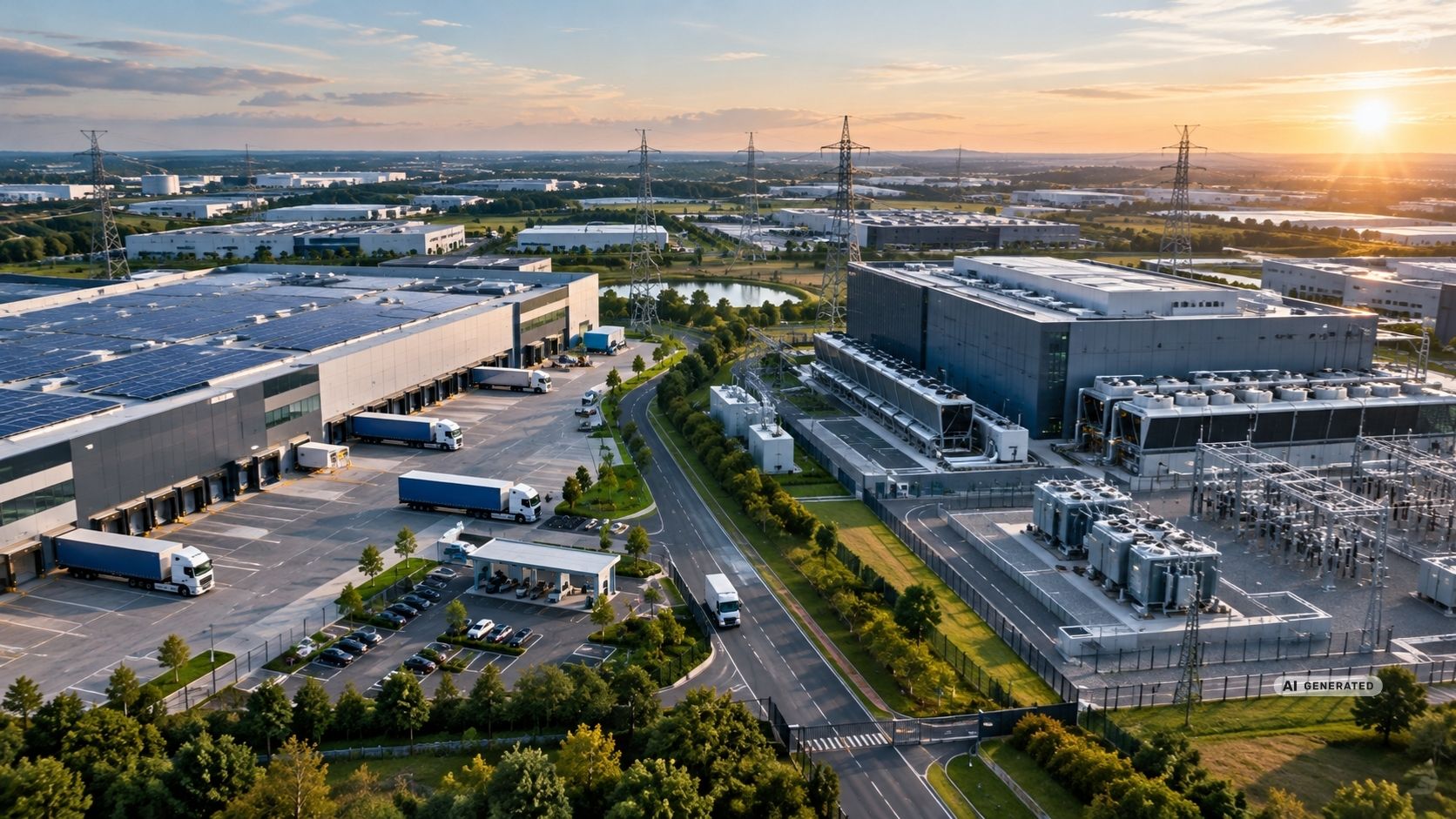
Data Centres vs. Logistics Facilities: The Race for Power and Land
Across Europe, logistics operators are competing for more than land and transport access. They increasingly need something much harder to secure: grid capacity. Data centres are intensifying that competition — and changing how logistics locations are evaluated....

Chinese companies discover Europe's logistics real estate
Chinese companies are becoming an increasingly visible user group in Europe's logistics real estate market. What does this mean for warehouse space, 3PL structures and the requirements for European logistics locations?...
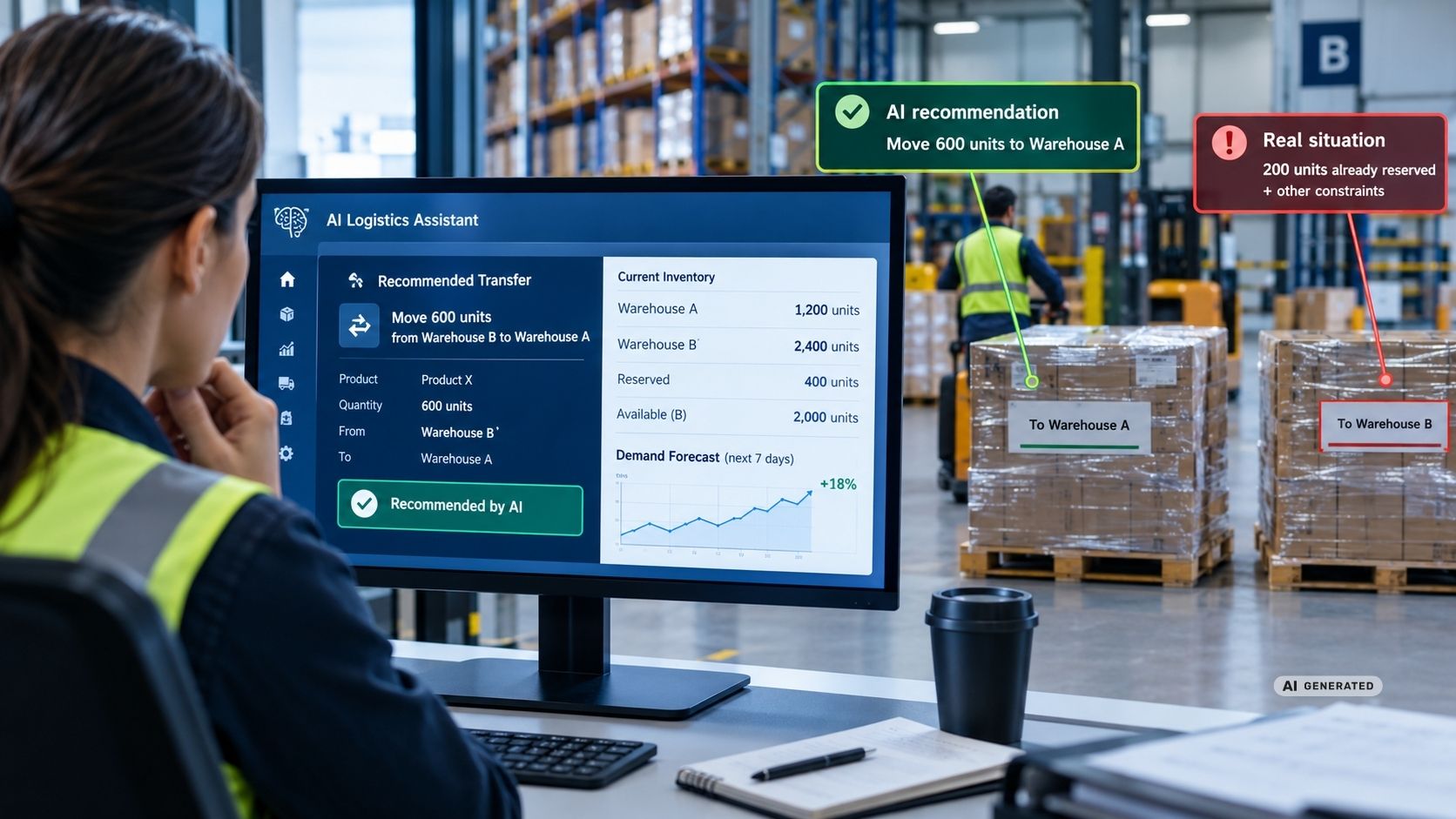
AI Hallucinations in Logistics: When AI Plans the Wrong Delivery
AI can analyze enormous amounts of logistics data — but it can also produce a convincing answer that is simply wrong. The critical question is not whether AI makes mistakes, but what happens when a wrong recommendation becomes an operational decision....
The Green Revolution on the Hall Roof: From Concrete Block to Ecological Power Plant?
Logistics roofs can do more than PV: greening, bees, urban farming and even sports areas turn unused roof space into multifunctional rooms....