



Minimum Wage Meets Artificial Intelligence: The Warehouse Logistics Revolution in a Cost Check
Table of Contents
- The Status Quo: The Development of the Minimum Wage and its Direct Burden
- What has Changed in Logistics since the Introduction of the Minimum Wage?
- AI as a Curse and a Blessing: Where do Companies Stand Today?
- Fear of AI: Is it due to the Minimum Wage and the Shortage of Skilled Workers?
- The Amazon Example: Layoffs in the Name of Progress?
- International Comparison: Where does Germany Stand?
- Practical Example: The Transformation of "Müller Logistik GmbH"
- Outlook: The Next 5 years in Warehouse Logistics
- Conclusion: Fear is a Bad Advisor – Adaptation is Mandatory
The logistics industry is facing a perfect storm. On the one hand, legal requirements such as the renewed increase in the minimum wage are driving up personnel costs – a factor that traditionally accounts for 50 to 70 percent of operating costs in labor-intensive warehouse logistics. On the other hand, artificial intelligence (AI) promises leaps in efficiency that were unthinkable just a few years ago.
But is AI really the savior in need or will it become the gravedigger of classic warehouse jobs? Should we be afraid of "American conditions" like Amazon, where technology displaces people? This article dives deep into the matter, analyzes figures, data and facts and dares to look ahead to the logistics world of tomorrow.
The Status Quo: The Development of the Minimum Wage and its Direct Burden
To understand the current explosiveness, we have to look at the numbers. Since its introduction, the statutory minimum wage in Germany has only known one direction: upwards.
The development in figures
- October 2022: Increase to €12.00
- January 2024: Increase to €12.41
- January 2025: Planned increase to €12.82
(Source: Federal Government / Minimum Wage Commission, as of 2024)
For warehouse logistics, this means in concrete terms: A warehouse with 100 industrial employees in single-shift operation is confronted with additional costs in the high five-digit range due to the increase from 2024 to 2025 alone – not including non-wage labor costs. Since margins in contract logistics are often only in the single-digit percentage range, these costs cannot simply be "swallowed".
The central question: Can logistics still pass on these costs to the customer, or has the pain threshold been reached?
What has Changed in Logistics since the Introduction of the Minimum Wage?
The introduction of the minimum wage in 2015 was a turning point. Looking back, three major changes in warehouse logistics can be identified:
- Professionalization of processes: Where in the past "cheap hands" compensated for inefficiencies, today processes have to be lean. Every minute that an order picker runs unnecessarily now costs measurably more money.
- Intensification of work: The expectations for pick performance (picks per hour) have increased. Companies try to justify the higher wage with higher productivity.
- Increased attractiveness: Paradoxically, the minimum wage has not solved the shortage of skilled workers. Since €12.41+ is now also paid in retail or gastronomy, the hard work in the warehouse loses its monetary incentive if it is not paid well above the minimum wage.
Logistics has inevitably had to change from a "low-wage sector" to an "efficiency sector". Anyone who still works purely manually and in an unorganized manner is in the red.
AI as a Curse and a Blessing: Where do Companies Stand Today?
Artificial intelligence is no longer a dream of the future, but a real component of modern intralogistics. But there are two sides to the coin.
The blessing: efficiency and planning
AI helps where humans reach their cognitive limits:
- Predictive analytics: AI predicts which goods will be ordered next week. The warehouse is optimized in advance, distances are shortened.
- Route optimization: In a chaotic warehouse, the AI calculates the perfect route for the picker to avoid empty kilometers.
- Maintenance: "Predictive maintenance" on conveyor belts prevents expensive downtimes.
The curse: investment pressure and complexity
For small and medium-sized enterprises (SMEs), AI can become a curse:
- High barriers to entry: The implementation of intelligent warehouse management systems (WMS) costs time and money.
- Data quality: AI requires clean data. Many camps are still struggling with paperwork and Excel lists. Without digitalization, there is no AI.
- Dependency: If the system fails, operations often come to a standstill, as manual "improvisation" is hardly possible.
Fear of AI: Is it due to the Minimum Wage and the Shortage of Skilled Workers?
Question: Does the employee have to be afraid that he will be replaced by the robot because it has become too expensive?
The answer is differentiated: In the short term, no, in the long term, yes – but differently than expected.
Currently, the shortage of skilled workers is the stronger driver than the minimum wage. According to a study by the German Economic Institute (IW), there was a shortage of tens of thousands of skilled workers in the warehousing/logistics sector in 2023. Companies are investing in AI and robotics (such as Autonomous Mobile Robots - AMRs), not primarily to lay off staff, but because they simply cannot find staff to cope with growth.
However, the minimum wage sets a lower limit for the profitability of automation.
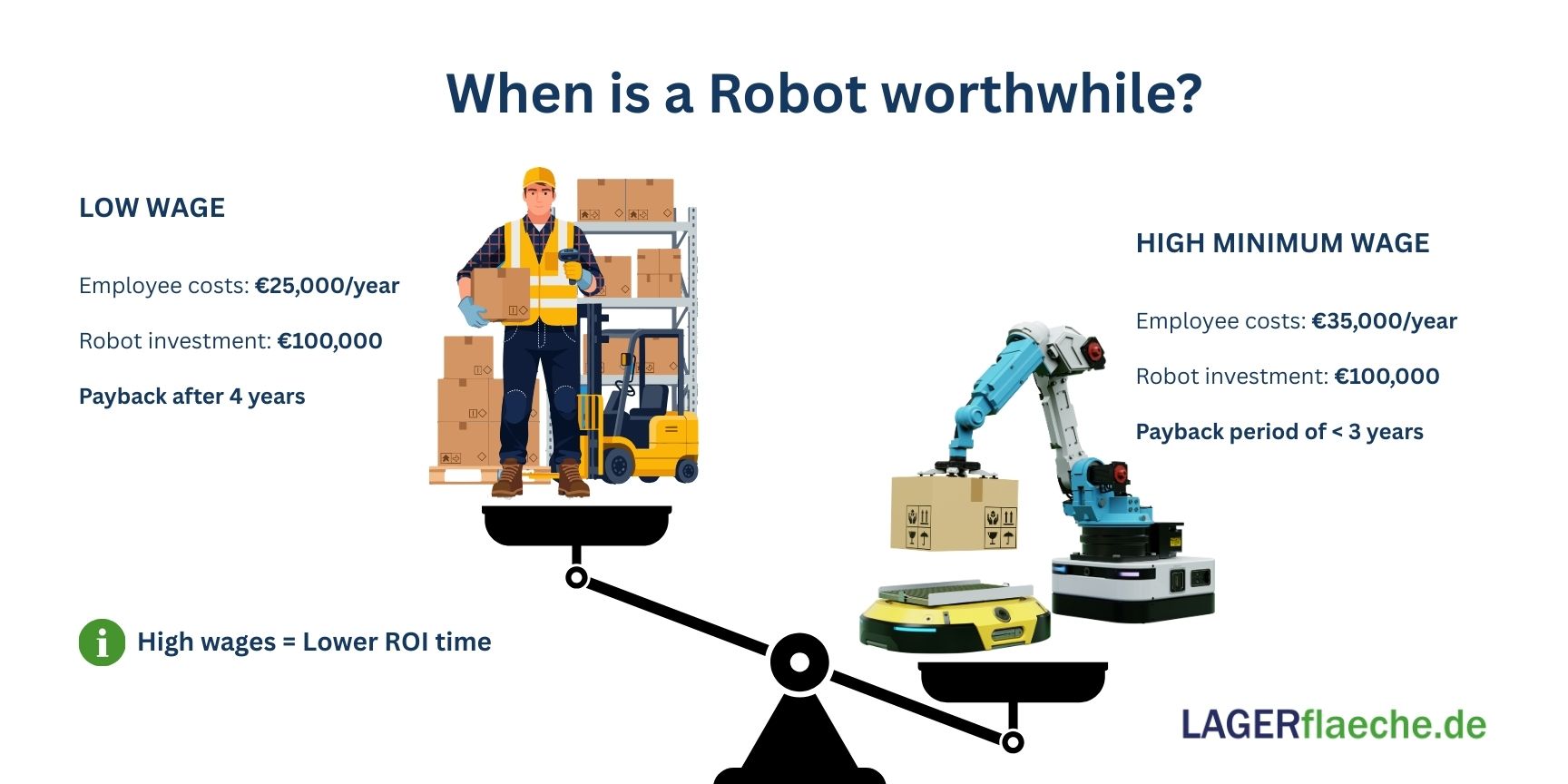
- If an employee costs €25,000 a year, a €100,000 robot only pays for itself after 4 years.
- If the wage cost block rises to €35,000, the robot pays for itself after less than 3 years.
The "break-even point" for automation decreases with each minimum wage increase. Simple activities (palletizing, simple repositioning) will disappear.
The Amazon Example: Layoffs in the Name of Progress?
Amazon is often the trailblazer when it comes to trends. Reports of layoffs at tech giants are often generalized.
The facts: Amazon has indeed cut jobs in certain areas. But you have to look closely: The cuts often affected administrative areas or divisions such as "Alexa". In the fulfillment centers, on the other hand, Amazon relies heavily on robotics (e.g. the robots "Proteus" or "Sparrow").
The strategy: Amazon does not necessarily lay off people in the warehouse in order to immediately replace them with robots. But they are hiring fewer new people for growth. AI takes care of scaling. At the same time, Amazon argues that technology will create new, higher-quality jobs (maintenance technicians, robot coordinators). Criticism: This is of little help to the unskilled warehouse worker, whose job profile is rationalized away. Here, AI is used to reduce dependence on the volatile and increasingly expensive factor "human".
International Comparison: Where does Germany Stand?
The German minimum wage is high by European standards, which puts pressure on the competitiveness of German logistics locations.
| Country | Minimum wage (approx.) | Logistics relevance | Degree of automation |
| Luxembourg | > 14,00 € | Very high, but niche. | High |
| Germany | 12,41 € | Logistics hub of Europe. High cost pressure. | Medium to High |
| France | approx. 11,65 € | Similar structure to DE, strong union influence. | Medium |
| Poland | approx. 6,50 - 7,00 € | Main competitor for DE. Many camps are being built near the border. | Very high (many new buildings) |
| United States | $7.25 (waistband)* | *Varies greatly per state (up to $16+). Extremely technologized. | Extremely High (Pioneer) |
| China | Variable (low) | World market leader in robotics production. | Explosive growth |
(Sources: Eurostat, WSI Minimum Wage Database)
Why is this important? Especially in e-commerce, warehouse locations are migrating to Poland or the Czech Republic. A warehouse in Poznań (Poland) can often serve the German market within 24 hours – with almost 50% lower labor costs. Germany cannot win this competition through price, but only through quality, speed and automation.
Practical Example: The Transformation of "Müller Logistik GmbH"
To illustrate the utility value, let's consider a (fictitious but realistic) scenario:
Initial situation: A medium-sized logistics service provider for spare parts. 50 warehouse employees. High fluctuation. The minimum wage increase in 2025 would completely eat up profits.
The measure: Instead of laying off employees, the company is investing in an "AutoStore" system (a high-density automated small parts warehouse) and pick-by-voice technology.
The result:
- Area: 60% less space required (saves rent/energy).
- Staff: The number of employees remains the same, but they no longer have to walk 15km a day. They operate the ports of the AutoStore.
- Output: The output per employee increases by a factor of 3.
- Salary: Due to the higher efficiency, the company can even pay an hourly wage of € 14.00 and thus becomes a more attractive employer in the region.
Conclusion of the example: AI and automation have saved jobs here, not destroyed them, by securing competitiveness despite the increase in wage costs.
Outlook: The Next 5 years in Warehouse Logistics
Where is the journey going by 2030? Here are four well-founded predictions:
- The "dark warehouse" remains a niche, hybrid wins: Completely deserted warehouses (dark warehouses) will remain rare. The future belongs to the "cobot" approach (Collaborative Robots). Humans and robots work hand in hand in the same aisle. The human does the complex handles, the robot the towing.
- AI as a supervisor: Algorithms will increasingly take over shift planning and real-time control. The shift supervisor's "gut feeling" is replaced by data. This can lead to stress ("algorithmic management") if it is not introduced ethically.
- Wage gap: The gap between "unskilled worker" (replaceable by AI) and "process monitor" (operated by AI) will widen. Qualification becomes the only job insurance.
- Reshoring through robotics: As transport costs and geopolitical risks increase, warehouses could move closer to the customer (to Germany) again. However, this can only be financed if the degree of automation is extremely high.
Conclusion: Fear is a Bad Advisor – Adaptation is Mandatory
The combination of a minimum wage increase and AI progress is not a doomsday scenario, but a long overdue modernization push. Companies that complain now and only argue about wage costs will lose. The winners are those who use AI to give their employees "superpowers".
For the employee, the following applies: Pure muscle power loses market value. The ability to interact with technology is becoming the new currency in the labor market.
Latest Blog Posts
Stay up to date with the newest trends, insights, and tips in warehouse and logistics. Our latest articles help you navigate the industry with confidence.
Data Centres vs. Logistics Facilities: The Race for Power and Land
Across Europe, logistics operators are competing for more than land and transport access. They increasingly need something much harder to secure: grid capacity. Data centres are intensifying that competition — and changing how logistics locations are evaluated....
Chinese companies discover Europe's logistics real estate
Chinese companies are becoming an increasingly visible user group in Europe's logistics real estate market. What does this mean for warehouse space, 3PL structures and the requirements for European logistics locations?...
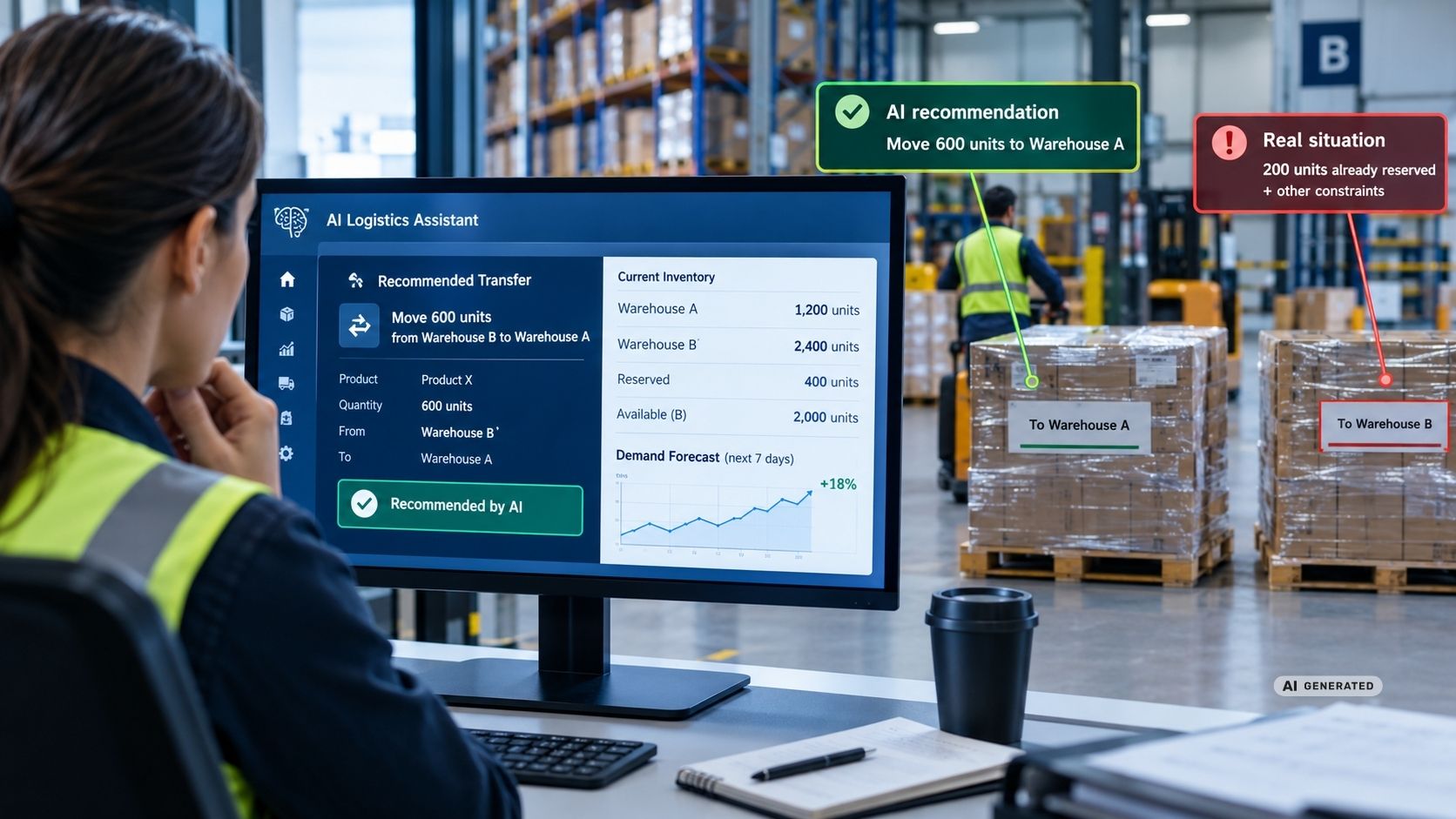
AI Hallucinations in Logistics: When AI Plans the Wrong Delivery
AI can analyze enormous amounts of logistics data — but it can also produce a convincing answer that is simply wrong. The critical question is not whether AI makes mistakes, but what happens when a wrong recommendation becomes an operational decision....
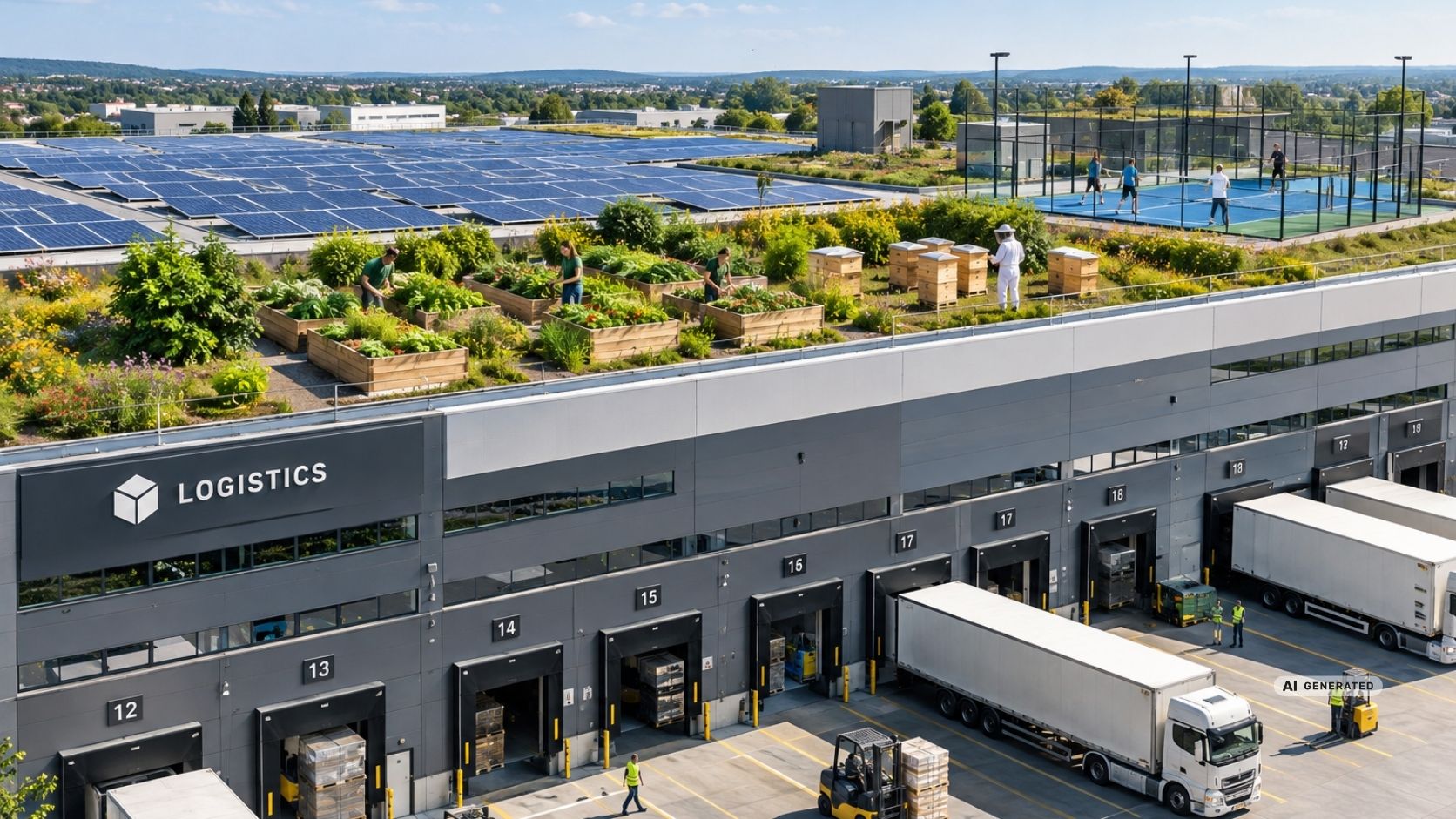
The Green Revolution on the Hall Roof: From Concrete Block to Ecological Power Plant?
Logistics roofs can do more than PV: greening, bees, urban farming and even sports areas turn unused roof space into multifunctional rooms....