



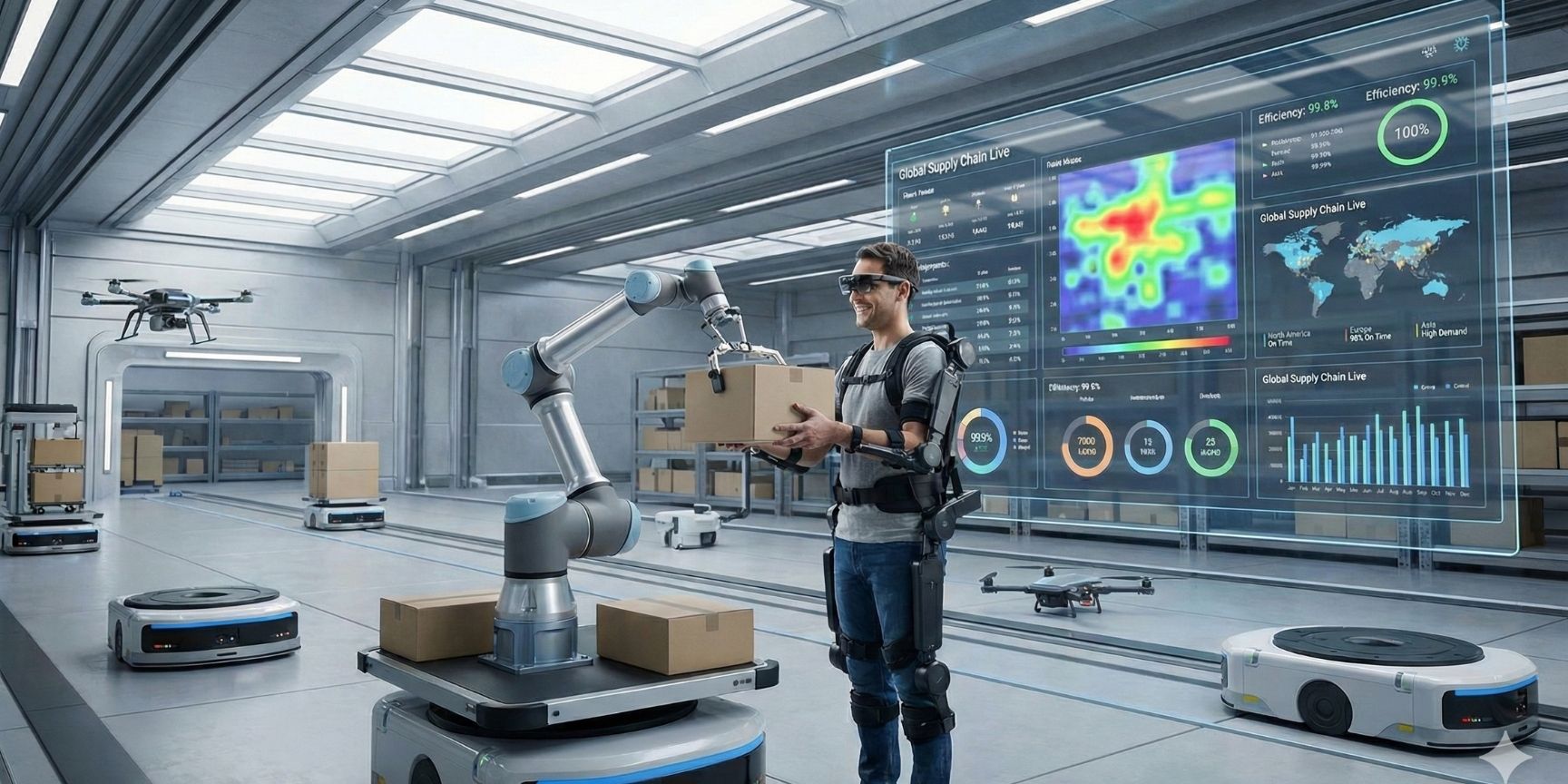
Logistics Revolution: Why Startups are the Backbone of the Supply Chain Today
Table of Contents
- The Innovation Dilemma: Why the Industry Needs Startups
- Buying instead of Building: Why Contract Logistics Companies are becoming Investors
- Waste of Money or Stroke of Genius? The Risk of Early Entry
- SMEs in a Quandary: Left Behind or Promoted?
- The Startup Fair Phenomenon: Why Demand is Exploding
- Top 10: The Most Exciting Logistics Startups at the Moment (2024/2025)
- Global Comparison: Germany vs. Worldwide
- Practical Example: Increasing Efficiency through AI Startup Integration
- Conclusion: The Future Belongs to the Brave
For a long time, the logistics industry was considered conservative, characterized by the smell of diesel, paper lists and grown structures. But the wind has changed. Today, logistics is the playground for high-tech visionaries. But why is that? Why are traditional contract logistics companies and freight forwarders risking millions for young companies, which are often not yet in the black? Is it the fear of losing touch or a calculated strategy?
In this article, we shed light on the deeper layers of startup culture in logistics, analyze global competition, and determine whether German SMEs are being crushed between tech giants and agile newcomers.
The Innovation Dilemma: Why the Industry Needs Startups
Classic logistics is trimmed for efficiency and stability. That is their strength, but also their greatest weakness. Innovation within rigid structures is slow and expensive. Startups, on the other hand, have a completely different DNA: agility, fault tolerance and radical user-centricity.
Why are startups essential for warehouse logistics?
Traditional providers often reach their limits when it comes to solving complex problems – whether it's optimizing the "last mile", automating picking processes, or transparently tracking supply chains in real time. Startups fill these gaps by:
- Technological specialization: While a large-scale logistics company has to be able to do everything, a startup focuses on only one problem (e.g. AI-supported route planning).
- Speed: The time from idea to prototype (MVP - Minimum Viable Product) is often only months, not years, for startups.
- Talent magnetism: Top developers prefer to work on disruptive technologies rather than maintaining legacy systems of aging corporations.
Buying instead of Building: Why Contract Logistics Companies are becoming Investors
It is a trend that has become entrenched: Big players such as DHL, Kuehne + Nagel or DB Schenker are increasingly acting like venture capital companies. But what drives them?
Strategic knowledge purchasing
Buying a startup is often cheaper and less risky than developing a software solution yourself. According to a study by Gartner, by 2026, over 50% of global logistics companies will invest in startups to accelerate their digital transformation.
The benefits at a glance:
| Advantage | Description |
| Time-to-Market | Instant access to market-ready technologies. |
| Cultural change | "Infection" of the parent company with an agile mindset. |
| Asset-light models | Digital freight forwarders (e.g. Sennder) often do not have their own trucks, which massively increases scalability. |
Waste of Money or Stroke of Genius? The Risk of Early Entry
Critics often interject: "Why pay a fortune for an idea when the finished product doesn't scale yet?"
It's a fine line. If a logistics company waits until a product is perfect, the market is usually already occupied or the price for a takeover is unaffordable. The investment in the early phase (seed or Series A) ensures exclusivity.
Is it a waste of money? Only if the startup is considered an isolated island. The real utility comes from integration. A practical example: If a contract logistics company buys a start-up for computer vision and thus reduces the error rate in order picking by 30%, the investment often pays for itself after 18-24 months.
Important question: Can we afford to wait for the "perfect" product while the competition is already learning the market with 80 percent solutions?
SMEs in a Quandary: Left Behind or Promoted?
Small and medium-sized enterprises (SMEs) in logistics rarely have the budget for multi-million dollar acquisitions. Is there a danger that they will be left behind by the "digital giants"?
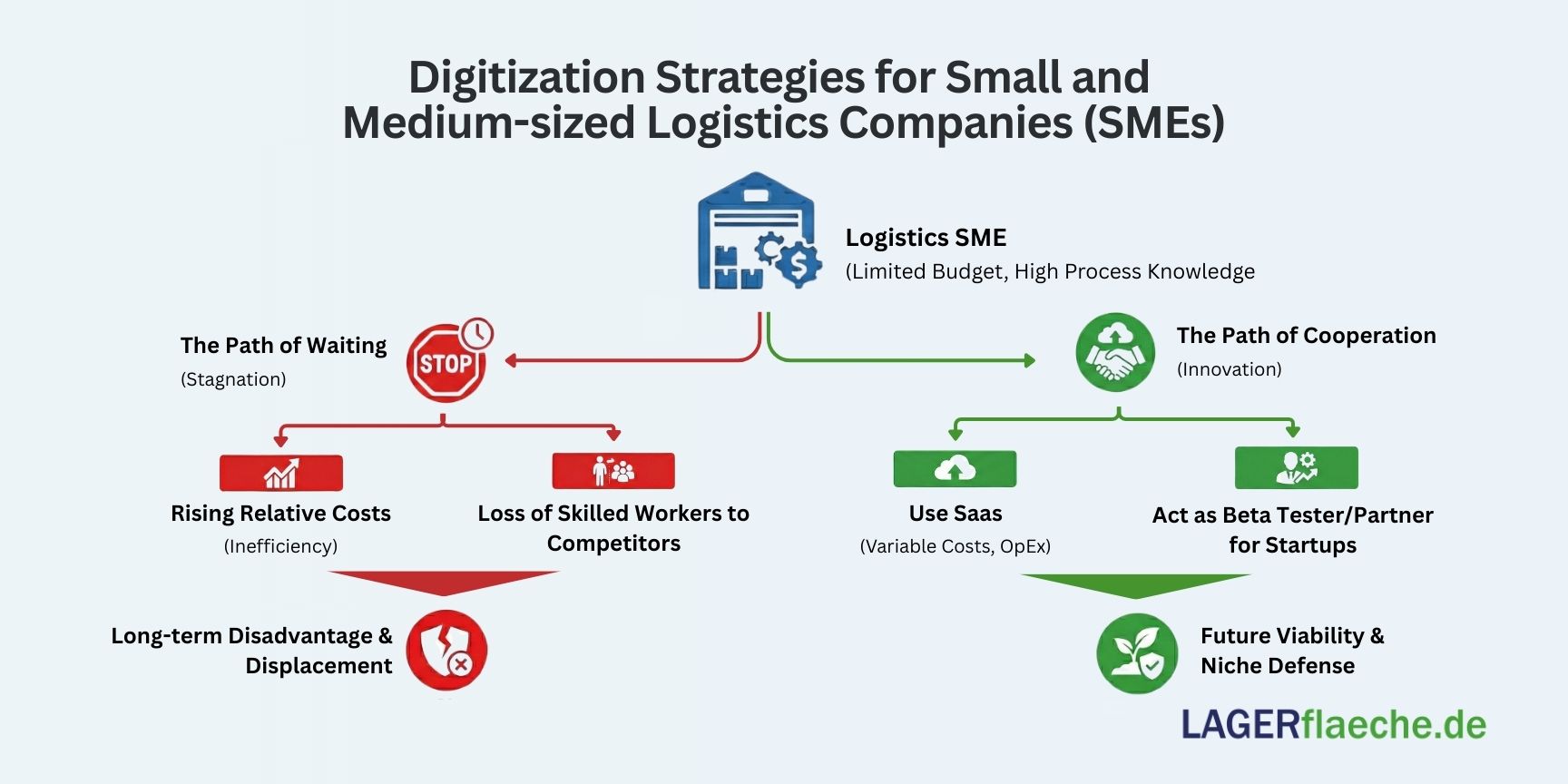
The answer is a clear one: No, but... SMEs don't have to buy themselves, they have to cooperate. The advantage of medium-sized companies is their proximity to customers and their in-depth understanding of processes. Startups are often desperately looking for "beta testers" and practice partners.
- Strategy for SMEs: "SaaS instead of M&A". Instead of buying the startup, SMEs use software-as-a-service solutions. This keeps costs variable and the technology up-to-date.
- Danger: Those who refuse digitization and insist on "we've always done it this way" will be undercut in terms of price in the long term by the higher efficiency of the digitized competition.
The Startup Fair Phenomenon: Why Demand is Exploding
Events such as LogiMAT, Hypermotion or Transport Logistic are dedicating ever larger areas to start-ups. The halls are full, the curiosity is huge. Why?
- Pressure to solve: The shortage of skilled workers is forcing companies to automate.
- Sustainability (ESG): Startups provide the algorithms to avoid empty runs and achieve CO2 targets.
- Network effect: Investors meet founders, and practitioners meet visionaries.
Demand is strengthened by the fact that logistics is no longer a "support process", but a strategic competitive advantage. Whoever has the best IT wins the customer.
Top 10: The Most Exciting Logistics Startups at the Moment (2024/2025)
These companies should be on the radar of every logistics decision-maker:
- Forto (Germany): Digital freight forwarder for air and sea freight. Focus on transparency and sustainability.
- Sennder (Germany): Europe's leading digital platform for full truck loads.
- Exotec (France): Revolutionary robotics for warehouse logistics (Skypod system).
- Einride (Sweden): Autonomous, electric truck systems.
- Project44 (USA/Global): Der Goldstandard für Supply Chain Visibility.
- Magazino (Germany): Mobile robots that can grasp individual objects in the warehouse (recently completely acquired by Jungheinrich).
- Instafreight (Germany): Digital handling of transport services.
- Gideon Brothers (Croatia): AI-driven autonomous forklifts and vehicles.
- Tive (USA): Real-time tracking of the location and condition (temperature, vibration) of the cargo.
- 7bridges (UK): AI platform to optimize the entire supply chain.
Global Comparison: Germany vs. Worldwide
The logistics startup landscape differs massively by region:
Germany: The "Engineering" Hub
Germany is strong in hardware-related logistics and the optimization of complex B2B processes. Thanks to the high density of world market leaders, there is excellent domain knowledge. But bureaucracy and a cautious financing culture often slow down growth compared to the US.
USA: The "platform" kings
The giants of supply chain visibility are emerging in the USA (e.g. Project44). Massive venture capital is flowing here. The focus is on radical scaling and occupying global market shares.
Estonia & Israel: The Software Forges
- Estonia: A fully digitized state structure creates extremely efficient SaaS solutions for logistics (e.g. Sixfold).
- Israel: Leader in cybersecurity for supply chains and highly complex algorithms for warehouse optimization.
China: Automation in the extreme
Nowhere is robotization in the warehouses as advanced as in China (e.g. Geek+). The vast domestic market of e-commerce is driving innovation at a speed that is hardly imaginable in Europe.
Practical Example: Increasing Efficiency through AI Startup Integration
Scenario: A medium-sized contract logistics company with 50,000 storage areas is struggling with a 2% error rate in picking and high energy costs due to inefficient routes.
The solution: Instead of hiring its own team of data scientists, the company cooperates with a startup for "digital twins".
- Step 1: Installation of sensors and integration of WMS data into the startup's cloud.
- Step 2: The AI calculates new routes and optimizes storage space occupancy based on seasonality.
- Result: * Reduction of walking distances by 15%.
- Error rate decreases to 0.5%.
- ROI reached after 9 months.
This example shows that the utility value is real, measurable and also achievable for non-corporations.
Conclusion: The Future Belongs to the Brave
Startups are not hype, they are the external research department of the logistics industry. For large companies, buying or investing is a survival strategy. For SMEs, cooperation is the key to not getting lost in the competition for efficiency.
The question is no longer whether to work with startups, but how quickly to implement the right solution. Logistics will be more digital, greener and more autonomous in five years – and today's startups will be the architects of this new world.
Have you already gained experience with startup collaborations in your warehouse? Where do you see the biggest hurdles?
Further sources & data:
- BVL (German Logistics Association): Annual report on digitalisation in SMEs.
- Statista: Investment volume in LogTech startups worldwide 2020-2024.
- Fraunhofer IML: Studies on autonomous intralogistics.
- DHL Trend Report: Next-Generation Logistics.
Latest Blog Posts
Stay up to date with the newest trends, insights, and tips in warehouse and logistics. Our latest articles help you navigate the industry with confidence.
Data Centres vs. Logistics Facilities: The Race for Power and Land
Across Europe, logistics operators are competing for more than land and transport access. They increasingly need something much harder to secure: grid capacity. Data centres are intensifying that competition — and changing how logistics locations are evaluated....
Chinese companies discover Europe's logistics real estate
Chinese companies are becoming an increasingly visible user group in Europe's logistics real estate market. What does this mean for warehouse space, 3PL structures and the requirements for European logistics locations?...
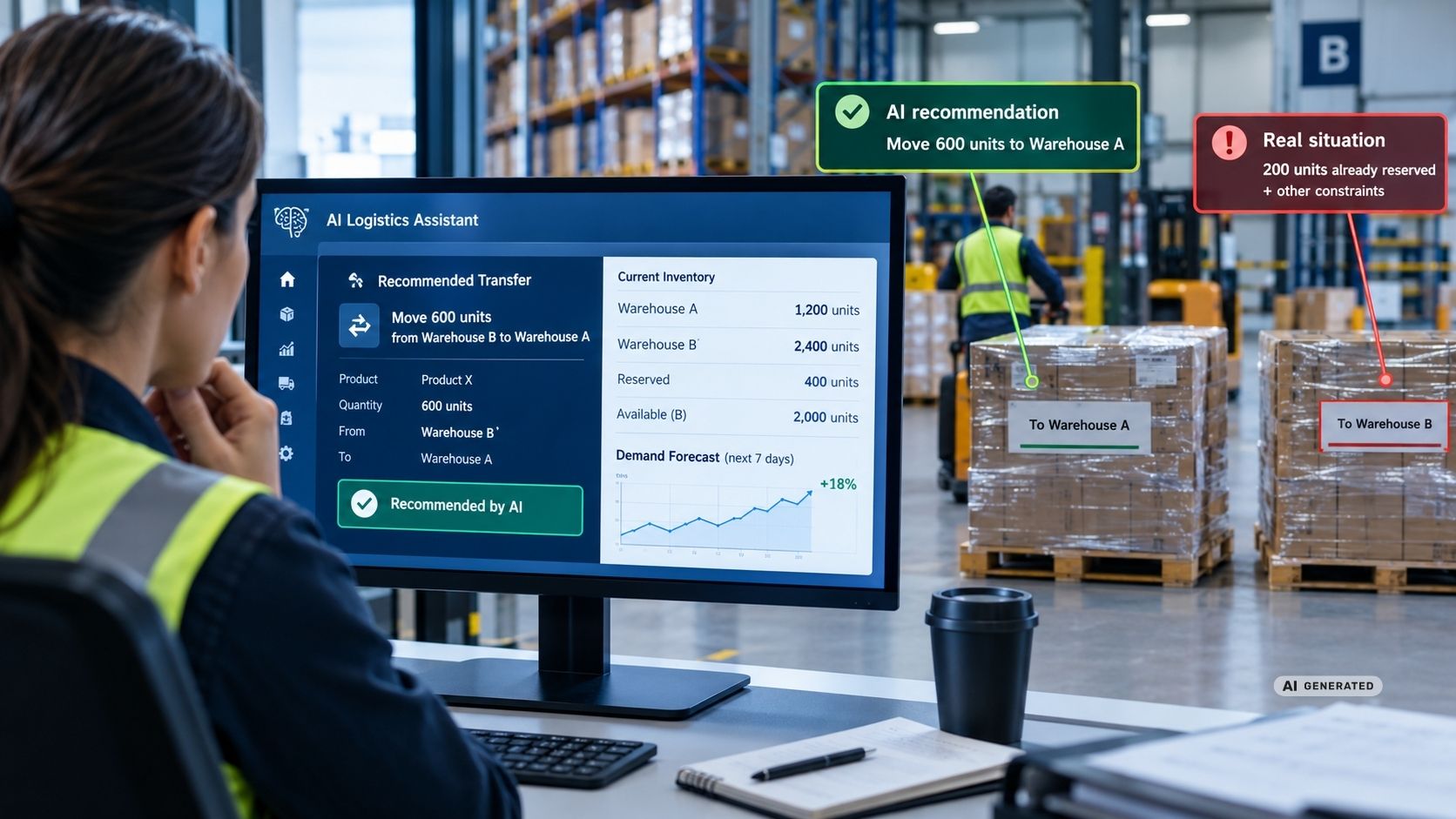
AI Hallucinations in Logistics: When AI Plans the Wrong Delivery
AI can analyze enormous amounts of logistics data — but it can also produce a convincing answer that is simply wrong. The critical question is not whether AI makes mistakes, but what happens when a wrong recommendation becomes an operational decision....
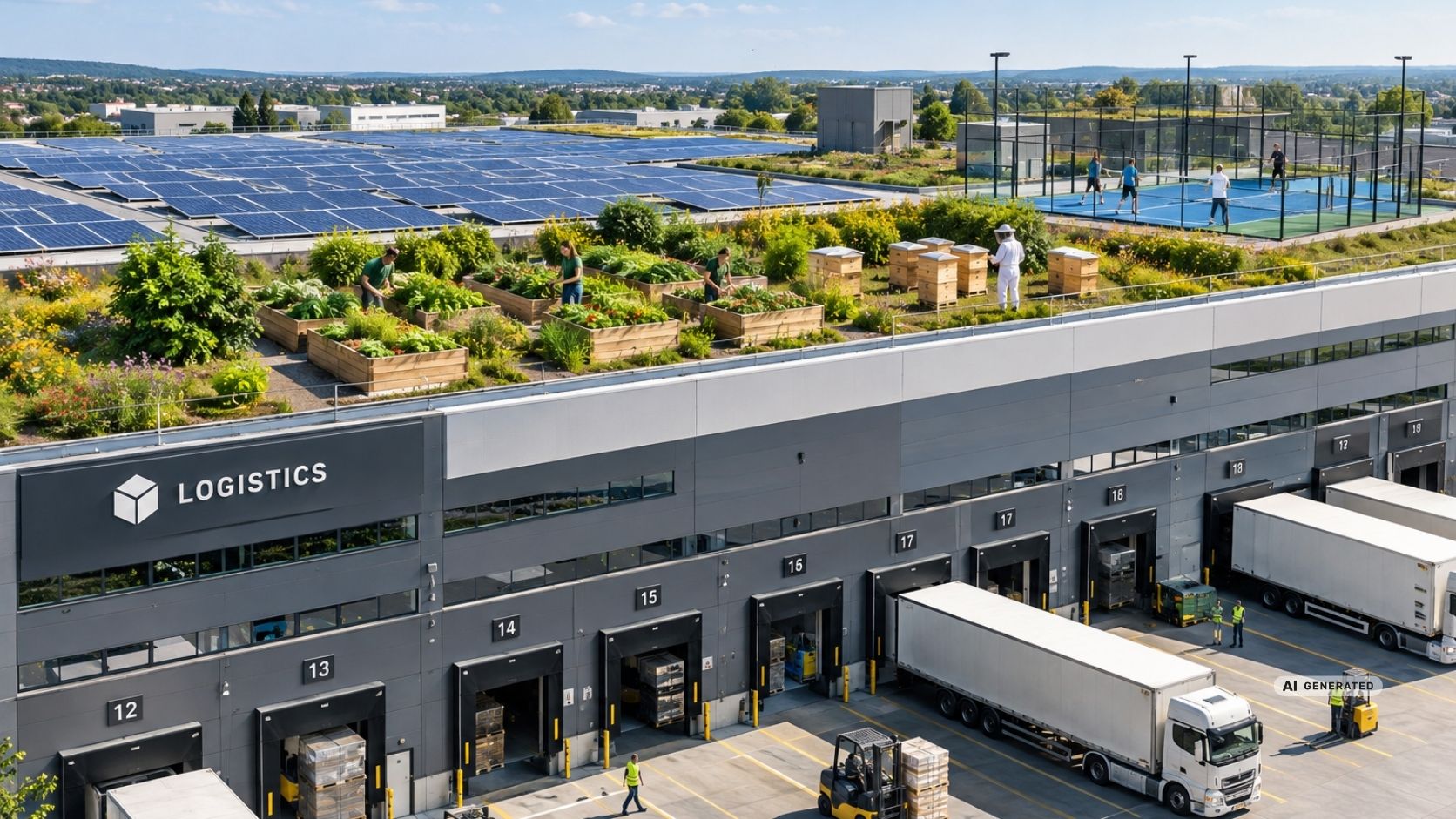
The Green Revolution on the Hall Roof: From Concrete Block to Ecological Power Plant?
Logistics roofs can do more than PV: greening, bees, urban farming and even sports areas turn unused roof space into multifunctional rooms....