



The Interest Rate Turnaround as a Game Changer: How Construction Interest Rates are Reshaping the Logistics Real Estate Landscape
Table of Contents
- The Mechanics of the Market: Why Construction Interest Rates are the most Important Lever for Logistics Real Estate
- Macroeconomic Drivers: Why do Construction Interest Rates actually Rise or Fall?
- Review and Status Quo: From "Gold Rush" to "Hangover Mood"?
- Impact on Logistics and Supply Chain: What happens if Interest Rates Remain Permanently High?
- International Differences: Germany vs. Europe & World
- Practical Example: The Invoice of "LogiBuild GmbH"
- Protection for Project Developers and Contract Logistics Companies
- Conclusion and Outlook: The New Reality Requires Agility
The era of "cheap money" is over. For more than a decade, the real estate markets – and especially the logistics real estate segment – knew only one direction: steeply upwards. But the abrupt turnaround in interest rates in 2022 and 2023 has reshuffled the cards. For investors, project developers and contract logistics companies, existential questions now arise: Is the construction freeze only temporary? How can projects still be calculated when financing costs have quadrupled? And who pays the bill in the end – the owner via loss of value or the tenant via the logistics costs?
In this deep dive, we analyze the complex interactions between capital market interest rates and the physical infrastructure of the global economy. We take a look behind the scenes of financial mathematics, compare Germany with global markets and give concrete recommendations for practical action.
We will examine the following key questions:
- Why is the rise in interest rates choking off new construction projects even though the demand for warehouse space is high?
- How do government bonds correlate directly with your hall rent?
- Why is the German market reacting more slowly than the British market?
- Which hedging strategies really work?
The Mechanics of the Market: Why Construction Interest Rates are the most Important Lever for Logistics Real Estate
To understand the current situation, we need to dive deep into the calculation of project developments. Logistics real estate is a capital-intensive asset. The construction interest rates act as a direct lever on two decisive factors: the financing costs of the construction and the investors' expected return.
The direct cost block
When a project developer builds a logistics hall for 20 million euros, it is rarely 100% financed from equity. With a typical loan-to-cost ratio of 60-70%, an interest rate increase from 1.0% to 4.0% means a tripling to quadrupling of the current interest burden during the construction and holding phase.
The cap rate effect (yield compression vs. decompression)
Even more serious is the influence on the exit factor (multiplier). Investors always compare real estate yields with the "risk-free interest rate" (usually 10-year government bonds).
- Low interest rate scenario: If the government bond is 0.5%, an investor accepts a prime yield of 3.5% for a logistics hall. The risk premium (spread) is 300 basis points.
- Interest rate turnaround scenario: If the government bond rises to 2.5%, the real estate yield must (theoretically) rise to 5.5% in order to maintain the same risk gap.
The mathematical consequence: If the required return (the denominator in the valuation equation) increases, the value of the property falls massively, unless the rental income increases at the same rate.
Remember: Rising interest rates inevitably lead to falling real estate values (price correction) if rents remain the same. This slows down new construction projects, as the construction costs are often higher than the achievable sales price.
Macroeconomic Drivers: Why do Construction Interest Rates actually Rise or Fall?
Construction interest rates are not arbitrary figures of the banks, but the result of global financial flows. The most important factors are:
- Key interest rates of the central banks (ECB / Fed): The European Central Bank fights inflation by raising key interest rates. This makes the refinancing of commercial banks more expensive.
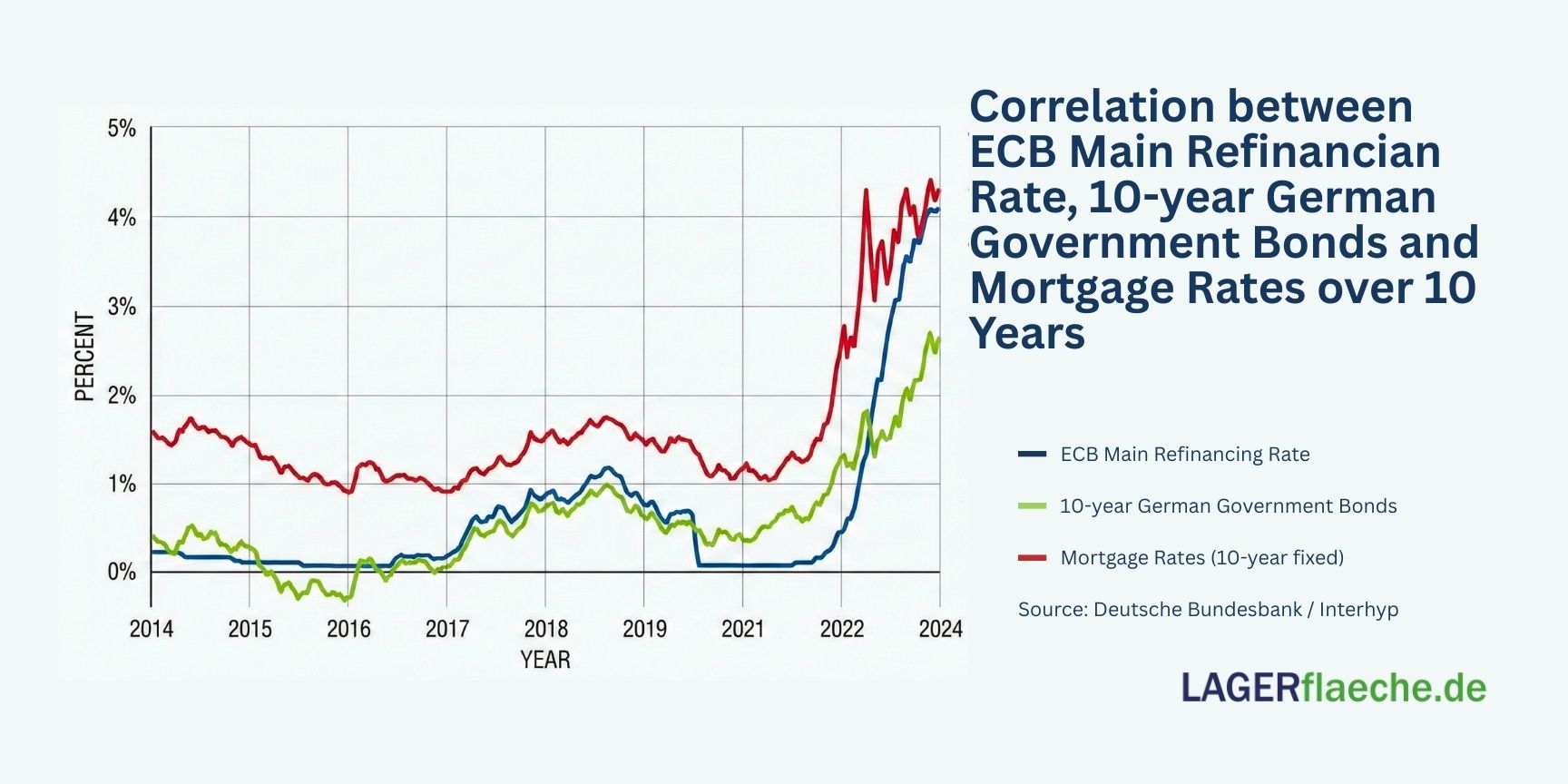
- Yields on covered bonds and government bonds: Mortgage interest rates are strongly based on the yield on 10-year German government bonds. If investors can get interest on safe government bonds again, mortgage capital will have to be more expensive to remain attractive.
- Inflation: Construction interest rates always contain an inflation expectation. If inflation is high, lenders demand higher interest rates to compensate for the loss of purchasing power.
- Risk premiums (margins): In uncertain times (war, recession), banks increase their margins to cover credit default risks.
Review and Status Quo: From "Gold Rush" to "Hangover Mood"?
The Past (2012–2021)
We experienced a historical anomaly. Construction interest rates were below 1% in some cases. Logistics real estate became the "darling" of investors, fueled by the e-commerce boom.
- As a result, prime yields fell to below 3.0%. Every new building was absorbed immediately. Construction costs played a subordinate role, as the "cheap money" made everything financially viable.
The Shock (2022–2023)
With the Ukraine war and the energy crisis, inflation shot up. The ECB reacted historically quickly. Construction interest rates jumped from around 1% to over 4% within a very short time.
- As a result, transaction markets froze ("Price Discovery Phase"). Sellers wanted the old high prices (based on low interest rates), buyers could only pay low prices (based on high financing costs).
The future (forecast 2024/2025)
Current data (as of Q1 2025 Trends) point to a "new normal". Interest rates have settled on a plateau (approx. 3.5% - 4.0%). A decline to the 1% level is extremely unlikely.
- Trend: The market is getting used to the interest rate level. Transactions are on the rise again, but at corrected prices.
Impact on Logistics and Supply Chain: What happens if Interest Rates Remain Permanently High?
The effects are not limited to the real estate industry, but hit operational logistics hard.
Shortage of supply (vacancy rate decreases)
Since many project developers have put planned buildings on hold ("shelving"), less new space is coming onto the market.
- Fact: In top logistics regions (Munich, Hamburg, Berlin), vacancy rates are often below 2-3%, which means practically full occupancy.
The rent shock
In order to still build profitably with high interest rates and high construction costs, project developers have to charge significantly higher rents.
- Rent increase: We have seen rent increases of 20-30% in prime locations in some cases over the last 24 months (source: JLL / CBRE Market Reports).
- Indexation: Existing contracts are often linked to the consumer price index (CPI). High inflation is also driving up rents in the portfolio.
For the logistics company, this means that real estate costs, which used to often account for only 5-10% of the total costs (in addition to personnel and transport), are becoming a dominant cost factor that squeezes margins.
International Differences: Germany vs. Europe & World
Why do markets react differently to the same global interest rate trend?
Germany: The Tanker
The German market is considered conservative. Valuations are often supported by appraisal procedures (material value procedures), which react more sluggishly than pure market prices.
- Effect: The price correction (devaluation of real estate) takes place more slowly ("salami tactic"). The transaction volume is collapsing more sharply because sellers and buyers are too far apart in terms of price.
Great Britain & USA: The speedboats
In Anglo-Saxon markets, repricing takes place almost in real time.
- Effect: Real estate values corrected extremely quickly by 20-30% in 2022/2023. This was painful, but led to the market bottoming out faster and investors returning earlier.
Poland & Eastern Europe: The cost advantage is dwindling
Countries such as Poland have long benefited from low construction costs and labor costs. However, interest rates hit these markets harder in some cases, as financing is often denominated in euros, but there are local currency risks. Nevertheless, Poland remains attractive due to the "nearshoring" trend (production moves closer to sales markets), even if the expected returns here must be significantly higher than in Germany (risk premium).
Practical Example: The Invoice of "LogiBuild GmbH"
To illustrate the drama, let's compare an identical project before and after the interest rate turnaround.
Project: Construction of a 20,000 m² logistics center. Total investment cost (TIC): EUR 20 million. Financing: 70% debt (EUR 14 million).
| Parameter | Scenario 2021 (low interest rates) | Scenario 2024 (interest rate turnaround) |
| Bauzins (10 d.) | 1,20% | 4,20% |
| Annual interest burden | 168.000 EUR | 588.000 EUR |
| Required return (investor) | 3,50% | 5,00% |
| Necessary annual rent (net) | approx. 700.000 EUR | approx. 1,000,000 EUR |
| Necessary rent per m² | 2.92 EUR/m² | 4.17 EUR/m² |
Note: This is a simplified calculation without repayment and management costs.
Conclusion of the example: Due to the rise in interest rates alone, the rent must increase by over 40% for the project to have the same profitability for the developer. If the market does not provide this 4.17 EUR (or in real terms rather 6.50-7.50 EUR incl. construction cost increase), there will be no construction.
Protection for Project Developers and Contract Logistics Companies
How can market participants protect themselves in this volatile environment?
For Project Developers
- Forward Funding: Sale of the project to an end investor before construction begins. This secures the exit yield, but reduces the profit margin.
- Interest rate swaps & caps: Use of interest rate derivatives (swaps) to exchange variable interest rates for fixed interest rates or to introduce caps. This costs a premium, but creates planning security.
- ESG as an anchor of value: Banks often finance certified "green buildings" (DGNB, BREEAM) at more favourable conditions (green loans). In addition, these properties are more stable in value when sold.
For contract logistics companies (tenants)
- Drafting of lease agreements: Negotiating "caps" for indexation (value retention clause), e.g. capping the increase to a maximum of 3% per year, even if inflation is higher.
- Ownership instead of rent (corporate real estate): For financially strong logistics companies, it can be worthwhile to build themselves (equity utilization) in order to decouple themselves from the volatility of the rental market.
- Longer terms: In return for longer leases (10-15 years), cheaper starting rents can often be negotiated, as this reduces the risk for the investor and improves his financing conditions.
Conclusion and Outlook: The New Reality Requires Agility
Construction interest rates will not return to the level of 2021 in the short term. The logistics industry must learn to live with interest rates of between 3% and 4%. This leads to a market shakeout: dubious project developers who have only bet on interest rate compression disappear. What remains are actors with strong substance.
For logistics, this means that space will become more expensive in the long term. Efficiency within the four walls (automation, robotics, cubic meter optimization) is becoming more important than the price per square meter itself. Anyone who acts as a logistics specialist or developer now should not speculate on falling interest rates, but make their business models "weatherproof" against high capital costs.
The good news is that the fundamental need for logistics space (driven by supply chain resilience and e-commerce) continues unabated. Logistics real estate remains one of the most attractive asset classes even with higher interest rates – as long as the calculation is correct.
References:
- JLL Logistics Market Report Germany (Q4 2023 / Q1 2024) - Data on prime yields and rents.
- Deutsche Bundesbank - Time series on mortgage interest rates and covered bonds.
- CBRE EMEA Logistics Rent Map - Comparison of European markets.
- Bulwiengesa - Project developer pipeline data.
Latest Blog Posts
Stay up to date with the newest trends, insights, and tips in warehouse and logistics. Our latest articles help you navigate the industry with confidence.
Data Centres vs. Logistics Facilities: The Race for Power and Land
Across Europe, logistics operators are competing for more than land and transport access. They increasingly need something much harder to secure: grid capacity. Data centres are intensifying that competition — and changing how logistics locations are evaluated....

Chinese companies discover Europe's logistics real estate
Chinese companies are becoming an increasingly visible user group in Europe's logistics real estate market. What does this mean for warehouse space, 3PL structures and the requirements for European logistics locations?...
AI Hallucinations in Logistics: When AI Plans the Wrong Delivery
AI can analyze enormous amounts of logistics data — but it can also produce a convincing answer that is simply wrong. The critical question is not whether AI makes mistakes, but what happens when a wrong recommendation becomes an operational decision....
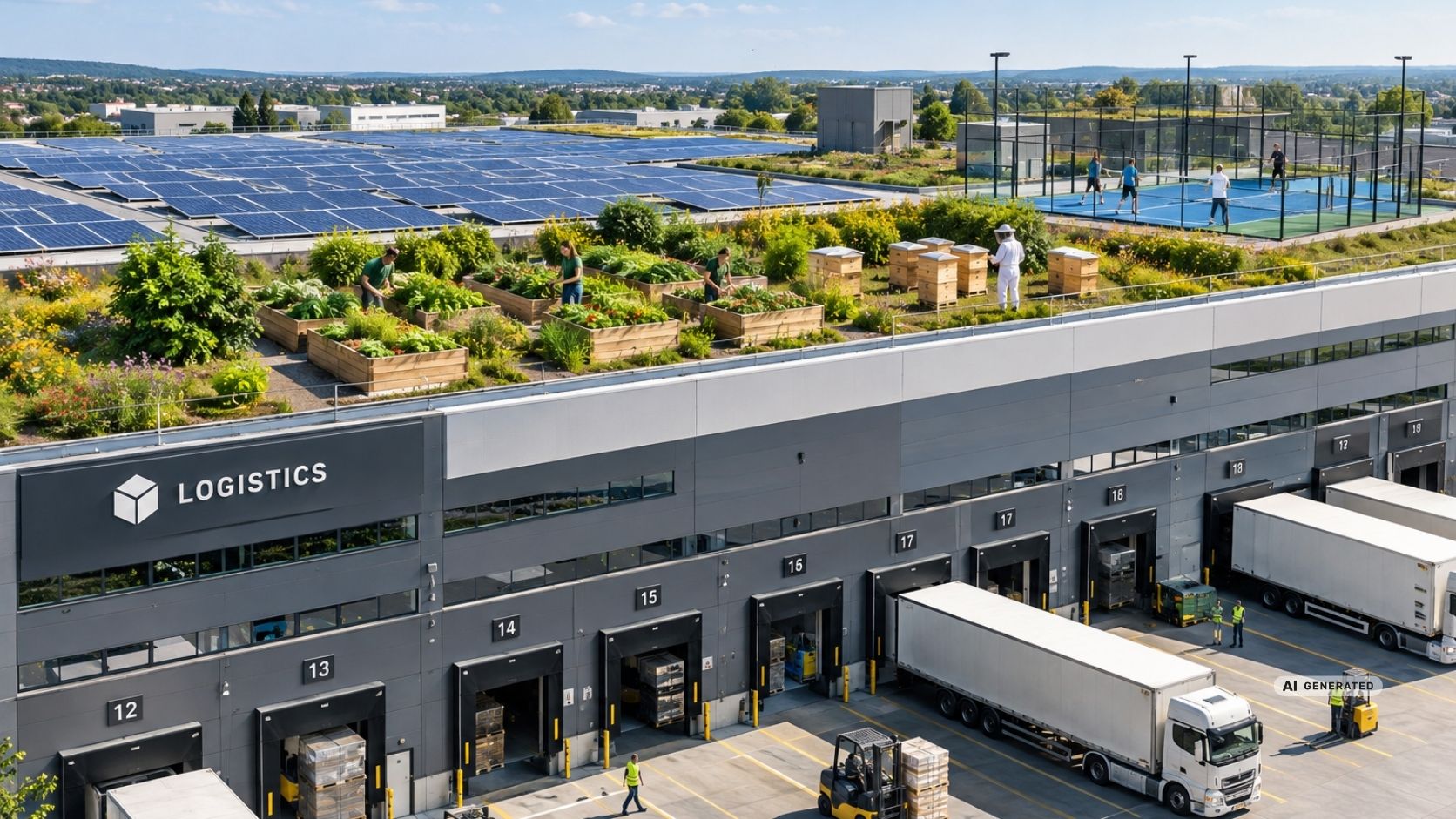
The Green Revolution on the Hall Roof: From Concrete Block to Ecological Power Plant?
Logistics roofs can do more than PV: greening, bees, urban farming and even sports areas turn unused roof space into multifunctional rooms....