




Mobile Warehouse Spare Parts Management in Warehouse Logistics
Table of contents
- Mobile warehouse spare parts management in practice
- What is Mobile Warehouse Spare Parts Management?
- The role of logistics real estate for mobile spare parts processes
- Strategic advantages for contract logistics
- Facts and figures on economic efficiency
- Future Outlook: Automation and Predictive Maintenance
- FAQ: Frequently asked questions about mobile warehouse spare parts management
Mobile warehouse spare parts management in practice
In modern logistics, downtime is the most expensive factor. Especially in the field of spare parts logistics, where the rapid availability of components is decisive for the maintenance of entire production lines or the satisfaction of end customers, a static warehouse is no longer sufficient. Mobile warehouse spare parts management has established itself as a decisive lever for accelerating processes, minimizing error rates and optimizing the use of space in logistics properties.
This guide examines how it works, the infrastructural requirements in the hall and the strategic advantages for contract logistics companies.
What is Mobile Warehouse Spare Parts Management?
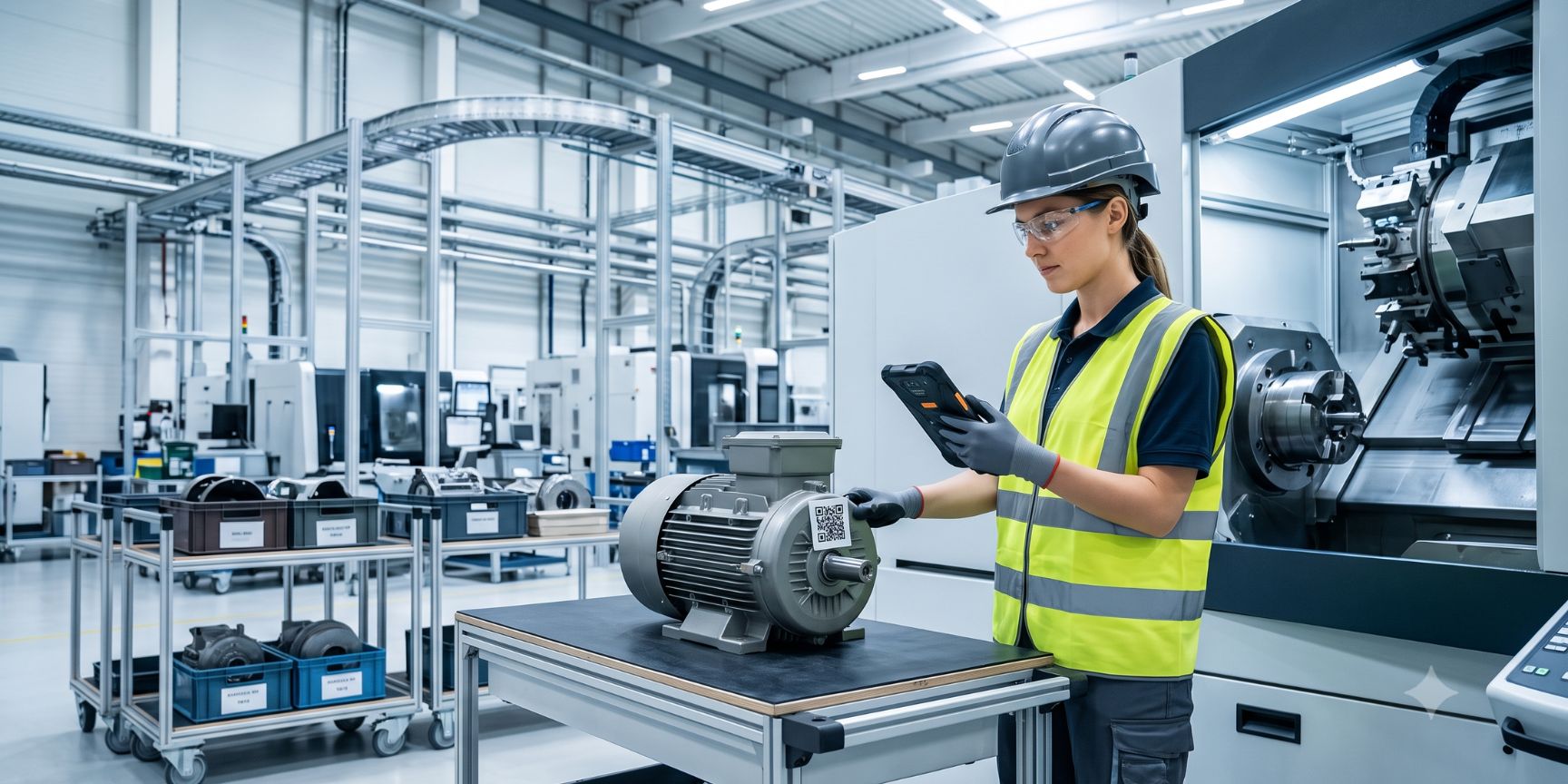
Mobile spare parts management describes the move away from paper-based, rigid processes to dynamic, system-supported inventory management directly at the point of action. The core of the concept is that warehouse employees no longer have to walk to a fixed terminal to retrieve or book data.
Instead, they are equipped with mobile data acquisition devices (MDE), tablets, wearables (e.g. smart glasses) or mobile order picking trolleys. These devices are connected to the warehouse management system (WMS) in real time via the warehouse's Wi-Fi or a 5G campus network. In state-of-the-art logistics properties, the term also includes automation solutions such as automated guided vehicles (AGVs) or autonomous mobile robots (AMR), which bring spare parts directly to the packing station according to the "goods-to-man" principle.
The role of logistics real estate for mobile spare parts processes
An often overlooked factor in the introduction of mobile processes is the physical nature of the hall. Not every older existing property (brownfield) is immediately suitable for highly dynamic spare parts management. The following structural and infrastructural requirements for the logistics property are essential:
- Seamless network coverage: Angled shelving systems, fire protection walls and steel-reinforced concrete ceilings can shield Wi-Fi signals. For mobile working, 100 percent illumination of the hall (or a dedicated 5G network) is absolutely necessary to avoid connection interruptions during scanning.
- Ground conditions for mobile robotics: When autonomous mobile robots (AMRs) transport the spare parts, the demands on the industrial floor increase enormously. Highest flatness tolerances (according to DIN 18202 or VDMA guidelines) are necessary to ensure that sensors work flawlessly and sensitive electronic components can be moved without vibration.
- Charging infrastructure and energy concept: Mobile equipment requires electricity. Logistics properties must offer sufficient capacity and safe zones for charging stations for handhelds, mobile workstations and AGV fleets, ideally coupled to an in-house photovoltaic system (ESG compliance).
Strategic advantages for contract logistics
For contract logistics companies that take over the after-sales logistics business for industrial or automotive customers, extremely tight service level agreements (SLAs) are the order of the day. Delivery within 12 to 24 hours is often contractually guaranteed.
Mobile spare parts management offers decisive competitive advantages here. Due to the route optimization on the MDE devices, employees are navigated through the hall on the shortest route, which massively increases the pick rates. In addition, mobile printers on the picking trolleys enable immediate labeling at the point of removal (pick & pack). This drastically reduces handling costs (transaction fees) and makes the service provider more profitable.
Facts and figures on economic efficiency
The extent to which the switch from static to mobile processes has an impact can be seen across all industries using specific benchmarks:
- Reduction of travel times: In classic warehouses, up to 50 to 60% of the working time is spent on pure walking distances. Mobile management and dynamic routing reduce this figure by up to 35%.
- Reduction of the error rate: Barcode scanning directly on the shelf (scanning verification) typically reduces the error rate when picking spare parts to less than 0.1%.
- Space optimization: Since inventories can be dynamically rebooked via mobile systems (chaotic warehousing), the utilization of the existing warehouse space can often be increased by 15 to 20% before an expensive hall expansion becomes necessary.

Future Outlook: Automation and Predictive Maintenance
The future of the spare parts warehouse in logistics real estate is not only mobile, but predictive. By linking mobile devices with artificial intelligence (AI), it is possible to predict which spare parts will be needed particularly frequently in the coming weeks (predictive maintenance). The WMS then controls mobile robots at night in such a way that these highly frequented parts are automatically relocated to the front, most easily accessible rows of racks (fast-moving zone).
FAQ: Frequently asked questions about mobile warehouse spare parts management
Question: What IT infrastructure is absolutely necessary in the warehouse?
Answer: The basic requirement is a high-performance, seamless Wi-Fi or 5G network within the entire logistics property. In addition, the warehouse management system (WMS) used must have open interfaces (APIs) in order to be able to communicate in real time with mobile devices (MDEs), tablets and automated conveyor systems.
Question: Is mobile spare parts management also worthwhile for smaller storage areas?
Answer: Yes. Even in smaller halls, mobile solutions pay for themselves quickly. The elimination of paper lists and stationary PCs significantly reduces walking distances and booking errors. For small to medium-sized enterprises (SMEs), commercially available industrial tablets or smartphones with a scan attachment that are connected via cloud-based WMS solutions are often sufficient.
Question: How does mobile management affect the pick rate in contract logistics?
Answer: The pick rate increases significantly. Mobile devices show the picker the next pick, which has been optimized for walking, directly on the display. Queries, searching for articles or subsequent system bookings on the PC are completely eliminated. This leads to a measurable increase in "picks per hour" and thus reduces the unit cost per transaction.
Question: What challenges are involved in implementing this in older logistics properties?
Answer: The biggest hurdles in older halls (brownfields) are usually thick concrete walls or outdated shelving systems that lead to Wi-Fi dead zones. In addition, older industrial floors often do not meet the strict flatness requirements required for the use of mobile robots (AMR) or modern narrow-aisle forklifts. A detailed network and soil survey before implementation is therefore advisable.
Your Ideal Logistics Warehouse
Browse listings for warehouse space, logistics real estate, industrial land, and contract logistics solutions.
Browse Exposés
Maximize Exposure for Your Warehouse Space
Showcase your logistics properties and attract qualified inquiries.
Discover Products