




Stacker trucks in the warehouse
Table of contents
- The stacker truck in warehouse and contract logistics
- What is a stacker? (Definition)
- Technical specifications: Facts and figures
- The use in contract logistics
- Requirements for the logistics property and warehouse
- Frequently Asked Questions and Answers (Glossary & FAQ)
- Practical utility: Purchase criteria for your warehouse
- Conclusion: Efficient use of space and cost reduction
The stacker truck in warehouse and contract logistics
Modern intralogistics requires machines that are flexible, manoeuvrable and powerful. Whether in fast-paced contract logistics or picking in a classic warehouse – industrial trucks are the backbone of the material flow. In this technical article, we take a look at the stacker truck (often also called pedestrian stacker) down to the smallest detail, provide important key figures and answer the most pressing questions for logistics decision-makers.
What is a stacker? (Definition)
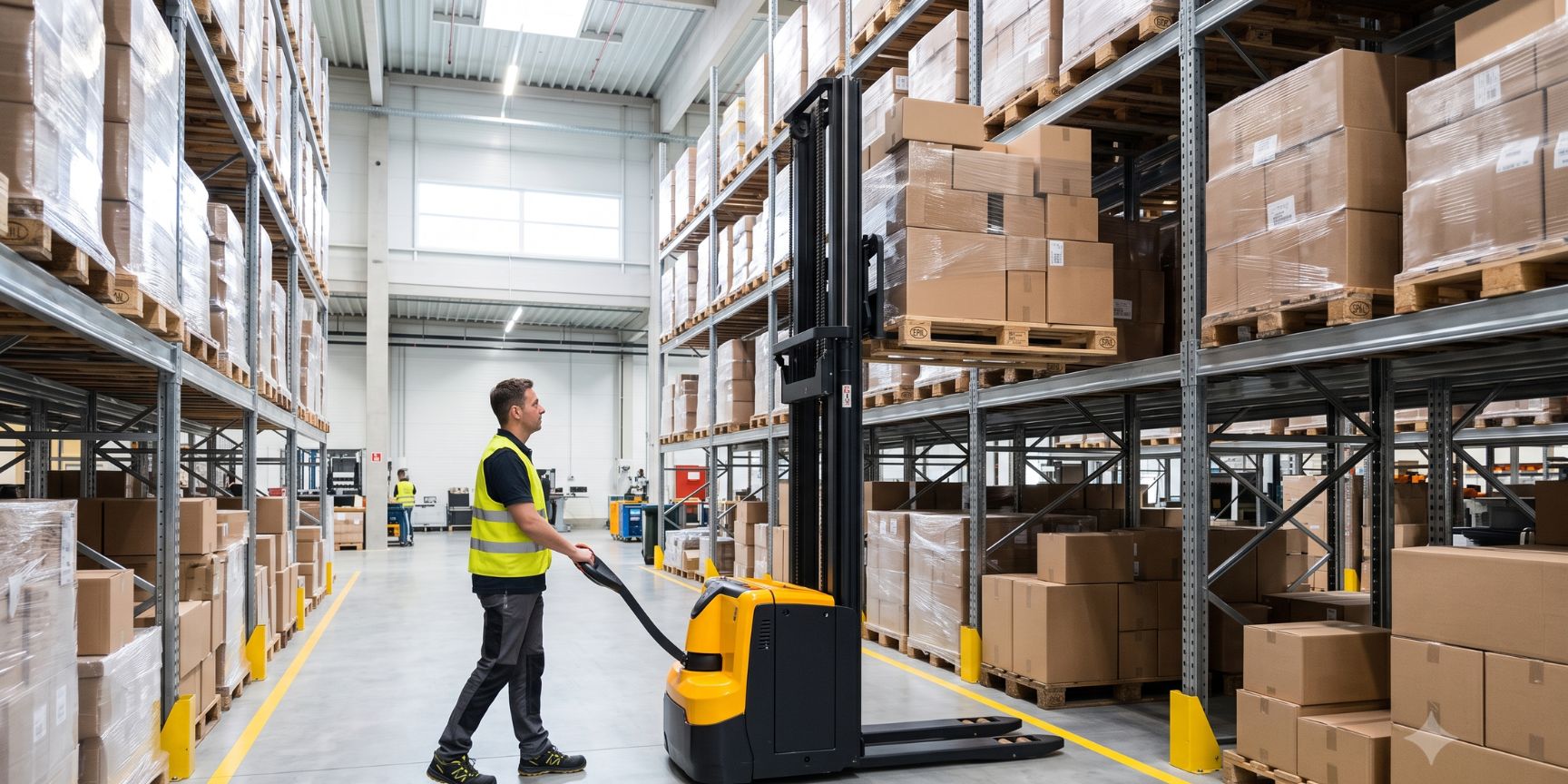
A stacker truck is a motor-driven industrial truck that is primarily guided by a drawbar. In contrast to the pallet truck, which only lifts pallets off the floor in order to transport them, the pallet truck has a mast. This makes it possible not only to move loads horizontally, but also to store and retrieve them vertically in racking systems. It thus combines the manoeuvrability of a simple hand pallet truck with the stacking characteristics of a classic forklift truck, but without the need for a protruding driver's cab.
Technical specifications: Facts and figures
Reliable key figures are crucial for precise planning in a logistics property. The following average values provide an orientation for commercially available, professional stackers in industrial use:
| Specification | Typical values / bandwidth |
| Load capacity | 1,000 kg to 2,000 kg |
| Maximum lifting height | 1,600 mm to 5,500 mm (depending on mast type) |
| Aisle width (knot) | approx. 2,100 mm to 2,500 mm (for Euro pallets) |
| Driving speed | 4 km/h to 6 km/h (pedestrian operation) |
| Battery technology | Lead-acid (classic) or lithium-ion (modern) |
| Net weight (incl. battery) | 600 kg to 1,500 kg |
The Use of Stacker Trucks in Contract Logistics
In contract logistics, customers and product ranges change frequently. This volatility requires maximum flexibility. Stackers are the perfect all-rounders here. They are significantly cheaper to purchase (approx. €4,000 to €12,000 depending on the equipment) than reach trucks and require less space.
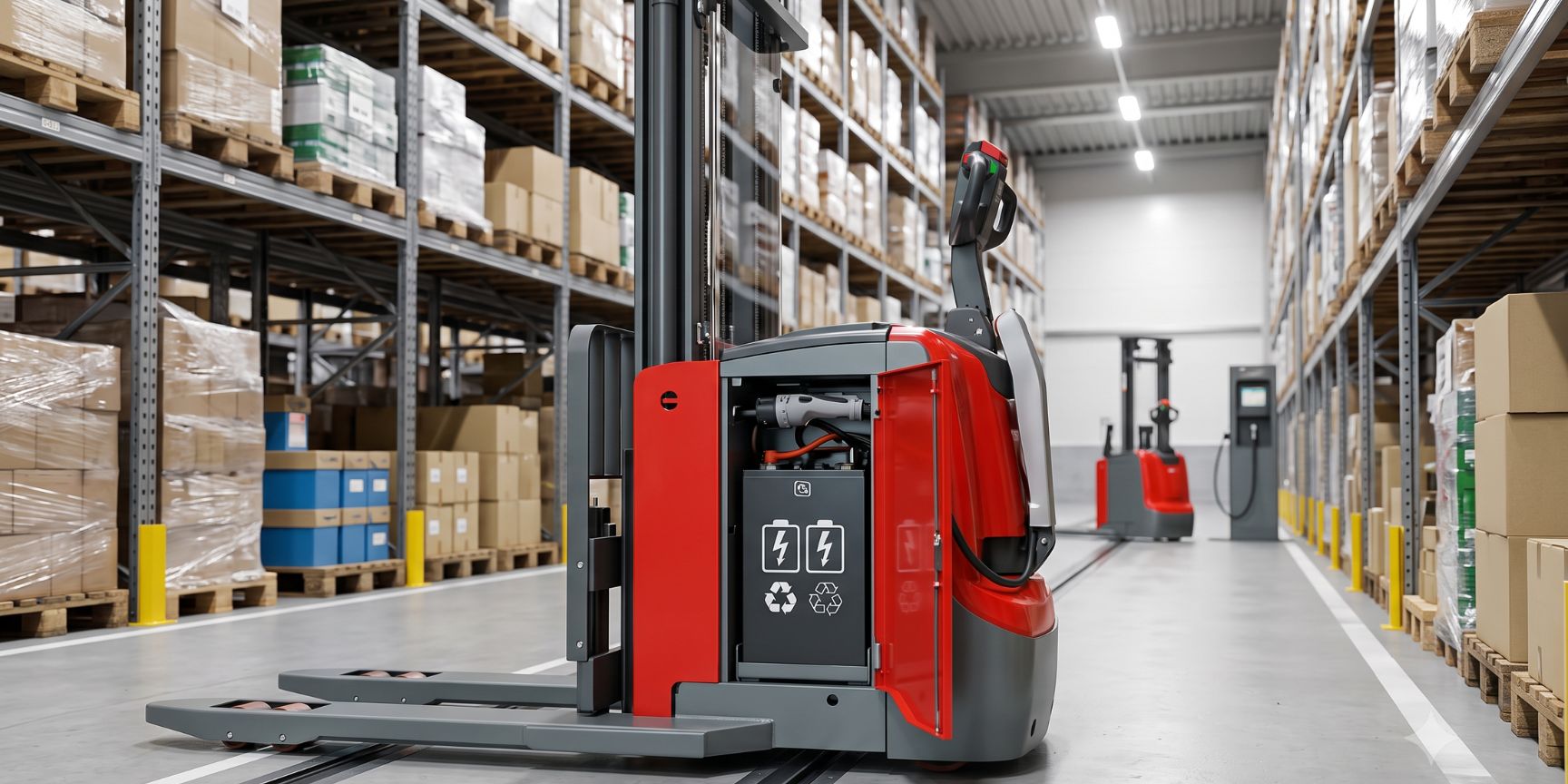
Another decisive advantage: lithium-ion technology. In contract logistics, work is often carried out in multiple shifts. Modern high-lift trucks with Li-ion batteries enable opportunity charging during breaks. A separate battery charging room, which blocks valuable square meters in the hall, is thus a thing of the past.
Requirements for the logistics property and warehouse
An industrial truck is only as good as the infrastructure in which it operates. If you are planning or renting a logistics property, the following aspects must be taken into account for the optimal use of pallet trucks:
- Ground conditions: Due to their polyurethane rollers, stackers have a lower ground clearance than forklifts with superelastic tyres. Joints, potholes or uneven hall floors (in accordance with DIN 18202) reduce handling performance and drastically increase wear.
- Floor load capacity: Even though they are lighter than counterbalance trucks, the weight (vehicle + maximum load of e.g. 2 tonnes) is concentrated on small rollers. The point load on the hall floor must be statically tested in advance.
- Racking systems and aisle widths: The so-called branch value (aisle width) determines how far apart the racks must be so that the stacker truck can perform a 90-degree rotation for storage. Compared to classic forklifts, you often save 30 to 50 cm aisle width with a stacker truck – this means more rows of racks and a higher use of space per square metre.
Frequently Asked Questions and Answers (Glossary & FAQ)
Question: What is the difference between simplex, duplex and triplex mast?
Answer: The mast determines the maximum lifting height and the overall height of the device.
- Simplex: Simple mast, usually up to approx. 1.60 m lifting height.
- Duplex: Double mast, allows lifting heights of up to approx. 3.50 m.
- Triplex: triple mast, reaches up to 5.50 m and often offers a high free lift (the forks lift without the mast extending immediately – ideal for low ceilings or containers).
Question: What does "Initialhub" mean and when do I need it?
Answer: Stackers with an initial lift can also lift the wheel arms. This increases ground clearance. This is absolutely necessary if ramps, uneven loading bridges or strong sleepers have to be driven on in the logistics property. In addition, devices with initial lift can transport two pallets at the same time (one on the wheel arms, one on the forks).
Question: Is a forklift license required for operation?
Answer: For pure pedestrian industrial trucks (the operator runs alongside), a formal forklift licence (driving licence for industrial trucks) is generally not legally mandatory in Germany according to DGUV requirements. However, well-founded, documented annual instruction is mandatory. As soon as the stacker has a fold-out driver's stand platform (ride-on operation), the forklift licence is mandatory.
Practical utility: Purchase criteria for your warehouse
Before you invest in a stacker truck for your hall, check the following checklist:
- Loading aids: Do you move open pallets (Euro pallets) or closed pallets (e.g. CHEP pallets)? For closed pallets, you need a wide-gauge stacker, otherwise the wheel arms would destroy the pallet.
- Duration of use: Is the device only used for 1-2 hours a day (lead-gel or AGM battery is sufficient) or in hard 3-shift operation (Li-Ion is mandatory)?
- Lifting height match: Measure the top crossbeam of your racking system exactly and add 200 mm of safety distance to lift the pallet out. This is your minimum required lifting height.
Conclusion: Efficient use of space and cost reduction
The stacker truck is the ideal entry-level and supplementary device for professional warehouse logistics. It closes the gap between simple pallet transport and highly complex narrow-aisle technology. Those who know the structural conditions of their logistics property precisely – from the floor profile to the aisle width – can maximise handling performance through the targeted use of pedestrian stackers and at the same time significantly reduce the total cost of ownership (TCO) in intralogistics.
Your Ideal Logistics Warehouse
Browse listings for warehouse space, logistics real estate, industrial land, and contract logistics solutions.
Browse Exposés
Maximize Exposure for Your Warehouse Space
Showcase your logistics properties and attract qualified inquiries.
Discover Products