




Inventory Coverage in logistics
Table of Contents
- Inventory Coverage in Logistics: The Ultimate Guide
- What does Days of Inventory (DOI) mean? (Definition)
- The Formula: How do you calculate inventory coverage?
- Why is this metric so important for logistics real estate?
- What factors influence inventory coverage?
- Contract Logistics: Service providers as coverage managers
- FAQ: Frequently Asked Questions about Inventory Coverage
- Practical tips for optimizing stock in your warehouse
- Conclusion: Finding the perfect balance in warehousing
Inventory Coverage in Logistics: The Ultimate Guide
In the modern supply chain, hardly any metric is as crucial as inventory coverage (often referred to as days of inventory or DOI). It serves as the direct link between pure inventory management, the required footprint within a logistics property, and the operational costs of contract logistics. But what exactly is behind this term, and how do companies find the perfect balance between supply security and warehousing costs?
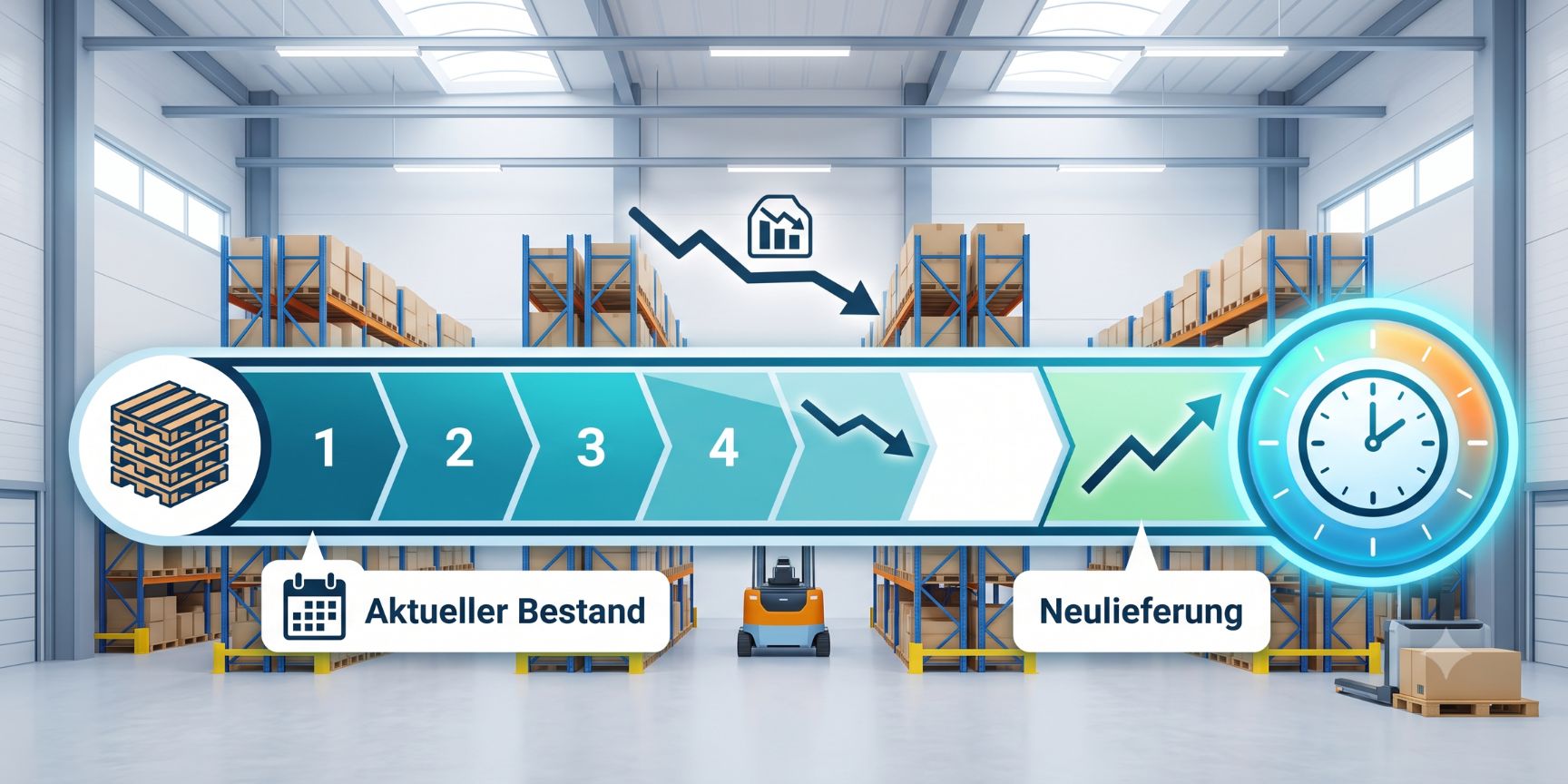
What does Days of Inventory (DOI) mean? (Definition)
Days of Inventory (DOI) indicates how long the current physical stock in a warehouse will last to meet the expected demand (e.g., through customer orders or production requirements) before new goods need to be replenished.
For the operator of a logistics property or a contract logistics provider, it is a central performance indicator: It largely dictates how many square meters or pallet positions must be permanently maintained. High coverage means high capacity utilization in the warehouse, whereas low coverage requires extremely fast and error-free handling processes (such as cross-docking or just-in-time delivery).
The Formula: How do you calculate inventory coverage?
The calculation is theoretically simple, but in practice, it requires highly precise data from the Warehouse Management System (WMS). The standard formula is:
Days of Inventory (DOI) = Current Stock Level / Average Demand per Period
A practical numerical example:
A contract logistics provider manages a warehouse for an e-commerce client. There are currently 5,000 pallets of consumer goods in stock. On average, 125 pallets are picked and dispatched per day.
Calculation: 5,000 / 125 = 40 days.
The warehouse therefore has Days of Inventory (DOI) of 40 days.
Why is this metric so important for logistics real estate?
Inventory coverage dictates the architecture and the costs of the logistics property. If a company decides to increase its strategic coverage from 30 to 60 days (e.g., to hedge against global supply chain disruptions), the space requirement theoretically doubles.
This has direct implications for warehouse selection:
- Space Requirements: Is a standard warehouse sufficient, or is a high-bay warehouse needed to store the inventory on the same footprint?
- Rental Costs: More inventory requires more square meters. With prime rents averaging between €7.50 and €9.00 per m² (depending on top regions in Germany, for example), every additional day of coverage is a massive cost driver.
- Contract Models: In contract logistics, fluctuating coverage often leads to flexible pay-per-pallet contracts rather than fixing the lease on rigid warehouse sections.
What factors influence inventory coverage?
Coverage in warehouse logistics is not a static number; it is a breathing system driven by various internal and external factors:
- Seasonality: Before Black Friday or the holiday season, Days of Inventory (DOI) in retail warehouses is artificially ramped up.
- Supply Chain Stability: Following the experiences of recent years (pandemics, Suez Canal blockages), many companies have shifted from "Just-in-Time" (JIT) to "Just-in-Case" (JIC). As a result, average inventory coverage has increased across multiple industries.
- Product Type (Shelf Life): Food or pharmaceutical products with expiration dates force logisticians to maintain meticulously synchronized, often shorter coverage to avoid spoilage.
Contract Logistics: Service providers as coverage managers
When companies outsource their warehousing to a contract logistics provider, they expect more than just the provision of floor space. Modern logistics service providers act as analysts: Through Value Added Services (VAS) and AI-driven forecasting, they help clients optimize their coverage. They monitor reorder points and raise the alarm when "dead stock" (slow movers with months of coverage) blocks valuable pallet positions in the logistics facility.
FAQ: Frequently Asked Questions about Inventory Coverage
Question: Is there an ideal benchmark for inventory coverage?
Answer: No, the ideal value is heavily dependent on the industry. While automotive logistics often measures coverage in hours or just a few days, coverage in spare parts management or seasonal fashion often spans several weeks or months.
Question: What is more dangerous: Too high or too low coverage?
Answer: Both carry immense risks. Coverage that is too low threatens to result in an "out-of-stock" situation at the slightest supply disruption—assembly lines halt, and customers churn. Conversely, excessive coverage incurs massive capital tie-up costs (OPEX) and blocks urgently needed storage space for fast-moving goods.
Question: How does AI help with optimization?
Answer: Artificial Intelligence analyzes historical sales data, weather forecasts, and social media trends to predict the "average demand" with extreme precision. This allows the warehouse to breathe dynamically without building up unnecessary buffer stocks.

Practical tips for optimizing stock in your warehouse
- Apply ABC Analysis: Differentiate your items. A-items (fast movers) should have close monitoring and a safety-focused coverage. C-items must not be allowed to block unnecessarily expensive picking zones.
- Dynamic Safety Stocks: Utilize a modern WMS that does not set safety stocks statically but adapts them to seasonal fluctuations.
- Choose the Right Property: If your coverage fluctuates heavily, do not lease a rigid warehouse. Look for multi-user centers where your contract logistics provider can flexibly add or release space as needed.
Conclusion: Finding the perfect balance in warehousing
Inventory coverage is far more than an isolated metric on a procurement manager's desk. It is the heartbeat of warehouse logistics. It dictates how much concrete must be poured for new logistics properties, how contract logistics providers plan their workforce, and how much capital is tied up in the high racks. Those who master this metric secure a decisive competitive and cost advantage in fiercely contested markets.
Are you currently looking for the right logistics property or a contract logistics provider to store your inventories optimally and scalably? Discover state-of-the-art halls and professional service providers for your individual setup on LAGERflaeche.de!
Your Ideal Logistics Warehouse
Browse listings for warehouse space, logistics real estate, industrial land, and contract logistics solutions.
Browse Exposés
Maximize Exposure for Your Warehouse Space
Showcase your logistics properties and attract qualified inquiries.
Discover Products